
Juan Carlos Delgado (b. 1973) moves through physical and mental spaces with astonishing fluidity. In explaining his work he enlists a heavy charge of literary, historical, and visual influences. With them, he fully justifies his oeuvre, even though the viewer needs no prior preparation to assimilate what it communicates. Undoubtedly Delgado’s work feeds on personal memories of travel or family, as well as wider concepts such as death or time, albeit from a highly particular perspective. Nonetheless, Delgado is careful not to fall into too subjective an emotionality.
When Delgado realizes he is revealing his own inventiveness, he holds back and simply articulates each piece’s formality. He relates how he first found himself being seduced by classical art and how he was dazzled by the works of art on his travels through Europe. In his search to acquire the technical dexterity of the old masters, he patiently copied over and over the paintings of artists such as Velázquez in order to define painting formulas.
A later creative interest drove him in more innovative directions, and he began to try new media. He drew garments found during his long urban walks, collected the gray soot that gathers under the city’s bridges, and even brought perishable organic elements into his installations.
Climbing the gallery’s staircase, we are immediately struck by a series of circular red markings arranged on white planes. These are sealing wax impastos that reveal subtle human faces. This work has antecedents in older pieces created with ink stains in which Delgado discovered facial features and made them explicit, or the large red walls that demanded a slow inspection to reveal other images. The faces in these seals emerge in the same way and allude to a reality that is volatile but which, nevertheless, can be captured. They are contained movements and, at the same time, static traces of memory.
In antiquity, monograms or coats-of-arms printed in wax were clear symbols of a family’s identity within society, and as a group with blood ties. It is not too far off, then, to refer to the connotation of blood here when it comes to the red markings of this piece. Thus, instead of being a violent referent, blood, in this as well as in other works by Delgado, is a metaphor for the vital force of being.
Along the same lines, is a photographic triptych with a very dark background that highlights small flames contained in innumerable tiny vessels the artist has planted on puddles of water/blood. The image has features of a ritual ceremony, but without touching on specific scenes of sacrifice or offering, it attempts to transfer the viewer to a spiritual plane. Those incandescent presences seen from below create the illusion of floating in space. The reflections on the water and blood invite the viewer to “navigate through the plane in a position of metaphysical analysis.”
With regard to this work, Delgado mentions the ships that in Eastern funerals move through lakes filled with lamps to transport the soul to a superior realm. It is unavoidable to link this piece to another one shown here, very close to the photographic triptych. It is also divided into three parts, each with a white wooden frame around a shining acrylic sheet. A toy-scale ship of aluminum has been screwed onto each sheet placed against the wall. The ship is attached to the sheet through its base. Such disposition places the viewer as if he or she were seeing the objects from above. The lustrous black acrylic reflects the aluminum, the gallery’s spaces, the rest of the works, as well as the viewer, all of which provokes a non-conventional perception of space.
In the same scheme, there is another multi-paneled work, but instead of ships, it has human ears made of aluminum. In front of all the panels, there is a white metal bar from which an aluminum bell hangs. It alludes to sounds that are not heard, to words that dissolve into air, to an expression that is not assimilated but which, through this work, is able to exist.
With these works of impeccable reflective surface, Delgado creates what he calls “black holes.” These planes are something like visual bridges between two different dimensions. Some repeat obsessively the shape of a child’s shoe on the vertical surface, sometimes in symmetrical schemes as if in military formation, sometimes in a circular scheme that with the reflections of light on metal resemble suns radiating a cold brightness. To the question of why the repetition, the artist replies that concepts are strengthened in reiteration. The motif of the shoe establishes a parallel with the passage of time that so interests Delgado. The act of walking remains captive in the shoe, and each step is a second that passes and a record of someone’s journey.
Another outstanding piece in this show is a photograph that, placed inside a light box, is activated when the viewer moves in front of it. When off, it is a black-surfaced mirror that seems to permit some kind of access to a space beyond the wall; it is mysterious and suggestive. When the light is on, it reveals a nineteenth-century photograph of a baby in its carriage. The ambivalence between the past, the current action, and the “beyond” of the dark passage trigger multiple interpretations; the artist favors such subjective interactions with the viewer, emphasizing that it is what keeps his work alive.
Other pieces also express temporal allusions. On an aluminum cane extended to more than two meters high, the artist has engraved an almost imperceptible series of concrete dates. To the future, it is a work in progress that waits to be marked by more key moments, be they in the personal life of the artist, of some important figure, or a historical landmark. All of this coexists with and affects in one way or another, the universal context. The cane as a support object and as a contact of being to gain stability on earth has clear, albeit implicit, existential connotations.
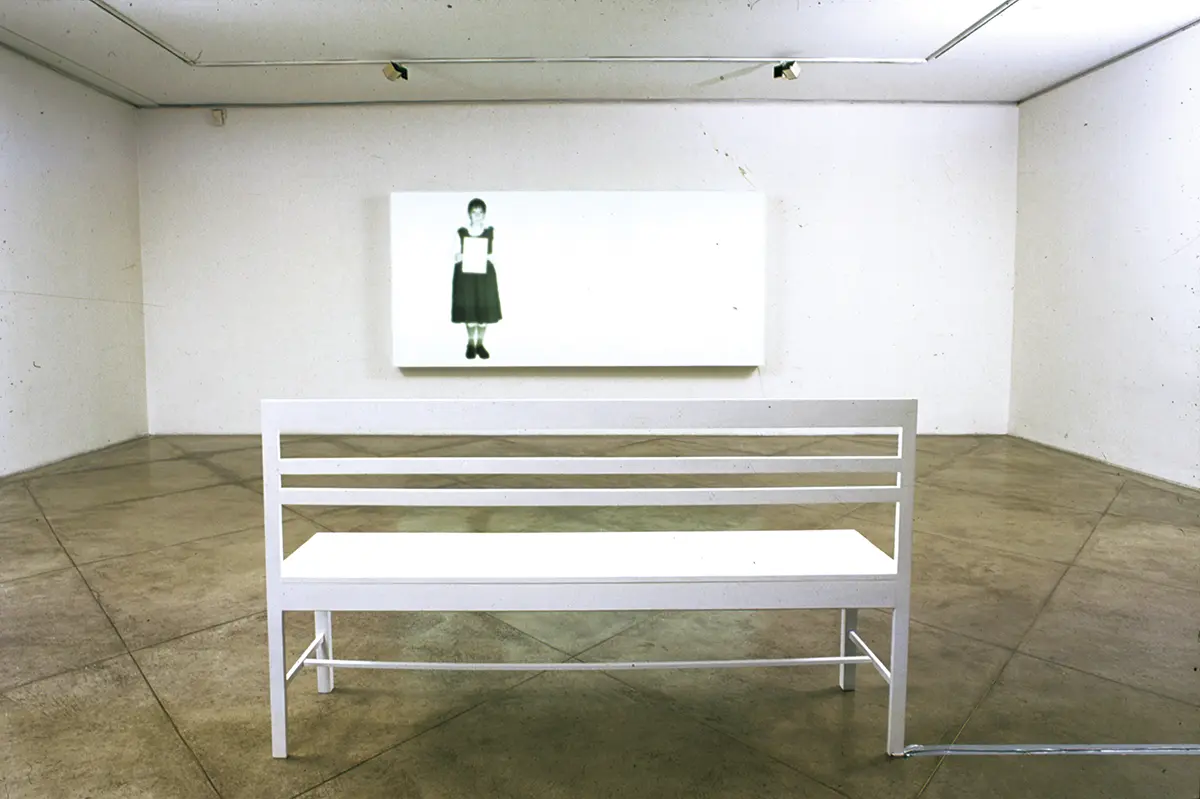
Finally, we must mention a disturbing piece that consists of the projection of a drawing against the white wall, confronted with a bench in the same color on which an intense light beam rests. To the left of the large plane, we find what appears to be an old photograph of a woman. These planes are so “clean” that they almost forbid our direct intervention, and the viewer has to work to make out the blurred image. In the end, it is not a photograph but a drawing, and we discover that it is impossible to focus on it clearly. It is a trick of contemplation and a sample of reality that we try to make concrete, but which is inevitably ephemeral. Delgado’s work attempts to be —in all its implications— “magical” and establishes itself as a challenge to the barriers of time, our senses, and of consciousness.
MARÍA JOSÉ RAMÍREZ