
In Buenas intenciones, his most recent show, Leonel Matheu calls for society to live in harmony with the environment. In previous exhibitions, Matheu’s characters fashioned a critique of modern life. His “little men” felt suffocated by the large masses of concrete that dominate our cities, and lamented the absence of nature in the urban landscape. In his recent works, the artist elaborates a more direct discourse and calls on the public to sensitize itself and to facilitate a balance between technology and society.
While in El escenario the little man—a constant character in Matheu’s graphic language—encounters an impenetrable wall with no exit, in Ciclos the same character appears taking large steps on the roof of skyscrapers, and although he carries with him an outsized portfolio, at least he has a chance to see the light of day, to enjoy a blue sky, and to reach for a star. Evidently, Matheu’s main interest is Earth itself, this smallish planet that in El estrellato appears under the chin of a little man representing Elvis Presley. A simple, almost childish kind of humor, akin to the symbolism employed by this artist formed in the graphic arts, conveys his message in a clear and direct manner.
Matheu’s illustrations, while caricature-like and even anecdotal, introduce serious themes with transcendental philosophical connotations, such as war and environmental degradation. The little man piloting a warplane in Comentario, or the one who dives into a tub of black liquid in Momento oportuno, refers to the current historical moment. The work of art that lends its title to the show is even stronger and more direct. Buenas intenciones is an installation using an oil container suspended by large chains, from the surface of which the figure of the little man emerges. Half submerged, he is nonetheless able to make eye contact with the viewer. Unlike the profiles depicted on the canvases, this figure confronts the public and transmits a feeling of anxiety produced by being trapped in crude oil.
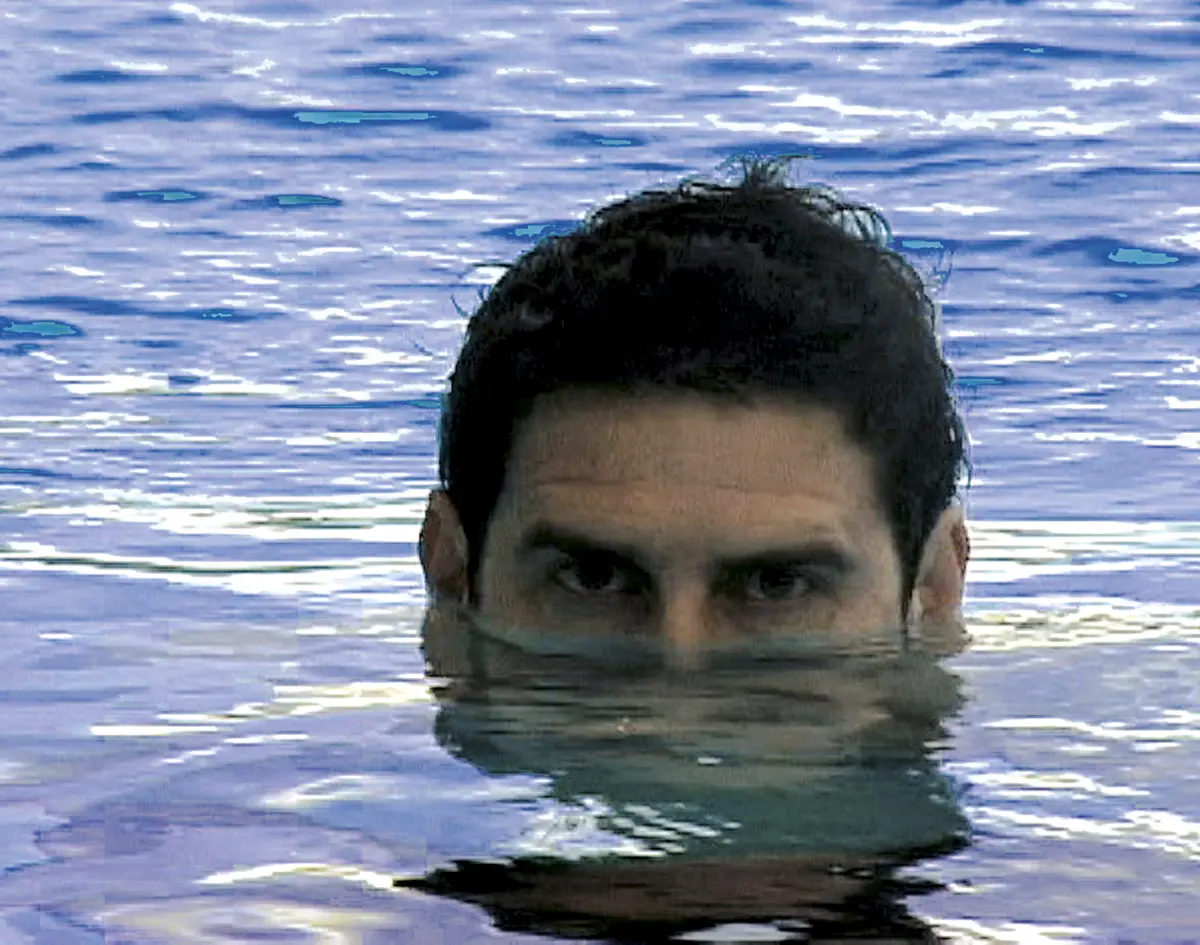
The same spirit of confrontation is found in another installation, Cuatro esquinas, where Matheu presents four little men drowning in a cross-shaped, tar-filled box. The best piece in the show is undoubtedly a video projection, also titled Buenas intenciones, showing the artist himself submerged in the ocean with the water just above his nose. The video, a three-minute loop, transcends Matheu’s pictorial and sculptural achievements to find in the photographic reproduction of a real image the necessary force to move and affect the viewer. The movement and lights reflected on a gray ocean contrast with the static image of the little man who holds his breath as a protest against the ailments of the world, particularly those who came from across the ocean.
By taking his characters beyond the canvas, Matheu has found a point of formal and conceptual consolidation. On the one hand, he reinforces the notion “of the environment that suffocates the individual as a social entity” by using an oil drum that simulates a real one, or when the artist himself is the focus of the piece; on the other, the felicitous use of media such as installation and video make the show functional in general terms, under a coherent curatorship.
FRANCINE BIRBRAGHER