The decision to bring together the work of Lucia Warck-Meister and Edith Derdyk is at once an obvious and inspired one. Both women have explored new possibilities of artistic expression by exploiting properties of materiality and space, and the recurring foundation of their art tends to return to the tactile line.
There have been some male artists, like Fred Sandback, who very successfully exploited the visual poetry and paradox of line as sculpture, and of course, Jackson Pollock remains the paradigm for weaving webs of painting and drawing. However, there seems to be something innately historical about the relationship between women and the woven line. From the Fates spinning and unraveling our lifelines, to Ariadne laying her labyrinthine line, there has been something intrinsic to women’s work and power in the use of thread and line. In Pending, these two women have, in different ways, pursued many of the possibilities of their craft and the results are fully apparent in a show that, rather than being a true collaboration and merging, functions more like an independent set of projects that enhance and complement each other beautifully.
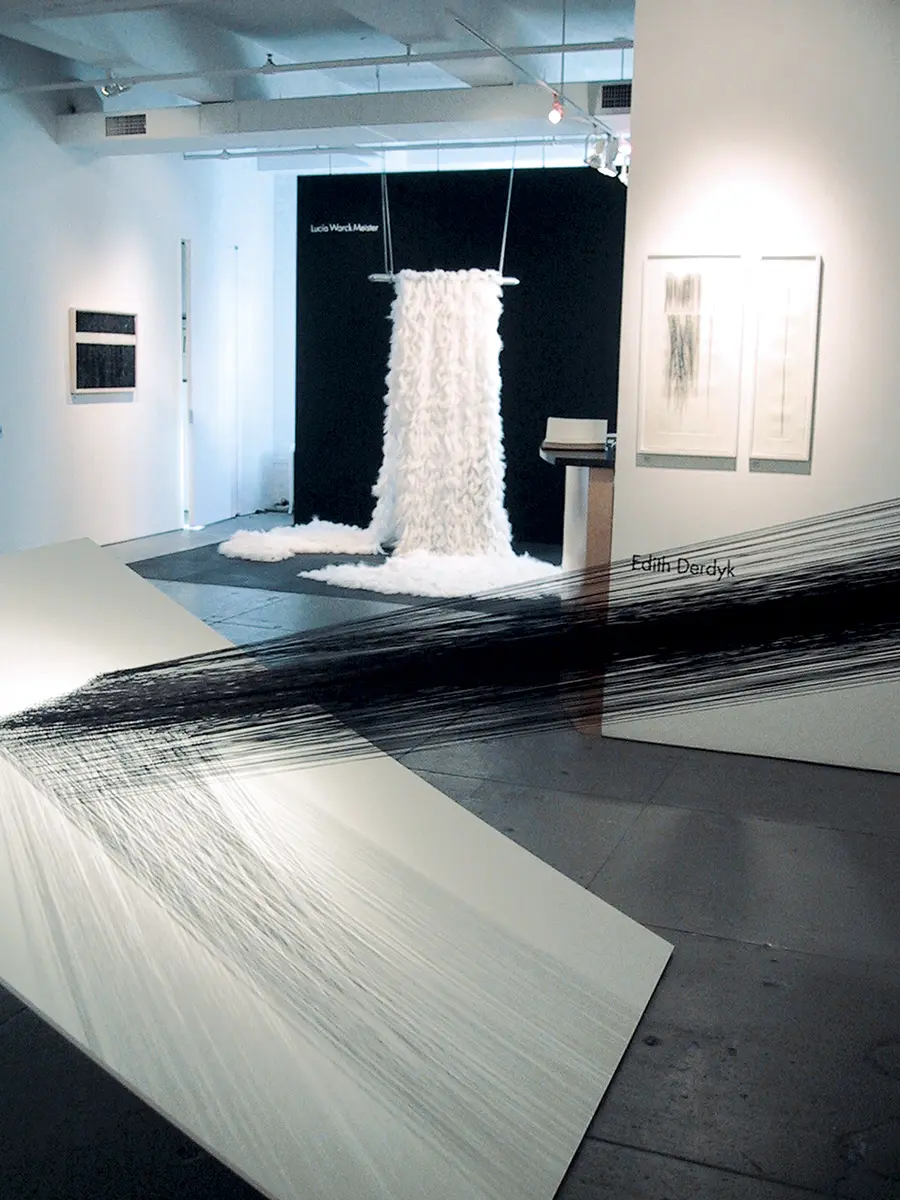
Edith Derdyk’s central work is a large installation titled Declive/Incline. Comprising 30,000 meters of black thread that span the space diagonally from the floor to the wall, and constructed with 20,000 staples, this work is an installation that carries the potential of its process within itself. When fully set up, the fragile threads form a unit that is at once densely monolithic and at the same time light permeable. It is sculptural mass and drawn lines. The diagonal thrust of the threads is dynamic and taut, with a downward slope or an ascending peak. Throughout her career Derdyk often has added a sense of ritual to her artworks by staging readings of verse while her works are on view and intact; in this work, she compelled us to consider the thread-as-life metaphor when she began to create a new sculpture by deconstructing sections of her piece with a pair of scissors.
Warck-Meister similarly treads such multilayered and potentially self-contradictory paths in her art. Over the years Warck-Meister has spun many webs to create fragile yet spatially complex installations and has used materials like hot glue to render lacelike drawings of glistening lines. They remain compelling in their embrace of sculpture and drawing, chaos and control, and tangibility and ethereality. In recent works Warck-Meister has also pushed the limits of other materials and processes; in Arms, a woven blanket of feathers hangs in two folds from a suspended aluminum rod. As a pair of feathered units, these could be read as wings, their white color making them pure and angelic. They could also be some sort of ancient garment, a bridal veil, or a robe worn by a high priestess. The paradox of instruments of flight so obviously fallen victim to gravity is compounded by the material presence of an object made up of natural elements that have been artificially combined. This balanced duality is also present in Mouth, which presents a marble slab upon which rests a heavy pair of metal shears that are carefully wrapped in cotton. The shears could cut the cotton, but the cotton also dulls and softens the shears. The simple white cotton purifies the corrodible metal of the shears and almost becomes a protective element. The union of two opposites is achieved in a powerful embrace.
There are real differences between the way these women approach space, process, and monumentality. However, by working in the domain between weaving, drawing, and sculpture; by exploiting the full potential and paradox of their materials; and by explicitly evoking poetry and performance out of object-oriented art, these two artists join a distinguished group of women that includes Cecilia Vicuña and Petah Coyne in opening a field of possibilities for other artists to mine.
JOHN ANGELINE