
Guatemalan photographer Luis González Palma returned to public life with a one-man show at the Focus Gallery in London, where he exhibited traditional themes along with new creations that send a complex and comprehensive message about his already widely recognized corpus of work.
The majority of the works on exhibit were the portraits of gazes that propelled the artist into fame. Gazes of the elderly, of men and women, of adolescents and children, captured in the “extreme moment of tension between the internal gaze and the external gaze” according to the sculptor Juan Muñoz (the moment that González Palma succeeded in capturing in 80 milímetros, f.5.6 con 1/30 segundos, according to the title of one of his works.) Blank gazes that stand out, highlighted by the use of a shift to sepia that places the works in a fictitious time, charging them with memories and longing remembrances, and striking gazes seen in direct frontal portraits that arouse in the viewer increasingly deep and challenging questions.
The artist’s traditional sources of inspiration are from his native Guatemala, a country defined by its baroque, solemn, and excessive religiosity. “Guatemala does not have Brazil’s festive culture or Argentina’s psychoanalysis to compensate for the stumbling blocks of its history,” says González Palma. Therefore his subjects’ gazes reflect a solemn vision of life as seen in the agony of the crown of thorns, or the sanctity of divine women venerated in gold-laminated paintings worn out by the devotion of intemporal incense and the touch of eternal worshippers.
González Palma does not consider the goal of his portraits as one of indigenous vindication. “I’m not interested in taking pictures of sad indigenous people,” he says. He defines himself as the producer of responsible images aimed at offering a glimpse, through the sweet deceit of the portraits shaded in sepia, of questions that transcend the fundamental elements of Guatemalan culture into vast universal themes, which convey subtle answers in the form of interrogations that are suggested but never imposed on our free will as observers.
In Fetiche the model, with her dreamy look and long hair softly lying on her side, appears without the attributes of the divine woman: amulets, crown of thorns or gold… In an unusual gesture, she avoids our gaze as if she just woke up from an overwhelming reflection regarding her condition as “fetish” defined as a “cult idol or object among savages” in a dusty ancient Real Academia dictionary. In not trying to arouse an attitude of sacred respect for the pain of loss or life’s suffering, she does not conform to the sacred, serious, and eternally pious women that characterize the portraits of women by González Palma. Fetiche liberates the artist from the reign of sacred women and enables him to move into the world of earthly women, at once angels and demons, fit only for devotion by “savages.” In substituting the myth of the woman for the reality of the woman, Fetiche becomes an object of cult unique and revolutionary in the work of González Palma. Representing her as she is, the artist achieves a definite step in his self-realization. “I constructed myself from the divine gaze of the woman, now I want to construct myself from myself,” he says.
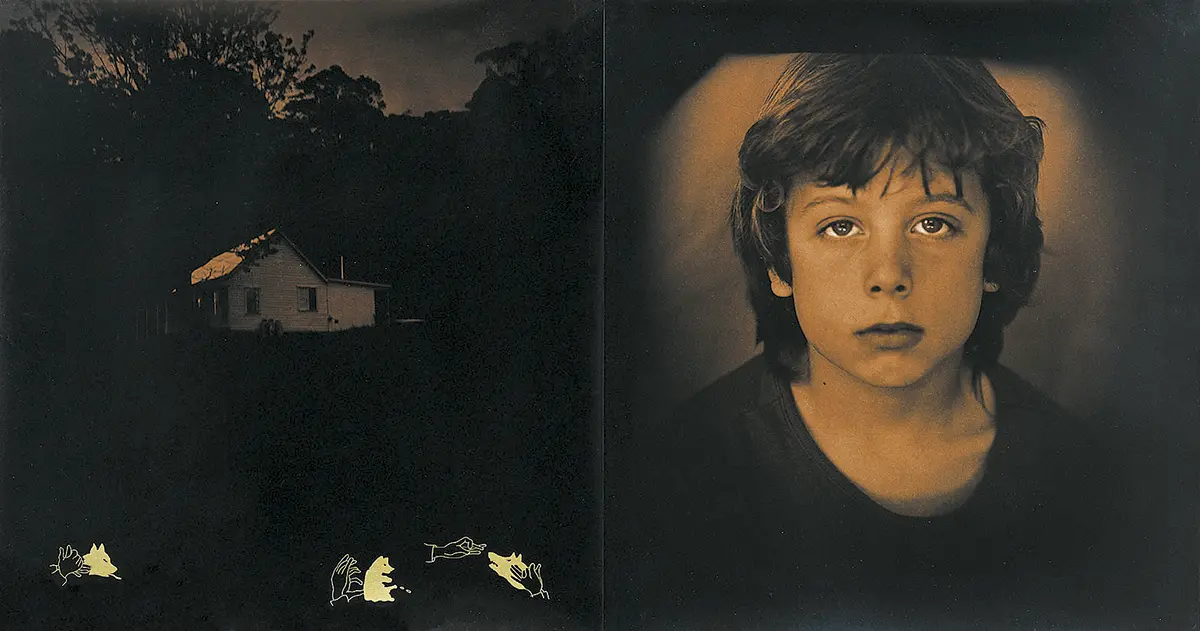
In the portrait titled Sebastián, González Palma presents his son along with excerpts from Platonic Dialogues. The pensive Sebastián appears to be looking out of the corner of his eye and wondering which Dialogue —Lysys, Crito, or any other— will he choose for his next reflection! González Palma knows the work of Plato thanks to a presentation of the Dialogues from his father. Relating this work to his son the artist seems to express the desire to someday initiate him into the humility of the Socratic idea of “I only know that I know nothing,” just like his father did with him years earlier. Masculine wisdom, atheistic and free, as opposed to feminine and anguishing mysticism of Catholic virgins? A rebellious thought against established religion? “Sebastián,” analyzed in the context of González Palma’s work as a whole, propels us into the deepest of the unknown of our Western being.
The Gaze is probably the most impressive portrait in the artist’s most recent work. Shown in an unusual arrangement, a portrait of an enlarged eye along with religious texts on which the classic frontal gaze of a woman and what could be a blueprint. This is in reality a copy of an ancient prison blueprint where you can see the prisoners’ cells from above. González Palma’s interest in the prison system arose as an indirect consequence of a project he carried out in an old jail of Bello Horizonte. The study led him to discover the work of Michel Foucault and his interest in analyzing the methods of coercion that led to the creation of the various institutions of power (the church, the justice system, the military, the educational system, and hospitals) designed to “discipline and punish” its students, disciples, or recruits. Foucault reminds us that in the 18th century, Bentham developed the Panopticon, a revolutionary architectural work that due to its structure made it possible to isolate prisoners in their cells, from where they could be surveyed without them seeing the surveyor or the other prisoners. According to this interpretation, the purpose of the religious texts that appear alongside the prison plan is not so different from the “discipline and punish” of Betham’s panopticon, and the enlarged eye becomes the omnipotent, omnipresent, merciless surveyor of our behavior.
The three portraits, through which González Palma communicates his reflections about femininity, fatherhood, and religion, are a demonstration of a mature and renewed work. The self-taught aspect of González Palma (he studied architecture) allows him to try out photographic techniques with great freedom, blending the most sophisticated computer-generated techniques (ambrotype, photo engraving, gold tones) with techniques from the previous century. Because he is not limited by the technical aspects of his work, which are often delegated to specialists, the artist can concentrate exclusively on his creative expression, a creativity that keeps him among the best Latin American photographers.
XAVIER DELPIERRE