
The Museo de Arte Moderno in Buenos Aires has just presented an exceptional exhibition of works on paper by Manuel Espinosa.
Exceptional, because most of the pieces had never been shown before, and also because they were a surprise for many local collectors, all too often inclined to focus their gaze only on those names who figure in international auctions, without paying attention to so many other artists in the country.
Manuel Espinosa was a member of the Asociación de Arte Concreto Invención and, in November 1994, alongside Tomás Maldonado, Alfredo Hlito, Lidi Prati, Enio Iommi, Alberto Molemberg, Claudio Girola, and others, took a step forward as a protagonist of concrete art in Argentina. Espinosa shared with them the March 18, 1946 exhibition where the group’s Manifesto was presented, and also the group’s later actions, even their temporary affiliation to the Communist Party and their opposition to Peronism in the February 1946 elections.
Hungry for the new, they were joined by architects, graphic artists, and designers ready to put their energy into the service of a positive transformation of the world.
The artists Espinosa visited during a trip to Europe in 1951 were selected for their adherence to the ideals of constructive no-figurative: Swiss concrete artists Max Bill, Richard Lohse, G. Vantongerloo; Vordemberge-Gildewart in Belgium; and some artists of MAC and of Forma in Italy.
This kind of exchange marked, as was to be expected, his insistence on the effort, his definition of the line to be followed, and the steady acquisition of complexities and ambiguities that guaranteed his work and indelible quality.
In this way, on the basis of concrete composition, demanding of certainties, of well-determined geometric shapes, and of a classically balanced general proposition, Espinosa was able to reveal the hidden tensions, the subtle relationships, the strange vibration of the real.
The selection of works presented in this show covers the years from 1950 to 1982. There are some undated pieces. The techniques used are tempera, ink, graphite, and lithographic ink. There are also some textile designs created in response to a call from entries by the Hisisa conglomerate.
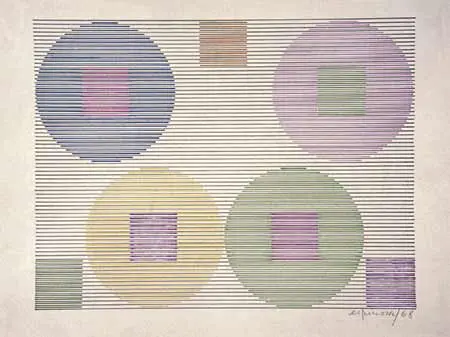
Espinosa’s works of the 1950s are interesting for a variety of reasons. First of all, for the variety of proposals —always against monochromatic backgrounds— using circles, squares filled or unfilled with one, two, or more colors. These geometric bodies were to be determinant in his later work, as was the superposition by transparency seen in some of these pieces.
While some may appear to be sketches for larger works, they are not, since their format is of a dominant vertical axis and Espinosa’s painting is dominated by fully or decidedly quadrangular supports. His compositional system demands a rigorous adherence to the proposition of the basal plane. He probably conceived them as “style exercises” or investigations.
The majority of these works are dominated by a respect for two-dimensionality, which for him —as an affirmation of the reality of flatness, according to his own words— was to be a necessary constant.
In other works of this series, Espinosa works with open, loose curves of varying thickness, with delineated free energy fields, and alludes to a limitless space, á la Max Bill or Vantongerloo. Espinosa, however, did not go far in this type of proposal.
A series of inks from the 1960s reveal already an artist at the peak of his skill: refinement in color, subtlety in the handling of lines, use of transparency to enrich space without abandoning flatness, the possibility of readings in which the visual dynamism encircles and seduces us.
In the black and white series, of great severity, we perceive the structural potency of a composition sometimes oriented as a centrifugal force, sometimes with calculated movements that give the plane a strong pulse through the tight interplay of rhythms.
The lozenges series, executed in lithographic ink and exhibited as a large mural, could overwhelm us with its communicative wealth and variety, were it not for the fact that conceptual clarity always wins the day in the case of this artist.
This show allows us to enter the indescribable creative maze of a true poet of Argentinean concrete art.
NELLY PERAZZO