The Pinacoteca do Estado de São Paulo is the city’s oldest museum, located in a building built between 1897 and 1900 for the São Paulo Liceu de Artes e Oficios. Projected by Ramos de Azevedo, the period’s most renowned engineer-architect, the building is one of several monumental constructions that dotted the region in the early Twentieth Century, today in the midst of a controversial process of recuperation after decades of neglect.
Despite having been conceived in grand style, however, the project remained unfinished and its exterior walls show almost with embarrassment the structural brick design, contradicting the building’s grandiose neoclassical architecture. The project of adapting the Pinacoteca to current museographic needs, developed by Paulo Mendes da Rocha, preserves the building’s original features, starting with its unfinished appearance, adding elements and materials that are clearly add-ons, annexations, and couplings. Some of the project’s keys are its thruways and metal guardrails, as well as the interior patios covered by glass structures and transformed into exhibition spaces.
The Octagon is one of those patios, the building’s central plaza is framed by eight double-height walls, brick on brick, which since January 2003 hosts a contemporary art exhibition program curated by Ivo Mesquita. It was in this space with marble floors and exposed brick walls where Marepe installed his Desemboladeira. The title joins two terms, on the one hand, desempobladeira (a tool used by masons to finish walls in s uniform manner) and embolada (a kind of music from the Brazilian Northeast with improvised lyrics that are said rapidly over repeating notes.)
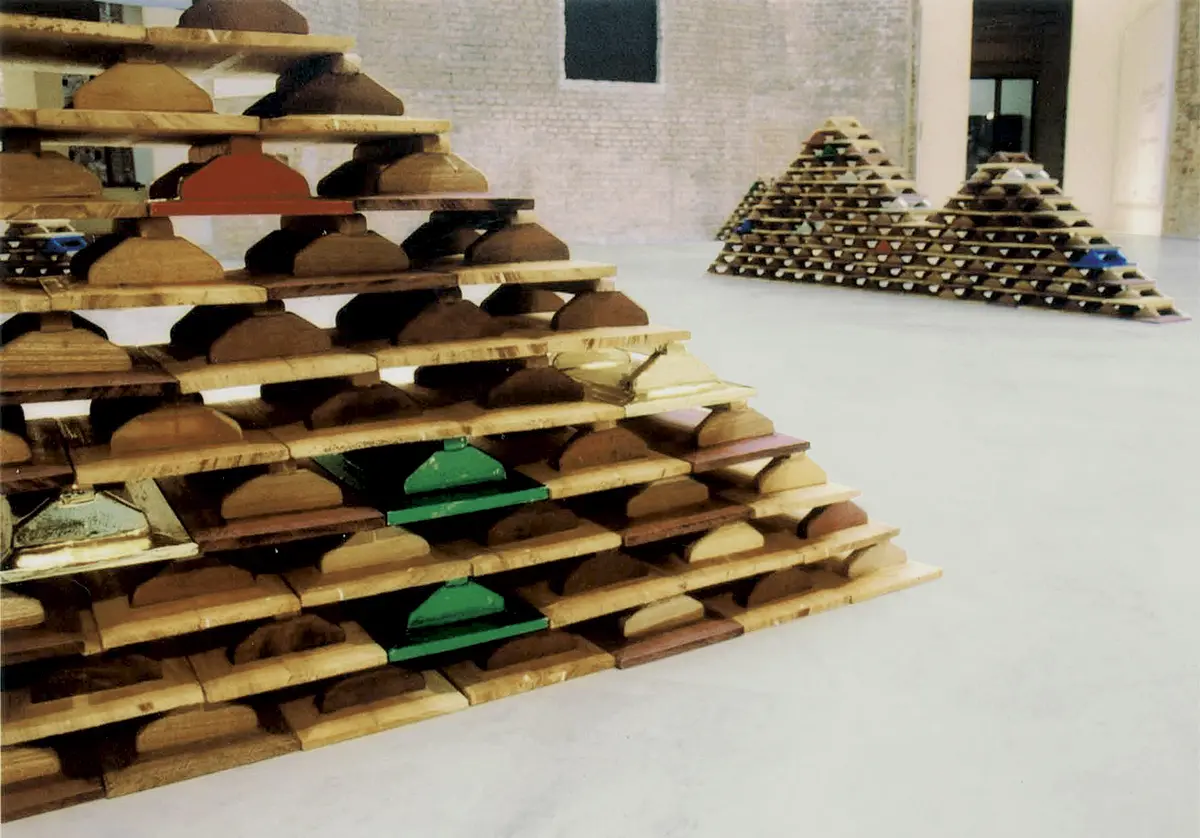
This site-specific piece, created with the city’s 450th-anniversary celebrations in mind, makes reference to the singularity of architecture. Besides a few lamps hanging from visible wires, the space only exhibited 450 desempobladeiras, like those that would have been needed to finish the surfaces of the walls that remain bare. The way in which the objects were piled up, each one on two halves of the under beams, repeated the logical drawing that keeps the bricks together. These resulted in triangular piles, like mountains whose height was determined by the size of the base, since there were as many rows as the initial number of desempobladeiras, each row with one less element until only one was left. Fifty had been covered with mirror paper in different colors, and the remaining 400, numbered, showing the various possible combinations of the three or four kinds of wood used: dark handle, light base; violet base, yellowish handle; and so forth.
One out of every ten visitors, always the tenth, was given a piece of paper upon entering the museum, with the explanation that it could be exchanged by a multiple of Marepe, a present for the city’s 450th anniversary. Thus the pieces were distributed during the show’s first weekend, and those who were lucky, or those who were able to do a quick count at the door, left the Pinacoteca with their desempobladeira.
In choosing this workman’s tool as the material for her work, Marepe is not only dealing with the site’s physical specificity. The reference to construction work is also a tribute to the workers who built São Paulo, like all cities. A large number of migrants from the Northeast come to São Paulo and find jobs in manual labor, including construction. Marepe lives and works in Santo Antonio de Jesus, Bahía, and perhaps that explains, in part, that for the São Paulo anniversary, he thought to pay homage to those builders, so often forgotten behind the finished works and the names of those who sign the plans.
The embolada is another reference to Northeasterner culture. It is a musical and poetic style characteristic of that region of the country. And the embolada was present not only in the title: the song by Pedro Osmar, Signagem (1997), heard in the Octagon if one paid attention, was inspired by embolada and other Northeast traditions.
It is interesting to see the Bahía artist articulating the history of São Paulo, and specifically the history of this building, which can be seen as a truncated project of symbolization by the Paulista bourgeoisie at the beginning of the last century, now associated with the questionable process of recuperation of the city center, a process in which cultural institutions play a decisive role.
CARLA ZACCAGNINI