
The Alonso Garcés Gallery presents medium-format works under the title Sin noticias de Dios. Nohemí Pérez’s (1962) paintings of street dogs touch on the theme of urban marginality from the curious perspective of our domestication and our effect on the environment as a force superior to all beings.
A first interpretation refers us to the Spanish film comedy of the same title, directed by Agustín Díaz Yanes, released in 2001. The connection between that film and this work is the way in which the fate of the characters is “controlled” without them being aware of it. In the film, it is the representatives of heaven and hell who fight over the soul of a boxer with a truculent past. In Nahomí Pérez’s oil series, that control is the prerogative of the city and the order of human civilization.
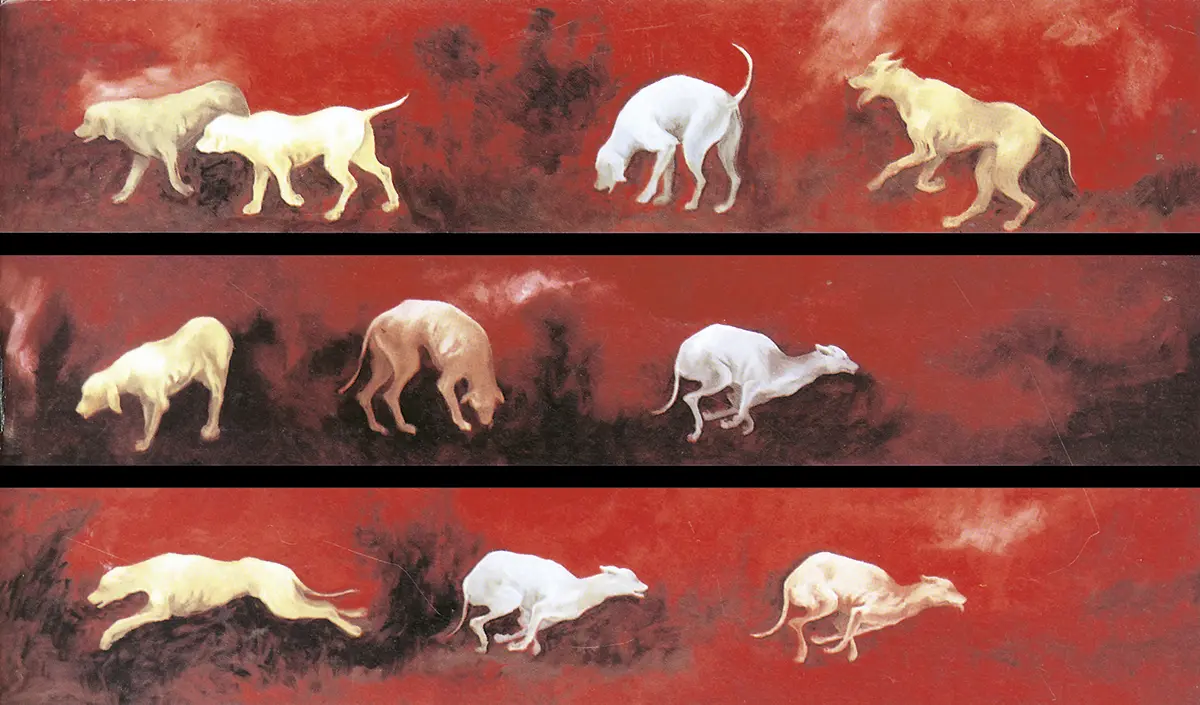
Perhaps in reference to that supposed order, the artist works in a serial manner and makes schematic combinations of dogs in various poses, as if attempting to establish a numerical system. The work used for the catalog cover stands out. It is an elongated horizontal piece with a red background, and it has been reordered several times taking each dog as an isolated element that can be relocated within the plane.
Nohemí Pérez presents these animals candidly as they jump, mate, or sleep as if observing obsessively from outside a caricaturesque event in a reality in which the observer is not involved. In the work mentioned, vermilion shades mix with wine tones to create a spatial sensation of depth, a yellow dog accompanies a brown one, a gray dog sniffs the ground and another one jumps playfully in the far right side of the plane. In the reordering of the catalog, the viewer’s exterior action is emphasized, and the artist allows or invites us to exercise a certain power over the images. Similarly, painting these situations and arranging them in diptychs and triptychs allows the viewer to arrange in the imagination different combinations of the fragments of the paintings.
Pérez’s palette is as somber and lugubrious as the section of the city affected by poverty, the weather, industry, and chaos. In other works with subtle contrasting blotches, we perceive reflections of water on the gray floor and certain shapes that suggest a non-figurative, barely perceivable human presence. The artist represents gray mists in her backgrounds as if they were smoke clouds with outlines sketched in black and geometric shapes allusive to constructions, lamp posts, façades, and the most salient features of the city’s visage. Her dogs are light sources on the plane, and they almost brake from it, which emphasizes the notion of isolation to focus the eye on the dog’s attitude as it fights, as it seeks insertion in a social group governed by the law of the strongest. The way in which Pérez’s thick, expressive, and bold brushstrokes reinforce these ideas in the piece is particularly interesting.
Inasmuch as the artist appropriates the dog’s everyday life, he turns them into active objects of reflection and, as such, indirectly gives them a new context on the basis of the level of thinking awareness. She, as creator, produces these images with formal tools, and the viewer intervenes in the imaginary by reinterpreting the reality presented in the work.
MARÍA JOSÉ RAMÍREZ