Among the most salient aspects of Pedro Diego Alvarado’s painting is the very fact that it is painting, done at a time when the genre’s credibility is increasingly questioned. While in the first half of the twentieth century, the argument was between figurative and abstract painting, in the post-World War II years, and especially after the 1960s, critical controversy hinged on the conflict between conceptual trends and two-dimensional works.
Even as the debate becomes high-pitched in a time when practically any object can be represented —for instance, through photography— and even invented —for example, digitally— Pedro Diego remains immune from such diatribes and maintains a predilection for this expressive medium. His technique, his working method, his talent (whether inherited or learned,) the forms he imagines, and the skill with which he elaborates and presents the results, make him an important part of Mexico’s contemporary artistic landscape. Alvarado observes nature, captures its splendor, abstracts the essence of its figures, and transfers them to his canvas.
Any representation, like any symbol, has meaning, yet its meaning unlike that of a symbol is transcendent. Alvarado, in addition to working on the problem of representation, problematizes reality, that is, what he considers problematic, or, to put in milder terms, challenging, is not isolated representation or its process of acquiring meaning, but reality itself. Alvarado’s painting can be understood as an attempt to solve problems, as a search directed towards the elaboration of transformations of a reality that has become fragile in a meaningless iconic universe. If images are the simulacra of reality, Alvarado’s paintings are transmutation.
This is evident in the subjects of his series: cacti, maguey plants, and candelabra; fruits, vegetables, and floral trees; landscapes, terrains, and cloud-covered skies. What is rich in Alvarado’s repertoire is not only the result as a whole but also the individual treatment given to each of the regions his canvases comprise.
Alvarado responds quickly but thoughtfully: he creates paintings that he himself enjoys so that the viewer enjoys them as well, at the very moment when the space for meditation is most needed. Gillo Dorfles called the period of time into which the artist thrusts us “the lost interval.” Without this “diastemic pause” all thoughts and reflections are abolished by the art of execution, and art is rendered useless. In order to digest the chaos of everyday experiences, we need silence, and Alvarado’s paintings give us that moment of quiet that is indispensable as a strategy for survival.
In an earlier series, titled Geometría quieta, Alvarado took as his models the same figures that appear in his current show (principally fruits, vegetables, and plants,) but his performance on the canvas was different. Back then, as the title indicates, he positioned such objects as if in a still life; in the current exhibition, Transmutaciones, the effect of a well-paced dynamism is generated. The elements are now freed from the rigidity of Geometría quieta. The atmosphere that is gained allows us to breathe in the same way in which the transmutations offer both a tactile and visual texture that bespeaks a more distilled technical labor. This refinement is due to the painstaking efforts of an artist who knows his trade. At the same time, it reflects great creative freedom. In Agaves tequileros, for instance, the seemingly innocuous landscape of lines of agave cacti in the foreground recedes in classic perspective towards a couple of mountains and the sky in the background. The stillness of the piece brings to mind De Chirico’s treatment in his metaphysical paintings, but without the suffocating aura of mystery that prevails in the Italian artist’s works. Alvarado allows his forms to breathe and his spaces make room for the undulating air to caress the plants, despite the sepulchral silence they communicate to the viewer.
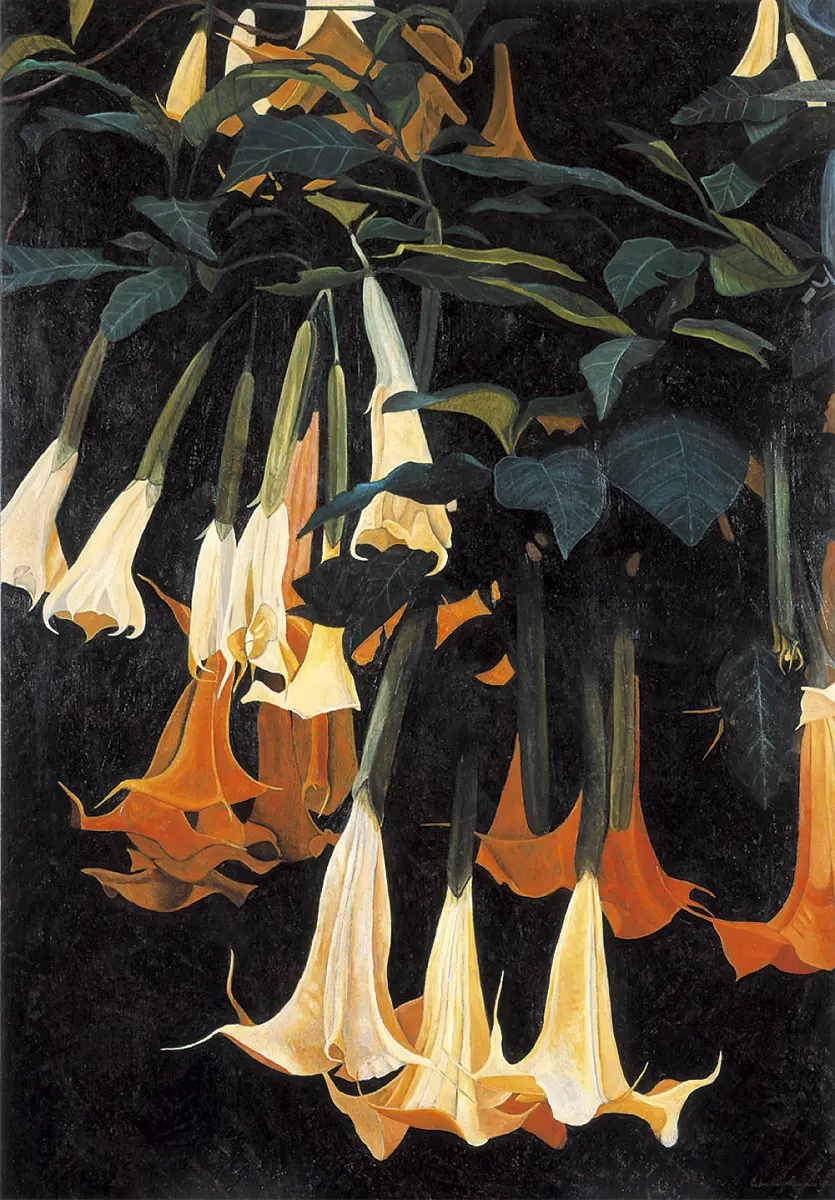
In the same vein, Datura vertical and Datura horizontal are excellent close-up pieces against finely realized backgrounds that cause the main figure to appear highlighted and clear in every detail. The space is more enclosed, yet the flowers dance unobstructed. Whether prickly pears, pears, pomegranates, cauliflowers, celeries, or radishes, the artist uses the elements intrinsic to each of their shapes in order to present them as a totality and to offer the viewer a prolonged “interval of silence” in which to conclude with an aesthetic catharsis.
LUZ SUPÚLVEDA