The title of Ray Smith’s New York show could have been “From Cultural Mythology to Visual Mythology.” Simultaneously in both of the Ramis Barquet Gallery locales, the artist created centripetal and centrifugal actions through temporal-spatial deformation.
Acceleration, compression, and deformation bring the viewer from the realm of volume to the realm of flatness, from the monumental to the small, from life to death, and from the desirable to the fatal. The frequent presence of human beings, animals, and plants seems to have given way, in these works, to the urban, the spatial, and the technological —car, rifle, and clock— treated by electronic means. However, it is in the codes of his language that this artist has expanded in order to continue talking about his personal history, the history of Mexico, and the mythology of the culture he grew up with, and to develop a vocabulary that is not the “trendy” one but one very much his own in the context of international visual arts. His paintings, prints, photographs, and three-dimensional objects are wide chapters, a symbolic overflow. Thus, his narrative must be visualized like the history portrayed in the centerfolds of cultural encyclopedias. Smith has not become global in the sense of losing his identity, even as he incorporates everyday agents such as the use of computers to analyze and deform images. This character whose name sounds like a pseudonym does not lose his profile in the anonymities of what’s “trendy,” nor is he interested in the aesthetics of consumerism. Be it jungle, dog, cavalry or clock, plane, and car, Smith portrays a big question about the mysteries of life and death.
In 1984, Ray Smith had a solo show in Mexico City. A short while before that, death had touched him closely when he lost two friends in a short amount of time in two separate automobile accidents. This was not part of the Mexican tradition of the “Great White Lady,” this was a shock; shortly afterward came the 1985 earthquake that devastated the city. These references take us back to that exhibition of Ray’s work at the now-defunct Eduardo Hagerman Gallery. On that occasion we established the keys to an understanding of his future work: sometime later the artist relocated to New York City on a permanent basis, although he spends some time in Mexico and Texas. From that period, we read: “. . . sculpture, painting, and drawing by Ray Smith Yturria. A young, non-conformist, intrusive, self-critical, self-satirizing artist who does not reject Orozco nor the North American abstract schools, although he is determined to reinterpret it all” (Graciela Kartofel, “Arte en cápsulas,” Vogue Mexico, vol. 5, no. 55: 77). In those three areas —painting, drawing, and sculpture— Smith retains a capacity to appear mythologically disquieting and contemporary; for this reason, we can read into his work a reference to Orozco, although both painters’ images are rather dissimilar to the eye. It is true Ray Smith doesn’t work with the obvious, he works with satire and critique, with figuration and abstraction. And as more time passes between Orozco’s works and Smith’s, the expressive deformations of both tend to become more appropriate (appropriate in the sense of adequate, and also in the sense of being appropriations, things taken from, and in both cases, adequate to and appropriated from the surrounding society of the period). In the early 1990s, Smith was a controversial figure, not recognized in Mexico as Mexican or in the United States as American. Since the nineteenth century, his mother’s family —Mexican like his wife’s— resided in the territories that would be taken over by “the other country.” His mixed education provided him with a cultural mythology that expands our gaze. Such diversity delineates the intense surcharge with which tradition/modernity, magic/unbelief are manifested and coexist in his monumental paintings on wood, oils on canvas, and also in his watercolors on paper, to cite only some examples that refer to the chapters of his work categorized by his use of materials.
In a dismantling of Smith’s works, we observe the constant encounter of two worlds; the artist presents it for us in the same way he lived it in his childhood. They are like two films running simultaneously, producing one clash after another. Everything curses in front of our eyes as if in front of the eyes of a surprised child, of an adolescent who does not justify the unjustifiable, and in front of the eyes of an adult who has learned the unreason of the world. Within Smith’s authorial production, estrangement, anguish, and protest against death are present, as for example, in the beautiful, symbolic, and resigned dogs, dogs that howl, hunt, tolerate, guard, and wait.
The animal theme, as well as landscape and portraiture, tends to express a thick charge of contained life. Smith does not paint scenes from a photographic camera; he paints incoherent, mannerist situations where the poles of reality and deformation play tennis doubles against a team formed by dimension and tension.
Ray Smith’s numerous portraits are not exactly self-portraits. What is important to him is to work in the context of an assumed autobiography.
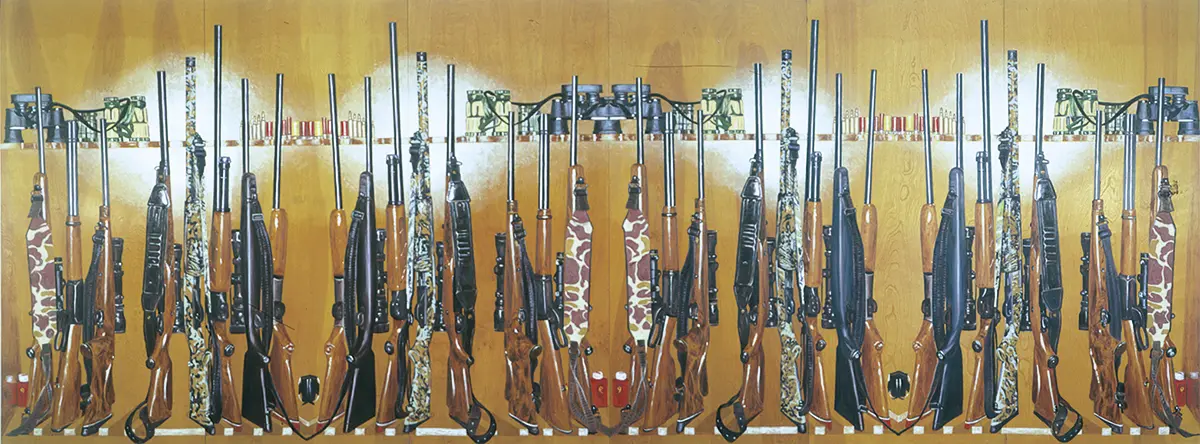
The arcana of Smith’s work has a contemporary undertone. He does not elaborate on the basis of archeological finds, or of fossils, but on the symbols of an atemporal, cultural present. The image of the virgin in the plateresco style coexists with figures of today. The historical moment is altered by gigantisms and disproportions, floating, and silence. There are occasional anthropomorphic elements, but what prevails is cultural anthropology. Smith has developed his imagery; at the same time, his gaze expands beyond the theme to refer to aspects and expressions that characterize various issues of cultural history. An example of this is the rifles in the current show that were asleep in Smith’s memory and reencountered; they are part of the reality of his Texas family home. The monumental blue car that occupies a large part of the gallery on 57th Street symbolizes speed and status, but above all, it is the fast piece that derives from the anguishing death of Smith’s two friends. In both segments of the exhibition, we are partners in urban imagery infused with post-9/11 feelings. Smith’s studies of clocks ratify a past surrealist vision of humanity whose hopes are melting and filled with deforming frustrations. Ray Smith, the real being, the highly skilled artist, does not reiterate Latin America’s magical realism models; he walks through them tangentially and expands them into a questioning language. His exploration of life and death is expressed through both varied formats and dimensions —circles, rectangles— and through satire. In attempting to understand the complexity and the contradictions of the two countries he inhabits, he knows that history doesn’t have all the answers. And that myth is in constant flux, as is language, as is life.
GRACIELA KARTOFEL