Galería Botello presented an exhibition of works by Colombia-based Argentinean artist Samuel Ruiz. The show comprised 11 canvases in a variety of formats, united by a suggestive thematic. Ruiz’s painting is focused on establishing harmony between contrary elements in execution, compositional structure, and the meaning of motifs. Ruiz has pointed out that he is “Searching always for a balance between the abstract and the concrete, the positive and the negative, yin and yan, the eternal condition that makes everything turn and transform, remembering nature, where everything is created and destroyed, living always in that not-so-mythic spiral that is life.” The resolution of opposites or harmony of contrary elements Ruiz seeks in his canvases echoes Heraclitus’ well-known aphorism: “Contraries agree and from the diversity the most beautiful harmony since everything originates in discord.” The canvas titled Zeus is an example of this idea. It features two insignificant everyday objects that, nevertheless, demand formal importance due to the technical virtuosity with which they are described through color layers and outlines. The container and the watering can give orient the composition; in turn, they are determined by the tension lines of the perspectival space. Seen from a high point of view, they seem made of the same material; the artist suppresses the differentiation of textures while at the same time highlighting the materiality of the strokes that describe the receptacle’s shape.
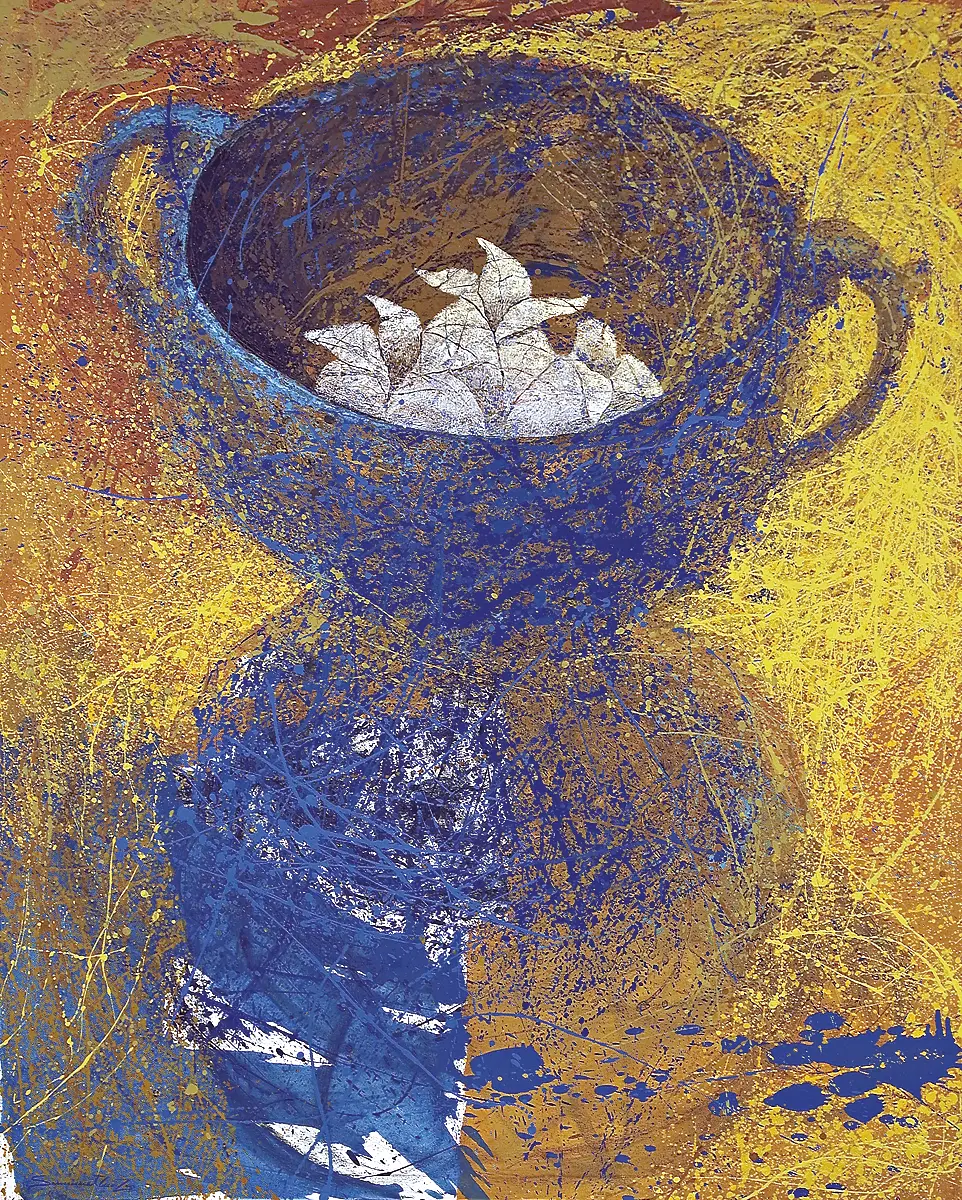
The container in Grial, like those in Zeus, is not of interest for its appearance, but it nonetheless stands out thanks to its protagonic role in the composition, its scale, the jumble of traces that form it and ties it to the background, and the mythical and religious meaning to which it relates.
Ruiz follows the direction established by artists like Robert Rauschenberg and Larry Rivers in the 1960s. He contrasts two extreme tendencies of contemporary art: figurative painting and the practices of abstract expressionism and action painting. His neat draftsmanship describes the outlines of bodies on the basis of a canon that respects the realism of forms while dripping and scratching activate the flat surface.
Ruiz has said: “It is immensely necessary for me to express what I feel and thinks through painting, horses, the human figure, intermixed like a hieroglyph accompanied by color and texture, producing a visual symphony.” Hieroglyphs function in his work as elements in an abstract meaning-producing language. Through them and the transparency of his layers of color, Ruiz outlines figures and motifs that stand out for their immateriality. This immateriality of the figures contrasts with the materiality of pigments, the canvas’ surface, and the artist’s brushstrokes. In the work of this painter, there is an inversion of the effects and notes that are characteristic of figuration and abstraction, reverting into a language of his own. Figures and motifs from nature become immaterial through the transparencies of color and the waterings, and, in turn, Ruiz’s pigment-heavy abstract tracings reaffirm their materiality on the canvas’ surface.
A circular trajectory based on the contrast of opposites is the common thread Ruiz gives Caminata nocturna, Reflejo lunar, Visión nocturna, and Fiesta dragón. The titles and motifs of these pieces suggest an epistemology where the issue of knowledge is related to a map of the fragmented body.
Fiesta dragón is a subtle and complex painting in which Ruiz has been able to join opposite elements. Two figures, the top part of their bodies hidden behind an exuberant and colorful foliage, appear with their genitals covered by branches; they remind us of Adam and Eve, as in Duhrer’s print of that title. These motifs can be associated with the theme of nudity, of nature, and of human beings. Nature appears naked while human nudity is hidden in response to a moral imperative. Sexuality in the myth of Adam and Eve, symbolic of an awareness of being and of the body, relates to the issue of the body’s contingency and transitory character as opposed to a Nature that is perennial and governed by laws that are different from human morality. This theme also alludes to sexual determinism in the definition of what is human.
In the map of the body, the eye takes first place in the hierarchy of the senses made explicit in Plato’s allegory of the cavern, Sophocles’ tragedy Oedipus Rex, and Leonardo’s theory of art. In Visión nocturna, a face with no eyes appears under a source of light. It reminds us of the meaning of Greek tragedy: lack of eyes is not lack of vision; on the contrary, it suggests a superior form of vision capable of apprehending the truth and essence of reality. After all, true reality —as in Plato— is not subject to sensorial vision, to what we exercise through the eyes in our faces. True reality, for the philosopher, is captured when we sharpen our inner vision, which is intellectual and spiritual.
The principal motif in Caminata nocturna is not the eyes, is the bottom part of the body, legs in movement, and the metonymy of the body, accompanied by a horse’s legs. The emphasis on the legs, within the map of the body, in Caminata nocturna, as opposed to Visión nocturna, suggests an oppositional symbolic association between that part of the body and the eye. We can infer that walking as a process, different from the process of seeing, without the top part of the body, is not guided by the higher faculties of our psyche. It is guided by the abdomen and the limbs, subject to disturbing emotions and to the passions of human nature’s animal side. Nevertheless, Caminata nocturna complements Visión nocturna in the circular trajectory of the map of a fragmented and separated body that Samuel Ruiz’s painting delineates. Just as a gradation of body parts in relation to knowledge is established, a symbolic gradation of sources of knowledge appears. If a source of knowledge in Plato’s allegory of the cavern is the light that comes from outside, from the Sun, Visión nocturna suggests that the light reflected on the eyeless face is also filtered from outside, from beyond the boundaries imposed by the painting’s format. Light in Reflejo lunar, on the other hand, comes from a lamp. A significant contrast could be pointed out between the lamp’s light and the light emanating from the small receptacle in Grial. It reminds us that divine light has an incomparable brightness and imposes a condition of inferiority on any source of light created by humans. The meaning of the motifs in the works mentioned lays a bridge between painting and philosophical thought, which since Antiquity has assumed the issue of knowledge as central to its disquisitions.
Ruiz’s art confronts opposites within a harmonious pictorial unity, while at the same time highlighting the fragmentation of motifs and the ambiguity of signs. It suggests a unifying principle that is characteristic of postmodern art: a shift in art’s way of signifying and the complexity of art that does not reject long-past sources.
INGRID MARÍA JIMÉNEZ