The work of Santiago Sierra, an artist born in Madrid in 1966 and living in Mexico since 1995, is in large part characterized by comprising a series of often absurd actions, carried out by people who are paid to do so, in places as dissimilar as Lima, Helsinki, or Havana; it is documented in video, usually by an intermediary so as to allow the artist to remain apart, and the corresponding black and white photographic record is presented alongside brief texts describing the action.
The thematic axes around which Sierra’s work revolves are corporate coercion, marginality, substance dependence, sexual commerce, ethnic discrimination, and cultural pseudo-humanism. These initiatives emerge in part from an interpretation of Marx’s arguments about the working conditions of the more unprotected social classes, a topic that has always moved the artist, whose main influence and predecessor is the Spanish artist Isidoro Valcálcel Medina, a conceptual and political art pioneer in Spain since the 1970s.
The artist’s method consists in carefully selecting the geo-political area where his actions are to be carried out and conducting a preparatory study of the economy, labor relations, minimum salary, and social and ethnic hierarchies there. The people paid for the action generally do not understand the project, immersed as they are in an act that transcends their comprehension of art and the business of cultural spectacles.
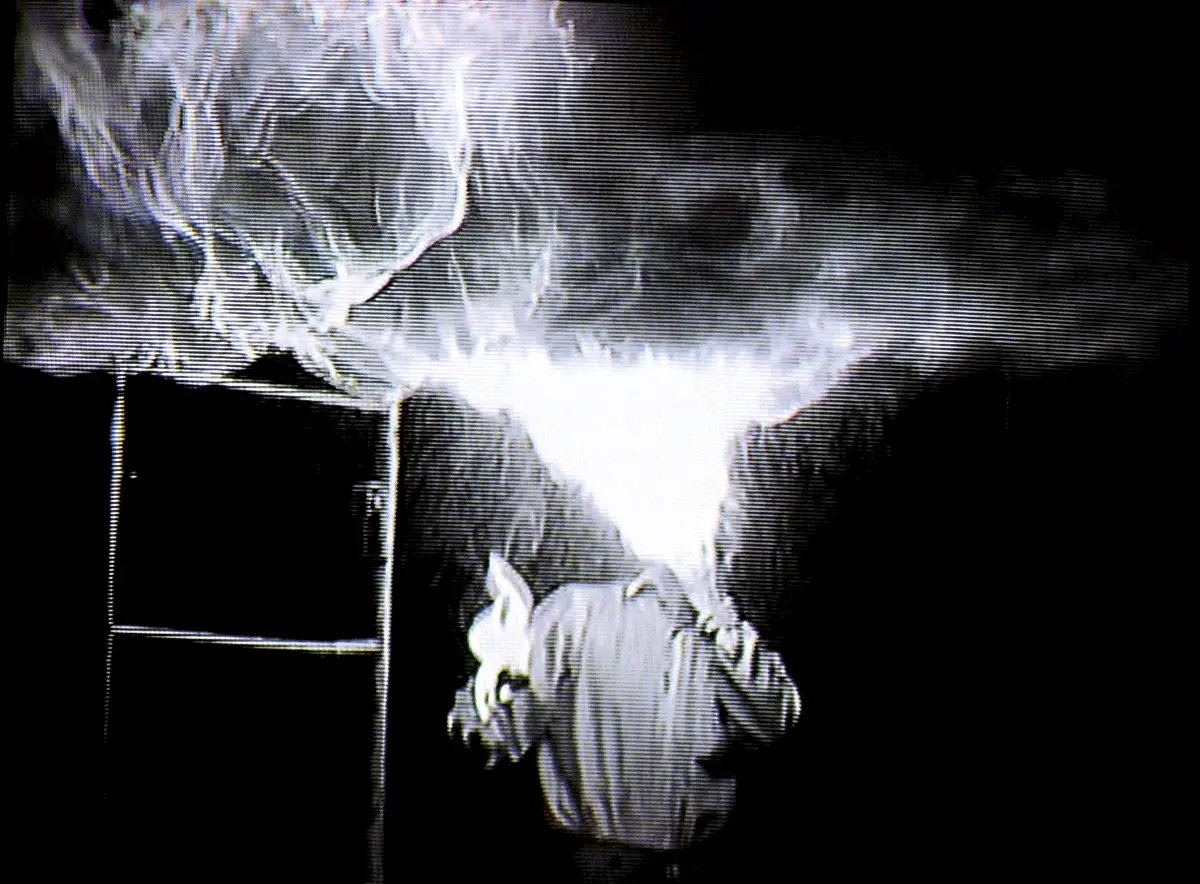
On this occasion, the artist presents seventeen paintings in two formats, thirteen at the Sala de Art Público Siqueiros (SAPS) and four smaller ones at Galería Enrique Guerrero, both in Mexico City and a video documenting the process of how a fire-eater was hired to “paint” the surfaces of the canvases with gasoline, doing exactly what he does in many corners of Mexico City: selling the illusion of fire magic in exchange for a few coins at the city’s stoplights.
Formally, Sierra’s paintings are an experiment in abstraction, with an aesthetic taken from a police station cell or a bar restroom where people make graffiti using cigarette lighters. Only in this case, a professional painter was hired to mount the canvases on passe-partout and hang them from a structure, after which the fire-eater began his process of burning with gasoline until the surfaces were completely blackened. All of this can be seen in the video, where scenes from the “pictorial” production are intercut with everyday street scenes of the fire-eater carrying on his trade and using the same technique that was used to “paint” the pieces.
It is these paintings that we see as we enter the large white cube of the SAPS where the large-format pieces are exhibited. Not knowing what to expect, the visitor finds himself or herself in front of a seemingly formal art exhibition without explanatory texts. The video is in a space next to the entrance, separated from the paintings, and an absent-minded viewer who did not pay attention to it would hardly understand the piece’s purpose, even though by themselves the large black paintings project a lugubrious and strangely intense atmosphere.
This is the work of a pessimist who defines his position: “I can’t change anything. There is not any chance we can change things with our artistic work. We do our work because we do art and because we believe art must be something, it must follow reality. But I don’t believe in the possibility of change. Not in the context of art, and not in the context of society.”
RUBÉN BONET