
The most visible characteristic of Adrianne Gallinari’s work is its desire to reconcile order and chaos. Something that, in terms of Gallinari’s exclusive dedication to drawing for over a decade, can be interpreted as a constant oscillation between fidelity to the medium and a deep exploration of its possibilities, seeking new supports, forms, and tools to produce her oeuvre, marked also by the blurring of all distinctions between figuration and abstraction, the physical and the mental.
At first glance, the artist’s most recent show was somewhat frustrating. After a series of experiences where Gallinari drew directly on the architectural space, almost all the drawings on large MDF sheets1 painted in white the artist presented on the gallery’s first floor, seemed an attempt to perpetuate rigid support for the relationship with architecture she had already established. However, in these wood objects, the border with the wall was ever more clearly defined, highlighting the work of their own environment, and the attempt to fuse the white background with the white of the architecture seemed to me overly timid. But, as I already knew, the main characteristic of Gallinari’s work is that same restlessness that, in the same way, ties us to draw, and makes us approach it always in a different way. Let’s consider, then, the images.
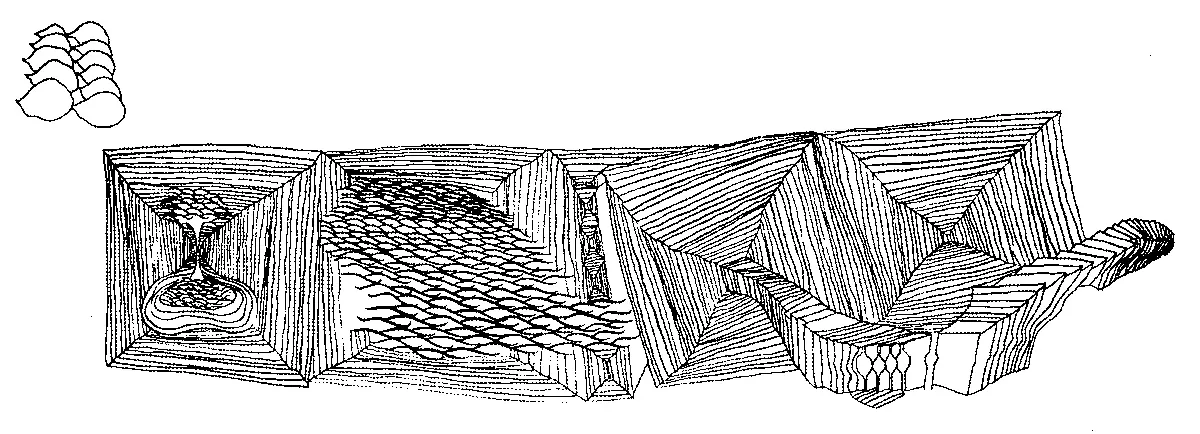
The largest work (all, Untitled, 2003) has the same motif seen in so many of her wall drawings: a kind of square spiral. These structures, perhaps “soft fences,” multiply from a center and reproduce themselves in pairs, one next to the other, resulting in an eerily calm composition thanks to the wound-up nature of the element. These structures also resemble perspectives, in allusion to mental landscapes, a motif found often in Gallinari’s recent work. Here, then, the use of the brush for the application of China ink to the support confers the form a much softer, sensual, and bright physiognomy. It is as if the principle of non-definition of lines was less clear with this new tracing, which in itself reveals a sinuosity that is not only formal but also mental, thus suggesting an inapprehensible corporeity (in that sense, I like to think of their animated drawings as indexes of that same inapprehensible character, which ends up contradicting her initial intent of organizing the space-wall or the support.) Some references are appropriate: Giacometti, Leonilson, Louise Bourgeois, Arthur Bispo do Rosario, Tunga, Lorenzato. What they have in common is their incomplete way of perceiving the world: thus, Gallinari’s drawings and her elements, sometimes dream-like, are truly traced from the experience of seeing and representing.
Other elements present in these large-format drawings are lines, screenings, chains of organic compounds, the organs of an artificial anatomy, roots, foliage, chain mail, nets, topographies cut in half. They always place us in a curious position of attempting to understand the points of view of a typological recognition, when what we can best do with them is to feel them in a phenomenological sense, from an almost intuitive construction of images. The same happened with the texts that used to populate her works and which, in this, her most recent production, have disappeared entirely. In the same show, in the gallery’s mezzanine, we saw several smaller-scale drawings on paper representing motifs that were more isolated, responding to simpler, almost classical compositions. One element per image, letting the background breathe, is an almost mechanical exercise of composition. Even with the small disappointment of the large-format drawings, the small drawings reminded me of the vital, joyful, affectionate character of Adrianne Gallinari’s work. As in life, they are always ready for the next opportunity.
NOTE
1. MDF: Medium Density Fiberboard.
RODRIGO MOURA