
Arturo Montoto is not only a greatly skilled artist but also a great researcher. This is the only possible way to surreptitiously dismount the stabilized canons of Western art discourse and “play” with its strategies of representation. And he doesn’t do this using elements alien to that very History, in fact, that is his merit, to do it from the same structural presuppositions that still today allow us to distinguish, confronted with any given work of art, whether it is still life, a landscape, or any other traditional Western genre. La lección de pintura is the show this artist presented recently at the Museo Nacional de Bellas Artes, comprising twenty-two canvases, eleven in medium-size format, a similar number in large format, and a kind of declaration of principles by the author.
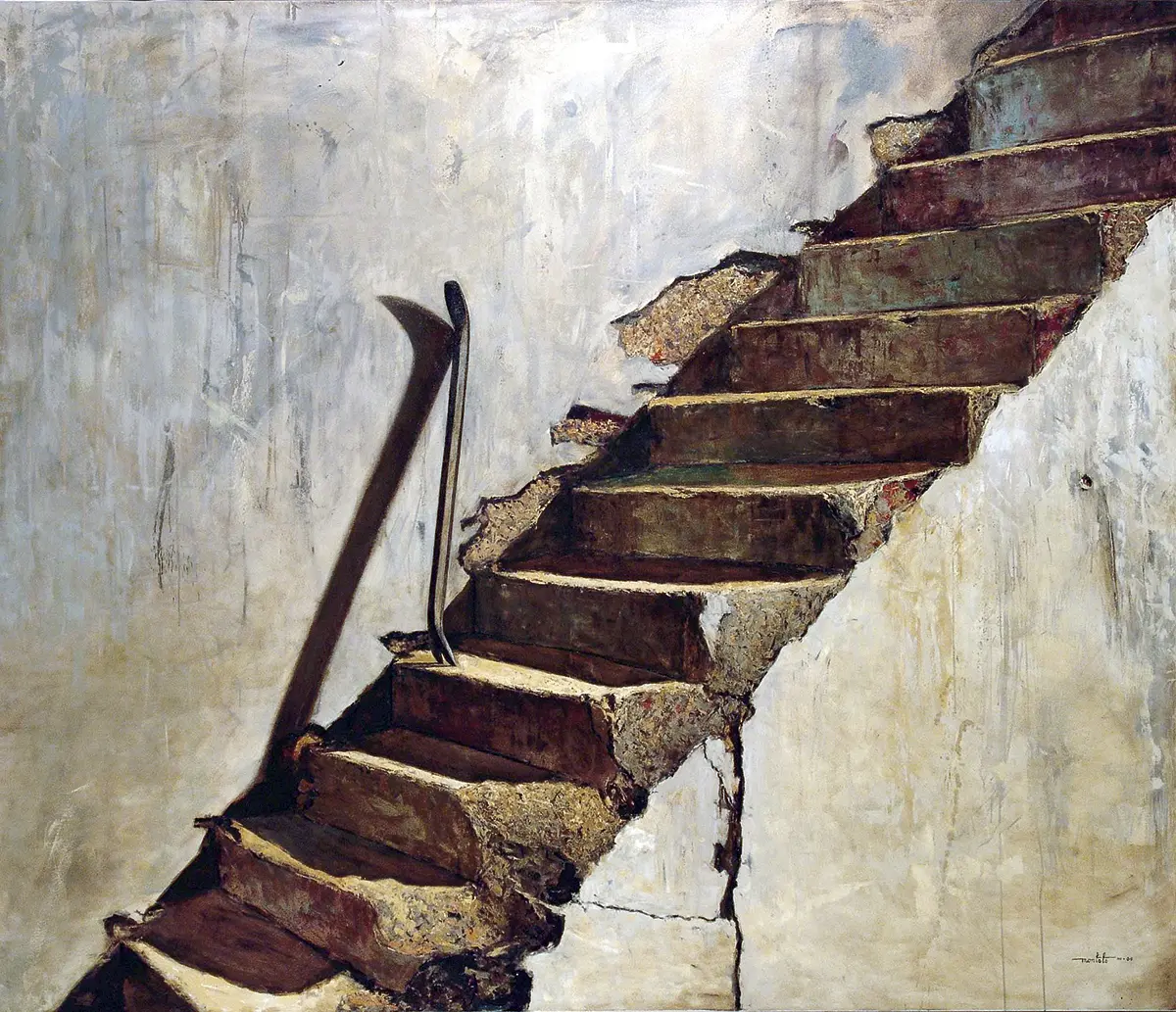
The show’s leitmotif is the process of artistic production, in this case, that of the author himself. Because Montoto (a man of peaceful demeanor) is obsessive about creative instruments, one who constantly questions concepts such as mimesis, anagnorisis, and poiesis, among others, derived from classical Greek culture. From the latter he has learned to value the importance of restraint and equilibrium in all aspects of life, qualities so cherished in today’s socio-cultural circumstances that are notably present in his discourse —a discourse full of contrasts at all levels.
The artist has arranged the smaller canvases in easels, in front of the works hanging on the walls, offering a logical sequence of the steps he follows before arriving at the final product. The painter’s declaration of principles, having erected himself as a Master, assumes three main audiences: the disciple seeking authorial individuality, the apprentice who imitates the exhibiting artists to the detriment of his own style, and a third receiver who, armed with technical tricks and talent, tries to establish his work and is forced to challenge the contemporary stigmas attached to the painting, related to its supposed inability to reflect on current problems. These symbolic audiences allow the author to comment on the status of the pictorial within the artistic practice; unfolding the mediations that exist between gnosis and representation, in a: game” that warns of the limitations of creativity regardless of the expressive vehicle used.
To a creator who possesses the rigor of Academia, one who has received awards and recognitions for his work as a photographer, one who has ventured into abstraction and installation, no artistic “trick” is really alien. There is an ironic rejoicing in his discourse, directed not only towards the often absurd reality of his social surroundings but also towards the hierarchy of aesthetic artifice. He tells me he has assumed this show is an exercise in experimentation that allows him to gradually move towards abstraction. The play with space that installs complicity with the viewer, the almost-natural scale of his objects, the objects’ loss of supremacy in the narrative, the preeminence of shadows that are alien to the compositional plot, and the presence of graffiti are some of the constants sketching a change of meaning relative to his prior work.
The same is the case with Montoto's figurative repertoire. If before it was a tendency to use fruits, whether in their most noble nature or in their voluptuous disposition, in these canvases the icons become aggressive and more plural in origin. Most of them are work tools connoting ad infinitum, proposing multiple associations within a dual semiotic-structural logic.
The best piece in the group, La autosustentacón del canon (which has also changed my view of his poetics,) summarizes the show’s intention. A mannequin of the kind used by artists in Academia rests against a wall, in a pose of abandonment. It holds its own broken leg, and in the background, we can see a (falsified) graffiti that reads: onanismo (onanism.) To the right of the canvas, a staircase moves into the darkness. Here the artists seem to be commenting on a History relegated to its condition of the model to be followed, which in the solitude of its self-sufficiency encounter at once consolation and anxiety. I confess I decided to approach Montoto’s world after reading an erratic statement about his discourse. Somebody had the idea of talking about minimalism in the artist’s proposal. I am thankful because I found significant works of art possessing a great level of synthesis despite pulsating states and conflicts that are so dissimilar. This very piece points towards the anguish of creative freedom in the face of the decay of the referent, and it has been solved in an atmosphere that fluctuates between enjoyment and melancholy.
The very suggestive Veleidades is another distinctive piece, so plain in its appearance and at the same time so contrasting when analyzed in detail. Here we see a lobster’s tail screaming its carnality after having been abandoned next to a door. Each of these works establishes a tension between the textures of the main composition, working with a spatula, and the softness of objects done with a brush. Here what we have is a contradiction: the majesty of the shadows does not obliterate the brightness of the enticing food, which appears alien, and slippery. The piece constitutes an allegory of the antithesis that can occur between society’s factual situation and that which is true or ideal.
Filled with textual superpositions, El cabo del hacha also stands out. It is a kind of epitome of ideological, political, and cultural decay in the contemporary world. Montoto is seduced by the idea of “playing” with the viewer’s interpretative ability, and he has placed an ax on top of two books bound in red. He claims to remember, joyfully, a popular saying: “you were hit with the butt of an ax,” and tries to expand it to all social fields in order to speak of human miseries.
All the artist’s narrativity has architecture as its backdrop. His desire to theatralize finds in architecture the ideal place, perhaps because architecture is the face of all societies. Through it, we verify the bonanza or decay of a given context, and in this case, the insecurity represented by these walls, staircases, and dispossessed openings is evident.
An electric tensor projecting its shadow in the form of a gallows, a two-beaked anvil serving as a barricade in the middle of a road, graffiti offhandedly announcing incisive phrases, insinuating knives, pole-obstacles, are some of the fable-making elements in Montoto’s proposal; for him, artworks as ergotherapy when outside his study he can’t find the: real”, that which satisfies him and prefers to stay with the “theater of shadows,” as in the Platonic myth of the cavern.
“The mysterious one,” as an old friend calls Montoto, is also a great manipulator, a restless artist who interrogates himself through his “painting lesson”. His lesson leaves several questions open: Will there be an evolution in his work after this exercise? Has the market been the catalyst for certain changes in his modus operandi? Will his discourse be more accurate through painting, or through some other expressive medium?… In the meantime, Night gathers, and nothing is visible enough as to allow for conclusions.
AMALINA BOMNIN