
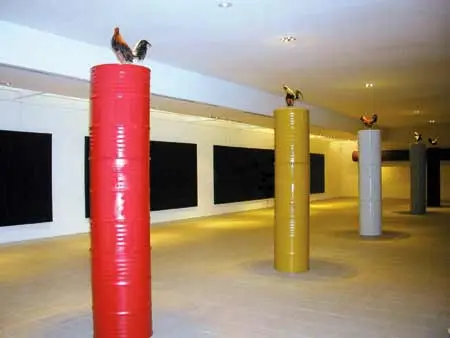
One day, a friend said to Eduardo Ponjuán, “Friend, you are a minimalist,” and Ponjuán replied, “I am a man, not a minimalist.” That phrase became the title of an installation at the Museo Nacional de Bellas Artes, which is showing Ponjuán’s work for the first time. There, the artist set up five towers with painted oil tanks, and on top of each tower, far above the viewers, he placed a stuffed fighting cock, a symbol of machismo, manliness, and, for many, Cubanness. Behind this piece, Ponjuán placed nine more rust-covered tanks that hung from the wall and were titled Todo lo sólido se desvanece en el aire (All That Is Solid Melts into Air), a phrase taken from the Communist Manifesto.
The exhibition takes its title from a piece called Lo tengo en la punta de la lengua. This everyday expression is used when one is trying to remember something that doesn’t fully come to mind. Ponjuán’s piece has a colossal presence —200 x 450 cm. and weighing 300 pounds— like the rest of the works in the show. It was executed using roofing paper, a material that is traditionally used by the poor to protect their houses against leaks. This material fascinated Ponjuán after he saw how a friend used it, and he incorporated it into his work for the first time in an installation titled Sueños con goteras.
In the end, each painting is a large black plane. The bottom half of Lo tengo en la punta de la lengua is covered with the names of artists who in one way or another have had something to do with the artist, including the sign painter who gave him his first lessons back in his hometown. Conmigo no hay casualidad is filled with what seems to be randomly placed letters, until one discovers the title phrase, which is related to the streets, to the world neighborhood tough guys. What appears to be the mark of a wide brush is in reality the trace of an iron letter, transferred by heat to the painting in a way that is similar to the branding of animals. Other works are Un roce anula el tiempo, the title taken from a poem by Ángel Escobar and printed using the same method; and Una pulgada y algo más, the fragment of a haiku in which Ponjuán created the composition in black sponges, in homage to Ives Klein.
To summarize, this exhibition related to minimalist poetics is at the same time an ironic proposal (Ponjuán asserts that in today’s Cuba, everybody wants to be a minimalist). It is also the artist’s way of de-sanctifying the Museo Nacional, Cuba’s most esteemed art institution. When I asked him about the poverty of the materials employed, he told me that “they may be everyday things, but each cost me a lot of money, and now my workshop has all kinds of leaks because the paper, once heated, can not be recovered. But I couldn’t resist the black matte, skin-like warm.”
After the break-up of the duo he formed with René Francisco Rodríguez, with whom he worked for eight years, Ponjuán has presented several solo shows. He did away with his personal library to make book objects (self-portraits), drawings, a diary about the accounting books of a notary public, etc. He views the current exhibition as closing his debt to the History of Art, particularly the New York School.
Although earlier he was interested in creating more cerebral, conceptual works, Ponjuán now claims to be attracted more toward presentation than representation. He wants to create works to be touched and smelled; above all, he wants to create works that exhaust him physically. In Koan, a Zen garden he prepared for the most recent Havana Biennial, Ponjuán covered the four walls with the same paper and covered the gravel ground with black asphalt, which required him to go up and down a staircase, carrying a bucket, 2,080 times. In a Zen way, he wanted to exhaust himself to the point of rendering his mind blank.
ERENA HERNÁNDEZ