Eleomar Puente is one of those Cuban artists so highly educated that, having mastered academic canons and the history of Western art, could very well paint like the classics, and apply that skill to a critical and postmodern figurativism. One of the pillars of the Lyle O. Reitzel Gallery, Puente has retained the obsessive elaboration of his pictorial treatments since his first solo show in Santo Domingo, twelve years ago.
This young artist has benefited from an exceptional welcome in a country where often only Dominicans are sought, with the exception of the protagonists of large auctions. Periodically, Eleomar Puente seduces an avid public that appreciates his unique contemporary style, between new realism and fantastic surrealism.
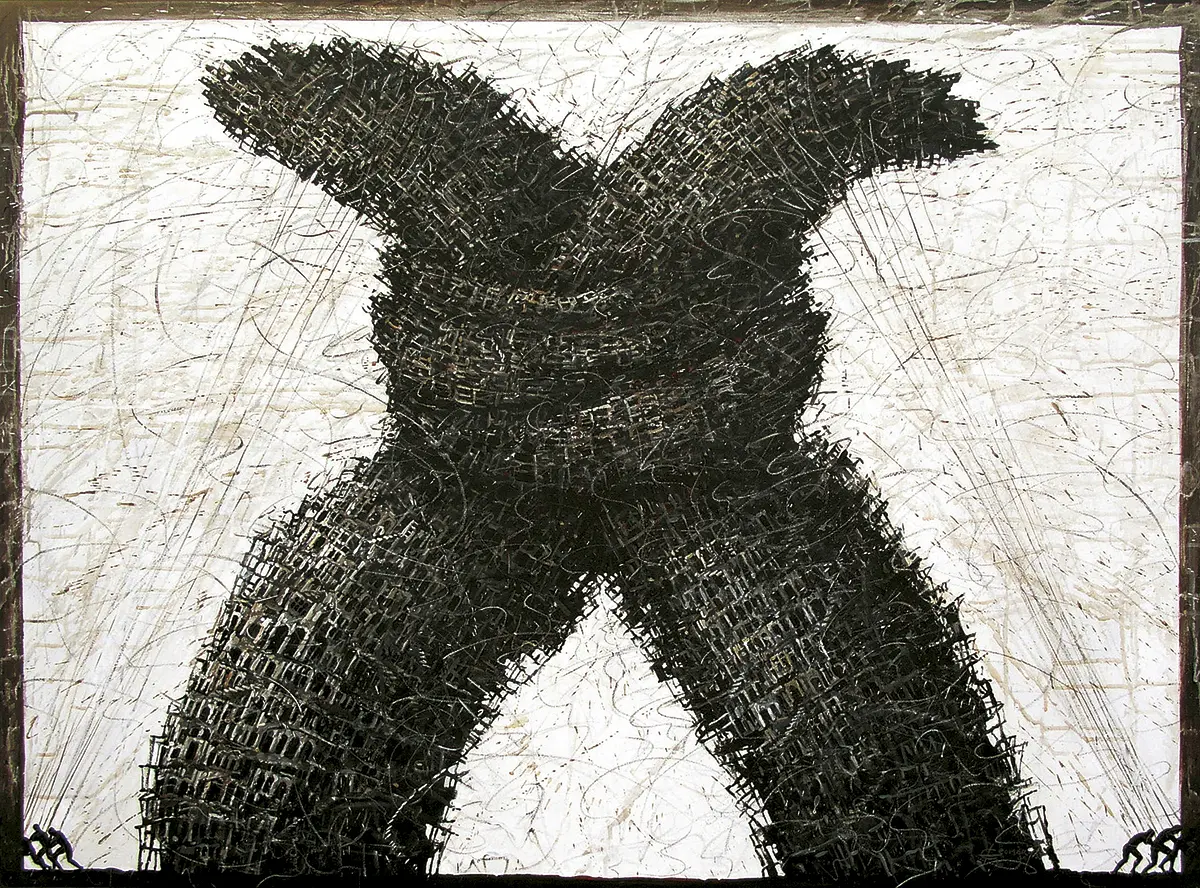
These features are still central to Contra el poder… o el fin del placer, his new show. The main characters in a hypnotic and chilling drama are still ascribed to the semi-imaginary portrait of the strange despot, a hybrid of man and beast, honored at the 2nd Caribbean Biennial. Meanwhile, the astonishment of revelation becomes suspense as we wait for each new mode of apocalypse proposed by Eleomar Puente.
Cruelty does not cease. Abuse, subjugation, and mistreatment intensify to the point of physical destruction. We agree with Laura Gil when she associates the impulses of a hellish world with the triad of Eros, Kratos, and Thanatos, pointing out, in this passion for painting, a “tension both social and human.”
Today, the element of humor has disappeared from the barbaric images of extermination, and the playful aspect persists only in the formal virtuosity with which the artist plays with the challenges of Academia. His iconography no longer wants to be ironic or entertain us at first glance, but to raise awareness, almost directly, of the horrors of destruction and genocide. To the bloodthirstiness of power, he opposes the fury of art.
The two vertical structures of Steel and Skin, atrocious in their accumulation of almost identical human and metallic bodies, cannot help but evoke the towers that fell on September 11. The difference between many artists’ denunciations and Eleomar’s comes from his intelligence and subtlety, and also from his ambiguity, which makes possible more than one interpretation, or perhaps requires a participant reader.
However, the end is near. Although the slaves have kept their emblematic pickaxes and muzzles, necessary accessories in the ideological–pictorial pandemonium, the barrage of lies and deceptions culminates in the asphyxiation of the caricaturesque, monstrous orator, pathetic in his ugliness. The microphones and metaphors of serpents, agglutinated and implacable, are about to strangle the tribune in Discurso, one of the series’ strongest pieces.
Eleomar Puente always presents urban scenarios, and what we consider a revival of the “gothic city” with its forests of skyscrapers (Complicidades), today exalts fantastic visions that push the gaze into backgrounds and platforms. People no longer communicate. Kites are not safe from the madness of propaganda. Even the sea and the sky have been contaminated. The artist becomes the designer and architect of closed perspectives. Here is the game of the virtuoso…
The apparition of ancient luxurious automobiles widens the repertoire of symbols with a primitive power, which beliefs in external signs to foment oppression and bewilderment. In Dominican political memory, we remember writer Juan Bosch, who denounced “long-necked” cars. A sinister palette, mostly red, black, and ashen tones, refers unstoppably to blood and lead, to the exterminated and the assassins. The mechanics of power has substituted nature, and the artist’s palette, which must guard itself against stereotypes, contributes to the piece’s psychological and social expression.
Interestingly, cold and heat coincide in an open reading of ice or melted wax blocks (Coolness and Cold communication, titled in English not exactly by chance…) with the same message of prison and loneliness, mutilation, and destruction. There is no escape.
Puente’s drawing is characterized by perfection, apt to reach illusionism, with equal precision and sophistication in realism as in his contorted and grotesque subjects. Through a painstaking execution, of the chromatic aspect, the painter achieves a life-like, insinuating luminosity even in his night and dusk scenes, in his grays, blacks, and “broken” whites. Chiaroscuro has no secrets for Eleomar Puente.
This very solid exhibition fits well with the line followed by Lyle O. Reitzel Arte Contemporáneo, whose main exclusive artists are committed to a unique kind of figurativism, rigorous in its formal components, sharp in its critique of humanity in danger, inexorably stalked by new demons… Will we find in an upcoming Eleomar Puente show the hour of salvation?
MARIANNE DE TOLENTINO