
Federica Matta is showing for the first time in France an important selection of acrylics on canvas, polychrome resin sculptures, drawings, and collages produced between 1993 and 2003, accompanied by a mobile, two earthen “urns,” and some architectural models (project for Favela de Campo Grande, Rio de Janeiro.) The Chilean artist (1955, Parisian Region) has settled in the French capital, where she works with great freedom, allowing herself all forms, colors, techniques, and formats, from the smallest objects to monumental urban art creations. Untroubled by fashion or the market, she enriches her artistic vocabulary by quoting, revisiting, and borrowing cultural and artistic sources from the whole world. A first glance at this prolific work evokes, certainly, those simply-decorated figures in primary colors preferred by Niki de St. Phalle in the 1980s. In Federica Matta we also find a similarity with the unfettered imagination of a free-figuration artist like France’s Hervé Di Rosa, a traveler of the imaginary and the real, inspired by comics, brut art, popular art, and naïf art.
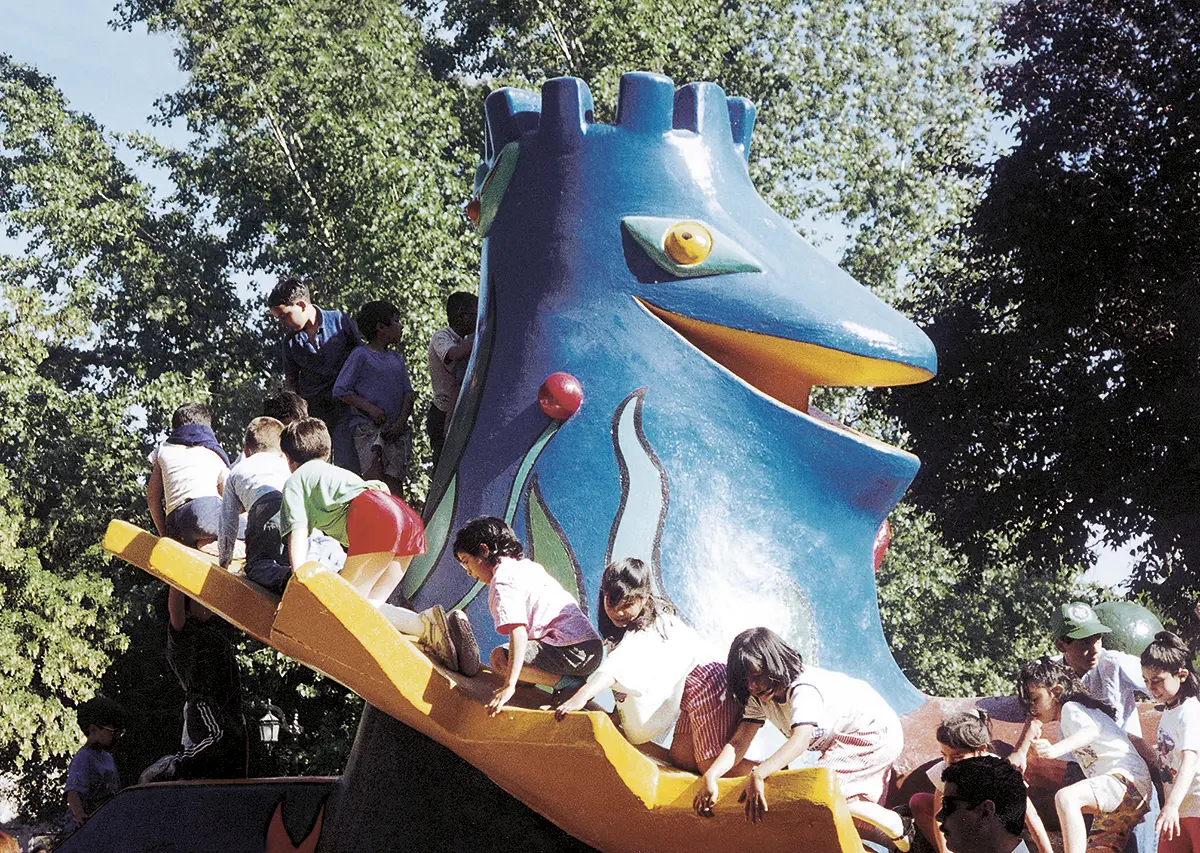
But beyond its relationship to a narrative family that expresses various aesthetic and imaginative natures, Matta imposes a personal path —in which we should not forget the iconographic language built by Roberto Matta— impregnated by surrealism, from Miró to Max Ernst and Víctor Brauner, and to the sculptures of Brazilian artist Maria Martins. This is the case of the bas-reliefs created for a Lisbon subway station, The Water Garden (Parque station, 1994), or of her monumental sculpture The Trip of the Mermaid (1999) installed in the city of St. Nazaire, France, as well as the large format canvas entitled Multiplicaciones (2003).
In a multiplicity of forms mixing a variety of universes, Federica Matta invented a world declined into a vocabulary of images where suns, stars, fish, birds, hearts, sirens, hybrid figures, goddesses or anthropomorphic or zoomorphic deities, and decorative figures recur. Water, nature, and cosmos connect in an unstable fluidity where the artist renews the eternal utopia of an imaginary paradise, similar at once to the Tlalocan of the Aztecs and the Garden of Earthly Delights of Hieronymus Bosch.
Her work evokes a joyful and smiling bacchanalia, populated by beings that are half angel and half demon, which would undoubtedly have fascinated the art forain (or “fair art”) of early-Twentieth Century France. This intermingling of elves, gnomes, and sympathetic monsters is dominated by the pleasure of imagining and freely creating forms, letting hand and color run at the will of emotion or of chance, through a kind of automatic design, a dreamed paradisiacal world, a universe inhabited by the generosity of the gesture, by the joy of establishing a dialog with the children we were and who still reside within us.1 Symbols and signs from primitive beliefs, Hindu myths, and figures (Shiva with her multiple arms and her sole eye), allusions to ancient Egypt (sphinx), representations of the first “savages imagined by Medieval Europeans (headless men,), etc, rub shoulders with references to the Americas, be it in pre-Columbian times, with images from the Codices that his father, Roberto Matta, also appreciated, or reference to Central American architecture with her sculpture The Temple (1993). or in contemporary terms, with the deities of Brazilian candomblé, evocations of tropical fauna (turtle, serpent, iguana, etc.), and volcanic landscapes found in the “Juego de la Oca” designed by the artist.
Federica Matta’s universe boils over with vitality, explodes in astonishment, and is impregnated with humor. It belongs to the so inherently Latin American “real-marvelous” style alluded to by Alejo Carpentier, but also resembles the “baroque” style of images and situations (‘’Magical Realism”) expressed in Latin American literature. If color occupies a central place both in her canvases and her sculptures, it does not occlude the strength and precision of her firm but free drawing of sober black designs against a white background, freely executed in the brush. Her unbridled imagination and her graphic virtuosity are also noticeable in two large canvases dominated by a drawing of white shapes against a gray background with scattered color blotches. Universes and Infinitum (1992) and Fire and Shadow (1991) stand out clearly in a group of works justified by an unlimited flow of bright colors. In these large-format pieces, the artist displays a highly diversified gesturality, a kind of calligraphy of images that imposes her draftsmanship and to demand, in other words, the predominance of color. Her eleven collages and paper cut-outs in unlimited polychromy of beige, black, white, and gray, remind us inevitably of the Guerrero Indian's amate paper figures, sacred images, ritual symbols, shamanic effigies used to invoke fertility and rain or to drive bad spirits away.
In her intertwined graphism populating a space in movement, we find a relationship to Matta’s explosive/implosive universe and to both artists’ desire to unknot the threads of history and the world. With her pyramidal accumulations, her animals and fantastic creatures, her abundance of often flat primary colors, her fruit masks, her women-flowers, her multiple suns, etc., Federica Matta offer us an enchanted world. Her exuberant obsession with image and color reveals, between visual saturation and fascination, a demand mixed with the daily joy of creation.
Far from our usual situations where the intellect dominates emotion, where often color, due to its very value, its visual and emotional impact, is absent, where everyday things are interrogated on the basis of their insignificant or damnable reality, Federica Matta’s world invites us to dream. Given the rather “austere” times we live in, in the art world, her playful and joyful oeuvre opens a space of light in the reigning monotony. Federica Matta does not intend to criticize the world. She wants to transcend it, to free it from its chains, imagining it better, utopian, as it could be and, sometimes, as it really is. The artist’s imagination touches our deepest memory, the memory that authorizes us to desire and to create for the pleasure of our eyes and our affections, a “real-magic” image of the world.
NOTE
1. The show’s catalog, which is not conventional, has been specially conceived for children, in the form of games. It is a series of five elements: a small catalog presenting some of the works on exhibit and texts drawn by Federica Matta; a “seven families” game; a “goose” game; a mobile to cut out; and masks to color and cut out.
CHRISTINE FRÉROT