
As the Twentieth Century pushed forward, the painting was considered by some artists as something already surpassed, and the complexity reached by pictorial thought was ignored. It had become a site for the explorations carried out by many contemporary artists, using new materials, expanding their speculative possibilities outside the format, and moving in space. This allows them to move “in and out” the pictorial experience with great freedom and affords them the chance to experiment with and reflect on it. And let’s not forget that since Leonardo da Vinci's painting “is a mental thing” each artist develops his or her own particular way of approaching the issue.
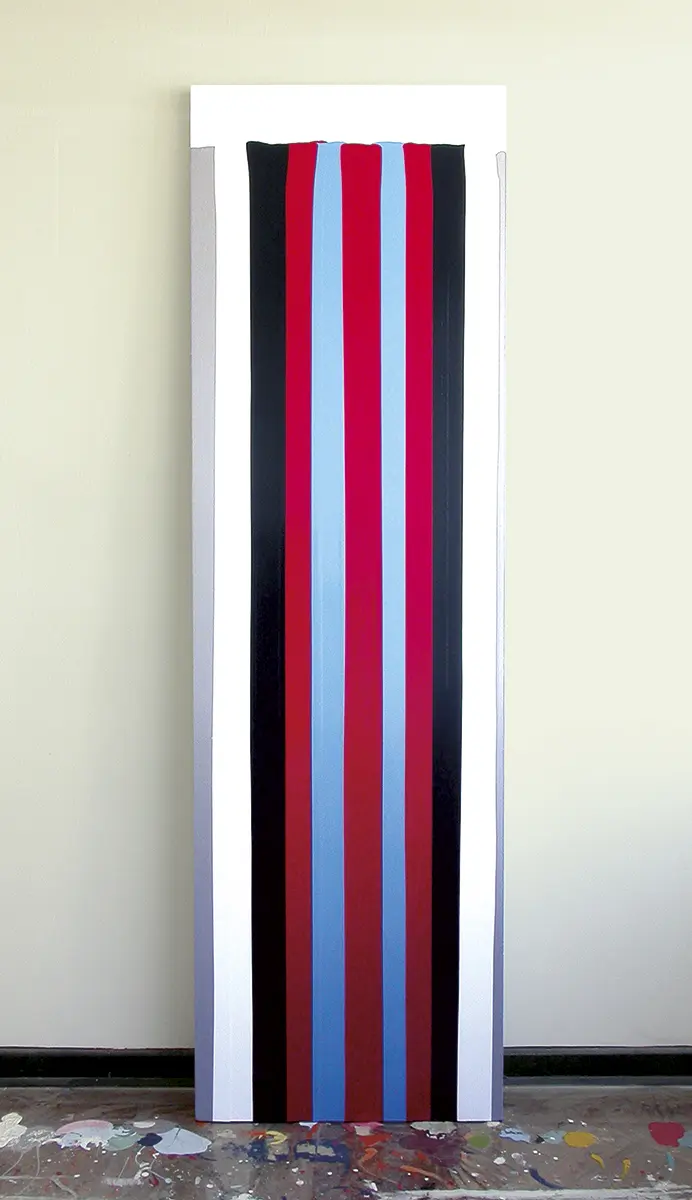
Fernando Uhía’s painting inscribes itself in this frame of exploration. In recent years Uhía has worked in painting and video, the latter a resource he uses once again in his show titled Technoesmaltes. On white doors, bought at a construction materials superstore, she let drip from the top down façade paint in different colors, which, due to gravity, forms works that at first glance can be categorized as strict geometry. However, as we get close we realize that this is the illusion of traditional geometry because the pigment running through the surface has irregularities made more evident by the superposition of chromatic strips. And there we recognize that Uhía continues investigating a subject that has been constant in his work: the weight of globalization in relation to images, brands, and colors imposed by fashion, present here through the use of colors that are often found in sport's shoes.
In this show, comprised of twelve pieces, the artist deals with the contradiction in contemporary painting between abstraction and figuration. Whether using one resource or another, what he is interested in is not representing the image by committing to one o those alternatives, but having the ability to manipulate historical models n order to incorporate references, in this case, chromatic references, of contemporary TV, fashion, and video images.
The illusionistic game Uhía proposes is far from the naturalist tradition of tricking the eye and reproducing the appearance of things. He tries to open up a more personal world using resources taken from what the artists call the “multinationals of the image,” making us think of a personal space of interpretation where the pictorial gesture, so seemingly simple, acquires new significance.
IVONNE PINI