
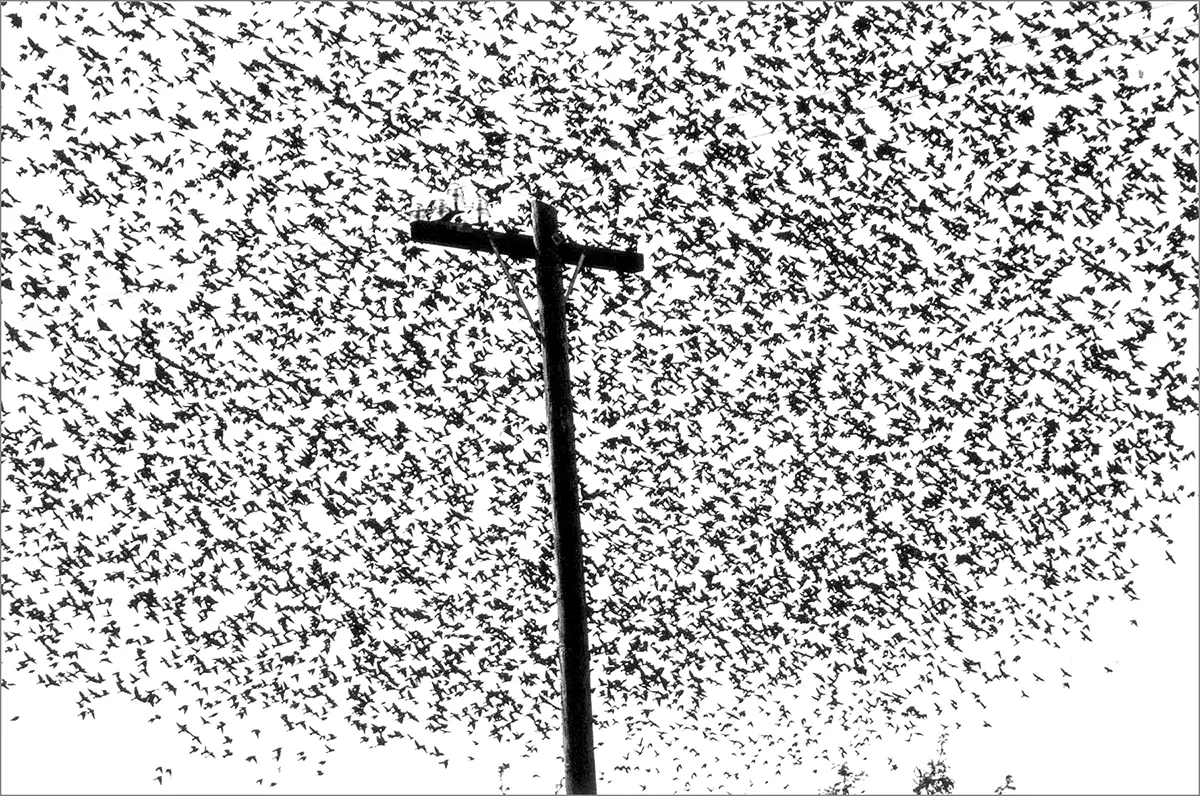
Graciela Iturbide is one of Mexico’s best living photographers and this exhibition, Pajaros, demonstrates why. The exhibition included black-and-white prints taken in Mexico and India in the eighties and late nineties that were published in her 2002 book of the same title. Although birds are featured in each gelatin silver or platinum print, photographs such as Lost Dogs, 1998, capture much more than the winged creatures. This work from India epitomizes Iturbide’s exceptional eye and uncanny ability to capture a moment that appears as both an abstract vision and an uncommon glimpse of a world. Four stray dogs with distinctively coiled tails stand apart and appear as dark figures atop a long, arid embankment in shadows. A vast, hazy sky fills the picture, its luminescent expanse broken by three lone, hovering black crows. It is a spare, dramatic image of unlikely juxtapositions, a moment frozen in time that results in a haunting composition of open air and light versus dark land and creatures.
In Untitled (Bull with Birds), 1998, the ethereal grace of pale birds in flight contrasts with the strong, solid fury of a black bull running through the flock. Wings aflutter, and countless pigeons scatter, filling the heavy air of walled space with their blurred bodies. The heavy limbs of densely leafed trees provide a backdrop to the patch of seed-covered pavement left bare in the aftermath of the bull’s charge. The ground pattern of blocks, light-toned and uniform, is the anchor around which the flux of ceaseless animal movement hums. It is an intoxicating vision in which flight and force converge within a world that appears dreamlike beside shadowed walls.
One of the strongest photographs in the show, Jacket and Crow, 1998, recalls the masterful prints of Graciela’s teacher, Mexican photographer Manuel Álvarez Bravo. This unsettling, iconic photo is defined by a man’s blazer hung to dry at the end of a tree branch. The indistinct image of a crow in flight punctuates the opaque, sunlit sky. Shot from below, the jacket appears suspended like a kite in the sky. The ground is marked only by the slice of a building in construction, its steel rebars jut heavenward signaling the impending addition of the dwelling’s next floor. This is a mesmerizing photograph conceived of an ordinary scene.
Through Iturbide’s lens, as though Álvarez Bravo’s before her, we see the extraordinary both in subject and form. She imparts a vision at once particular, of figures or places, and abstract, of dark versus light, intricate lines or textures versus blurred hues and spaces. Iturbide is a singular artist; her photographs, regardless of their size, subject, or the number of times we have viewed them force us to see anew.
MARY SCHNEIDER ENRIQUEZ