Janaina Tschäpe’s first one-person show in New York consisted of photographs, works on paper, video work, and a sculpture configured from plasticine that was affixed to the gallery’s wall. Titled The Sea and the Mountain, the exhibition was formally characterized by the above-mentioned media coupled with performance-oriented tableaux; most of the works depicted individuals with protruding corporeal-like globules that were connected to their bodies or appended to them in some fashion. The works recalled numerous art historical, theoretical, and cultural references, such as Hans Bellmer, Matthew Barney, Lygia Clark, and Gilles Deleuze’s Body without Organs, as well as the particular women’s fashion line created by the vanguard designer Rei Kawakubo.
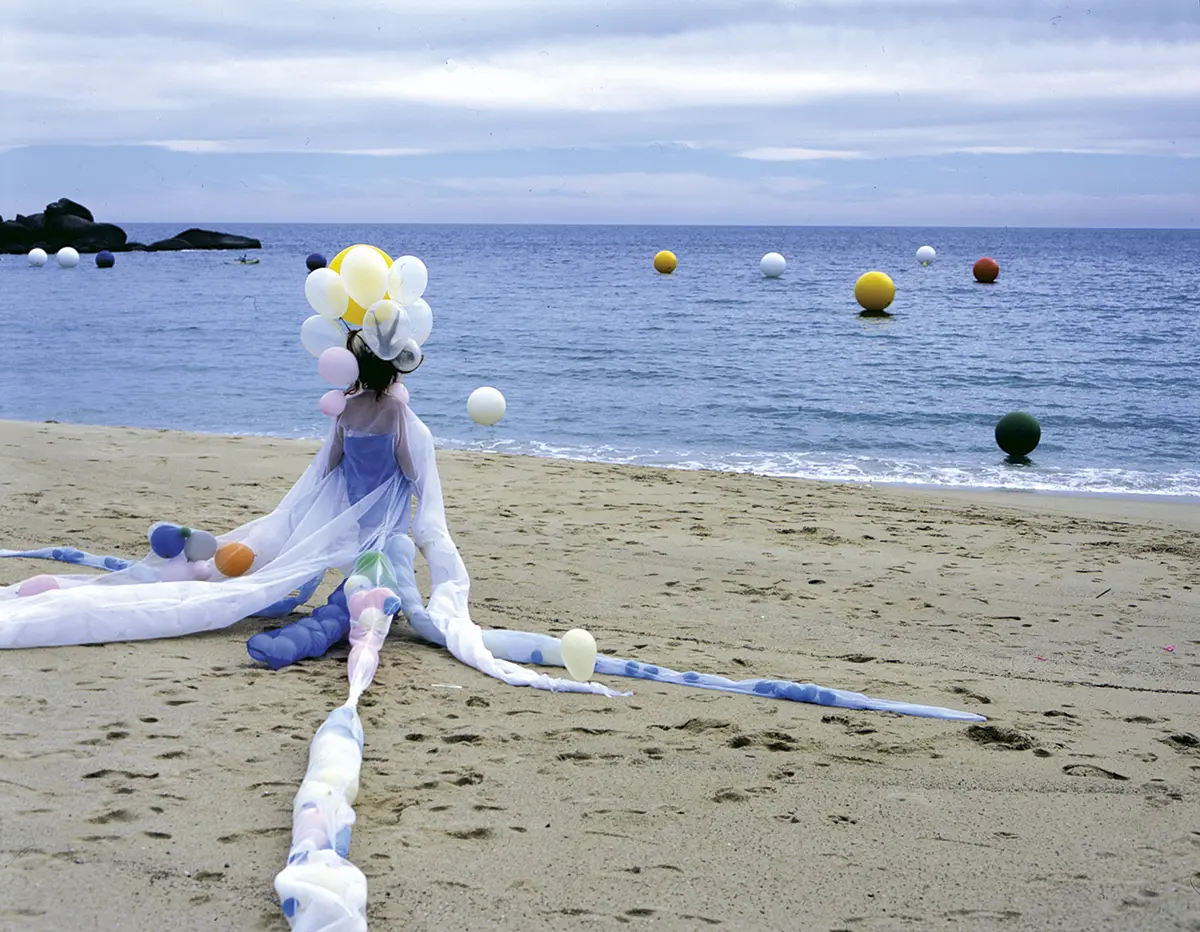
The figures were placed in various outdoor settings in the Bocaina region of Brazil, and in doing this Tschäpe seemed to push the nature/culture dichotomy in numerous directions. One support of this assertion is to try to imagine what the effect would be if these quasi-staged scenarios were brought indoors. Although Tschäpe has worked with urban space, her decision to use landscape as her backdrop was certainly effective. The setting of the figures was germane to the overall context of the work and one could see how the figures and works interacted with their environments in uncanny ways. Some of the figures seemed to be physically connected to the landscape; consequently, this created an interesting dialogue between if you will excuse the pun, figure, and ground. A plethora of associations was conveyed through the merging of body and sculpture, yet one is tempted to think that such an alignment of female gender with the earth is a throwback to the earth goddess type of feminism that has been seen as essentialist. While the works may allude to this, they also negate such singular readings. The show’s title and the amorphous shape of the figures could certainly recall more biological and evolutionary metaphors, such as life on land that supposedly evolved from the sea. Such a poetic coupling was also heightened by other pairings that paradoxically were as much in tension as they were complimentary to each other. Occasionally the figures transmitted a feeling of pure inertia and atrophy, or pulsating energy and dynamism while referring to birth and dissolution. They were also reminiscent of some of the early sculptures of Lygia Clark, especially Clark’s Shrouds, which were worn by a person to engage her/his inner self.
Where Tschäpe differs from Clark is that the former’s somatic-biomorphic forms create a dialogue between the landscape and the body as a way to engender interiority by way of phenomenological experience. Tactility is crucial here, not as an extension of the haptic, but more in the way that the enveloping forms are akin to an epidermis as they interact with their environments. One could see in these recent pieces just how far Tschäpe has evolved both formally and conceptually. Her previous series of works, such as her Dream Structures, engaged architecture by way of the body and made it a conduit of sorts for her architectonic interventions. Her current work seemed to be less a critical stance about synthetic social space, than it was about the body meshing with its surroundings in sensuous counterpoint. The precursor to these works is her haunting 100 Deaths series, photographs of a singular body usually placed face down on the ground. The memento mori of this work, as well as the architectonic insertions of her Dream Structures return in The Sea and the Mountain, however, not in the guise of death or in urban contexts, but in registers of regeneration and the landscape that amount to the haunting and poetic body of work that characterized Tschäpe’s New York debut.
RAÚL ZAMUDIO