Jorge Pardo —the Los Angeles-based, Cuban artist— makes work that feels as though it is perpetually in the process of becoming something else. This provisional quality doesn’t come from the materiality of the work, which is as solid and well-formed as any artist’s. Rather, this sensation is an aspect of the work’s design, which seems not quite willing to enter the material world.
Fittingly, Pardo is discussed as an interloper between categories —art/architecture, object/environment— because his work refuses to settle comfortably into any single slot. Since these categories are also more or less in flux, the source of Pardo’s multiplicity can be hard to pin down. His latest gallery show goes a long way toward building a material case for the slipperiness of his oeuvre and toward clarifying the relationship between these different modes.
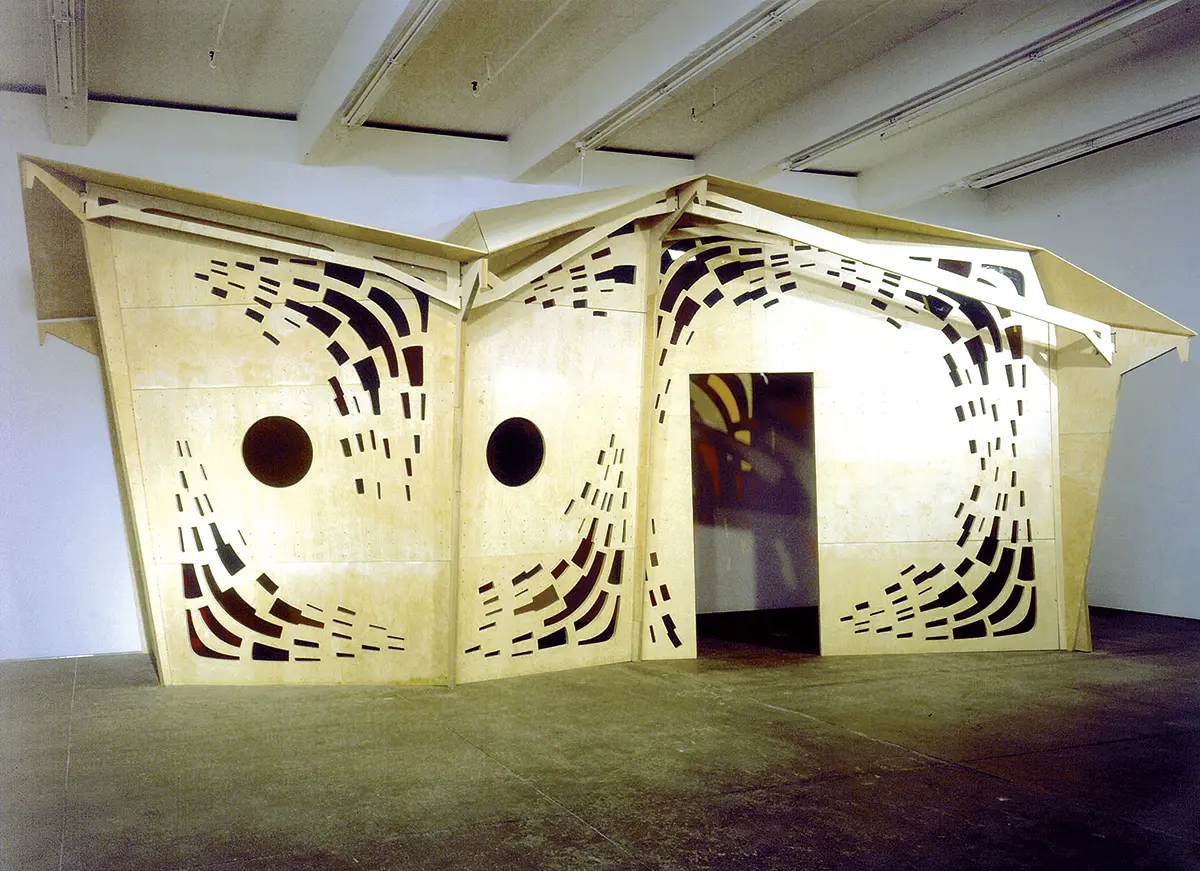
The central focus is a small, jigsaw puzzle-like structure assembled from interlocking pieces of birch plywood. The playful construction, witty angles, and small size suggest a child’s playhouse, but the pitched roof and decoration code the shelter to be read as a generic site of contemplation. The walls are perforated with circular portholes and cascading groupings of yellow and red Plexiglas that recall the ecumenical stained glass of high modernist church design.
Inside the structure, the ambiance is dappled with patches of colored light, geometric shapes, and a hushed reverence for high design. A modish light fixture of the same interlocking construction hangs like a shining star. This motif is further developed in a computer-aided drawing of abstract starbursts, presented on an inkjet print pinned to the back wall.
As a result of its punched-out, makeshift construction, and quasi-religious sensibility, the little shelter begs to be entered as an idea rather than a concrete object. One can also imagine a gingerbread cottage, casita, grotto, or children’s clubhouse —any small space scaled to human proportions and projections. (Isn’t this why kids make temporary shelters— to inscribe a space with their own ethos?). Insofar as Pardo’s art is about architecture, it calls up memories of spaces rather than constructing new ones —the nostalgia of architecture, if you will.
Elsewhere, Pardo tackles other hegemonic categories. Four sets of flamboyantly colored doors are hung by conventional hinges on the walls around the gallery. Each pair is constructed of sculpted MDF with more of the Plexiglas portals inserted. Their crudely painted surfaces undulate with rippled reliefs.
Yet, these grand doors are neither grand nor actual doors. Mounted on walls without openings, the ungainly objects are uncomfortably identified as one thing but operate as something else. Chiefly, they read as reversible paintings that viewers can swing back and forth, rearranging the exhibition at will. One might ask, is a door still a door when it cannot function as such?
Magritte said something similar about a pipe. But, Pardo’s inquiry is not lexical. He emphasizes the object qualities of objects by extracting their prescribed function, a conceptual liberation that passes through the senses rather than the intellect. Interestingly, the little chapel possesses a doorway but no door while across the gallery the abundance of doors has little to do.
Pardo seems to be saying that the raison d’être of objects is different from that of structures, and both are subject to the limitations and whims of human thought. Objects may have a presence, but they don’t enclose the mind. Structures create atmosphere —more accurately they define it— but by their very nature always exist at a psychological remove.
From inside the little chapel, it is a delight to peer into the white gallery through the yellow and red Plexiglas portals. The room’s atmosphere and objects are transformed by colored filters. In this manner, Pardo’s objects serve as conceptual intermediaries for raw sensation as well as for embedded attitudes about the material world that exist, for the most part, below the threshold of conscious thought.
That’s why the light fixture in the little chapel looks like an architectural drawing. And why the decorative design pinned to the plywood wall could be the beginning of an architectural plan. The provisional nature of design reflects the shifting uses, applications, and meanings invested in the material world. If Pardo’s work seems to hover between categories, it is a reflection of a fundamental quality of the contemporary mind.
JOHN EWING