
Pablo Suárez always gave priority to his ethical values and overall aesthetic vicissitudes. Considered among the most controversial Argentinean artists of the 1960s (he was born in 1937 in Buenos Aires,) Suárez carried his thought to the extreme when in 1968 he distributed a defiant letter to Jorge Romero Brest, director of visual arts at the Instituto Di Tella, refusing to take part of an exhibition to which he had been invited. Moved by the revolutionary spirit of the times, Suárez declared himself against art understood as a “code for the elite” and sought to abandon the usual exhibition spaces: “Those who want to be understood in any form should speak in the streets or wherever their words will not be twisted,” he wrote in his pamphlet. Ever since his trajectory has faithfully followed that path. During the times of military dictatorship, he avoided collaborating with official institutions; in 1974 he refused to represent Argentina in the São Paulo Biennale due to “political differences;” in the 1980s, after the country’s return to democracy, he joined young artists such as Miguel Harte and Marcelo Pombo in exhibitions at the Centro Cultural Rojas, an emerging space dependent on the University. In the 1990s, his decidedly figurative and narrative oeuvre gained significant local recognition, against the generalized trend towards abstraction and neo-formalism.
If it is possible to conceive a history of art based on facts rather than in pure discursive inventions, in 1999 Suárez once again produced one of its chapters, as the protagonist of a situation whose importance can be better appreciated today. The jury for the Constantini Awards —organized by Argentina’s most renowned collector with the purpose of reinforcing the contemporary anchoring of his patrimony, mostly modern and Latin American— gave Suárez First Prize in painting for a piece titled Exclusión. In the first place, the piece was not a “painting” in the orthodox sense, but a kind of relief on a plane, a sculpture “adapted” to the format required for the award, a somersault that laid bare the obsolescence of categories and limitations that —only five years ago— were still at work in Argentinean salons. From the conceptual point of view, Exclusión participated in Argentina’s lush satirical tradition conjoining humor and social critique. With this work, which entered the best local art collection and today shines at the MALBA (Museo de Arte Latinoamericano de Buenos Aires,) Suárez evoked, through a micro kind of representation —a man “hanging” from a train coach— a macro sort of problem derived from the free market policies that during that decade deepened the poverty of the country’s majorities. El escaso margen, Suárez exhibition of fifteen recent works created in the quiet of his Uruguayan “exile,”, moves in exactly the same direction.
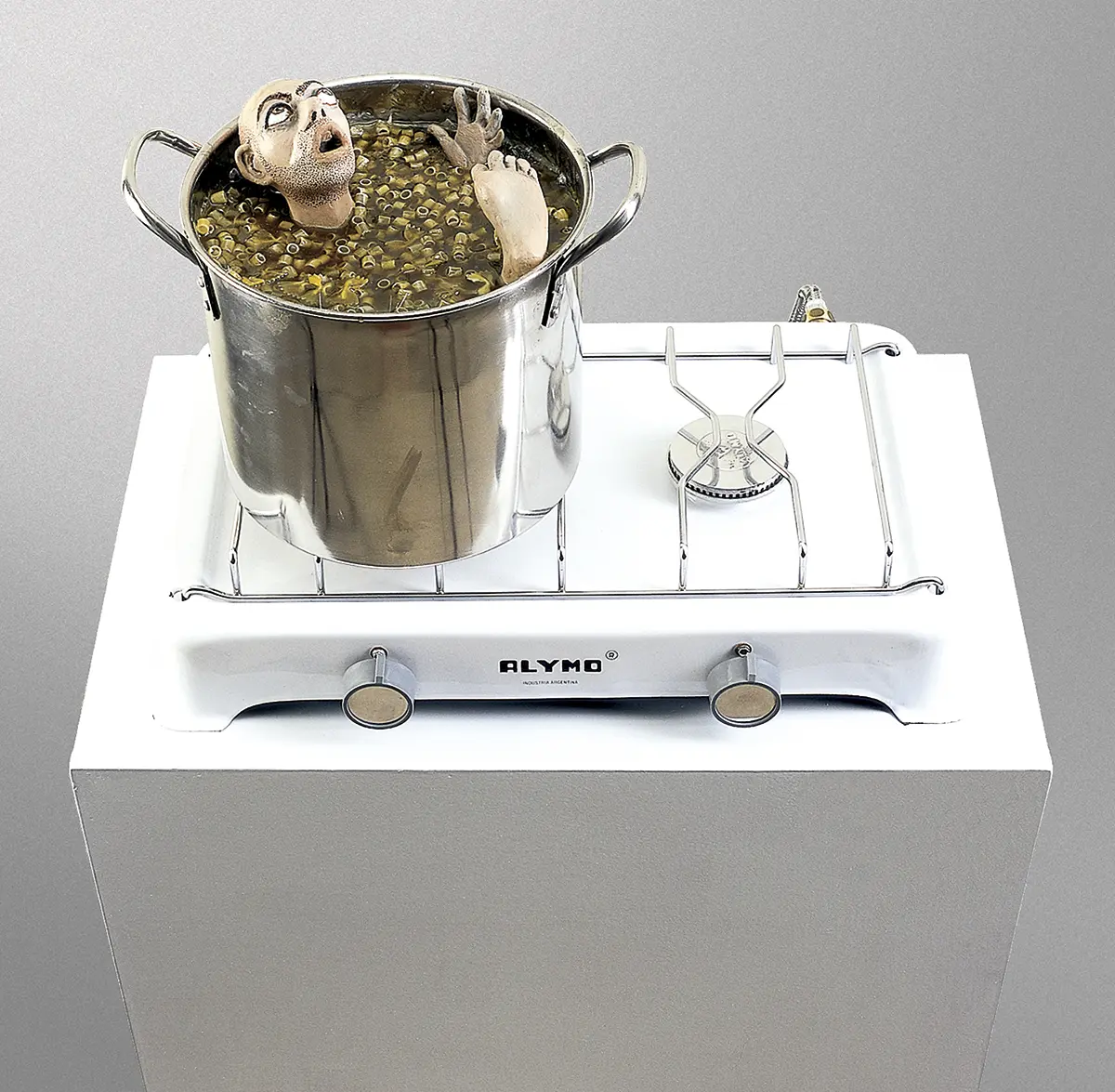
Executed in mixed technique, and polychromed, these works were situated so that they covered the gallery’s entire space: the distance between them is enough for the thread of meaning to plot its course without obliterating each piece’s particularities. In the catalog, Suárez makes explicit his desire for reading his show as a whole, a reading in which the viewer received the full impact of “accumulating information” Indeed, the show’s lighting contributes to generating that feeling of multiple events, a sort of circus —the saddest circus in the world— animated by a small troupe of marginal subjects. In Sopa de pobre, a man floats among the noodles of a stew, inside a pot; in Poca fe, a dubious “fakir” balances atop a sharp rod while his feet bleed; in Prisioneros, a dog gnaws at a bone while another dog watches, both inside a cage. Some more linear, some more hermetic (in Danza ritual del vuelo, for example, Suárez claim to have represented a custom linked to migration in New Guinea,) all seem to emerge from the artist’s sensitivity to injustices and inhumanity in Argentina and beyond. It is, certainly, a gaze that rejects imposture and lets itself be affected by the drama of real life, and in that sense the show is as ideologically hones as it is technically impeccable. However, in the face of the laudable intentions of this or any other protest art, we should always remember the words of the very own Pablo Suárez, in that letter he wrote in 1968: “A weapon only acquires meaning in action. In a store window, it poses no danger at all.”
EVA GRINSTEIN