The significance of Pedro Piña’s (Maracaibo, 1952) artistic trajectory motivated the Lía Bermúdez Art Center of the city of Maracaibo to organize an anthology exhibition of his work, with pieces dated between 1970 and 2003. This artist, today considered a young master, is one of the few current practitioners of geometric abstraction in Venezuela. He has worked in that direction since his formative years, resulting in a valuable representative of the style with a high-quality body of work that cannot be considered limited by the geometric proposals that were known in the 1960s. The exhibition was of great relevance for the Venezuelan artistic scene, as it coincides with a kind of revival of geometric interest. Artists of emerging generations have begun to explore the formalist codes of geometry, pushing them in new directions and presenting their contributions alongside those who never abandoned interests that were anchored in the field of geometry and constructivism. Quietly, but in a coherent and firm way, Piña’s career began in the 1960s. By the end of that decade, already immersed in the geometric school, he developed an extraordinary body of work of great chromatic sensibility, which can be summarized in the 1968 series Mosaico, true small-format jewels that demonstrated Piña’s mastery of constructive space, his special sensibility for color, and a spirituality that covers not only his art but also his personal life.
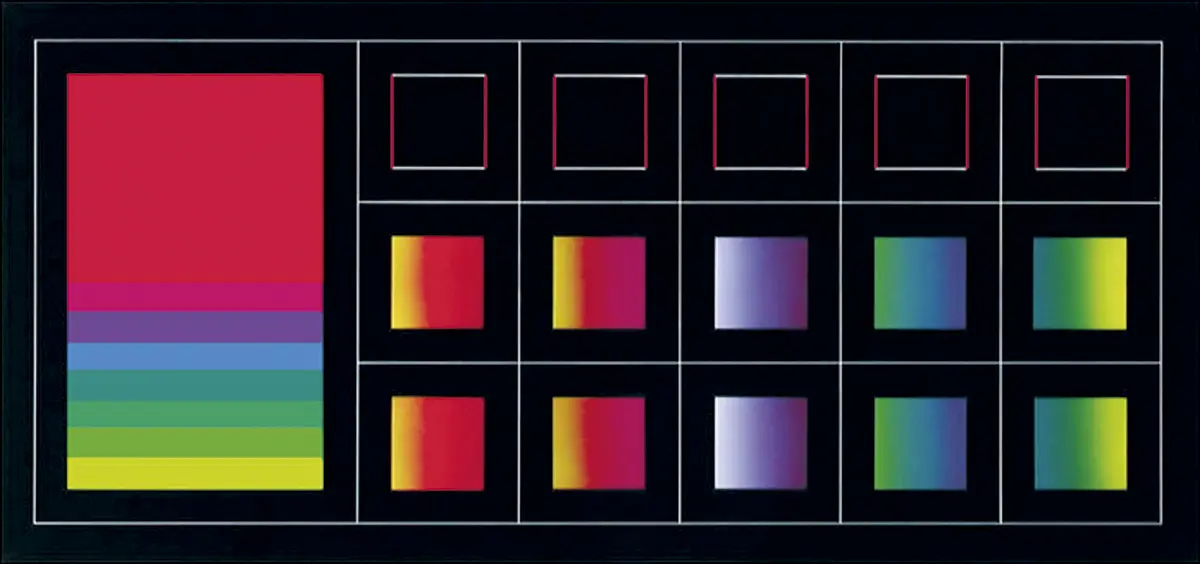
Piña’s life as an artist has been marked by an investigation into the behavior of color on flat surfaces, which brought him close to the principles of Op Art; into geometric structures as foundations of a visual reality both two- and three-dimensional; and into a very personal posture regarding meaningful abstraction and the discipline of repetition. The last factor is important to analyze in an artistic oeuvre fundamentally based on the repetition of geometric figures that emphasize their singularity as they are possessed by color, and that present a new identity each time we see them. Piña’s interpretation of geometry can be considered new. While he starts from geometry proposals established in the history of art, his investigations and explorations in the field of color and juxtaposed forms are—without diminishing the importance of light and shadow effects that clarify the surface and give his highly conceptual meanings a sense of reality—complex mutations analyzed through the shifts seen in artistic creation in recent years.
Painting and sculpture form a conceptual and formal whole in the work of an artist who remains on the sidelines when it comes to the process of changes undergone, sometimes faddishly, by Venezuelan art. His fidelity to an artistic form of expression that is not always appreciated in its true value, makes him part of a still open-ended history. Piña is interested in geometry, and this interest is expressed in an extraordinary body of work. As Sergio Antillano, a Venezuelan master art critic, put it: “Emotional and creative, this Master (Piña) is never cold or cerebral.” This statement locates the most effective substratum in Piña’s work, which is based on a geometry that could be located at the precise limit of Latin American sensible geometry. Piña has broken open the limitations of Venezuelan geometry. It is possible that the context in which he lives and works have influenced him, allowing him to appreciate the incandescence of light, and the exuberance of color, and also to transform a hallucinated world into magic and fantasy in order to organize it on the basis of the geometric shapes and precise grids that characterize his art.
BÉLGICA RODRÍGUEZ