
For the lapse of a month, the white wooden doors at the main entrance to the Palacio de las Artes were substituted by two fire-proof, metal, pivoting ones with anti-panic bars. Less than a meter into the exhibition area, six more identical doors, installed to the sides, articulated with their peer. After opening the, the visitor had a choice of paths, creating his or her own corridors and preferred architectural situations to enter or leave the museum. The change in façade materials also changes the building’s parallel position relative to the street. It is as if the whole construction was dislocated, accompanying the transversal configurations and acute angles for the new passages. The title of Renata Lucas’ work, Anti-Fogo (2003), suggests the containment of a fire whose focal point is not identified, precisely in order not to determine ideal vantage points or stimulate Manichean interpretations of danger.
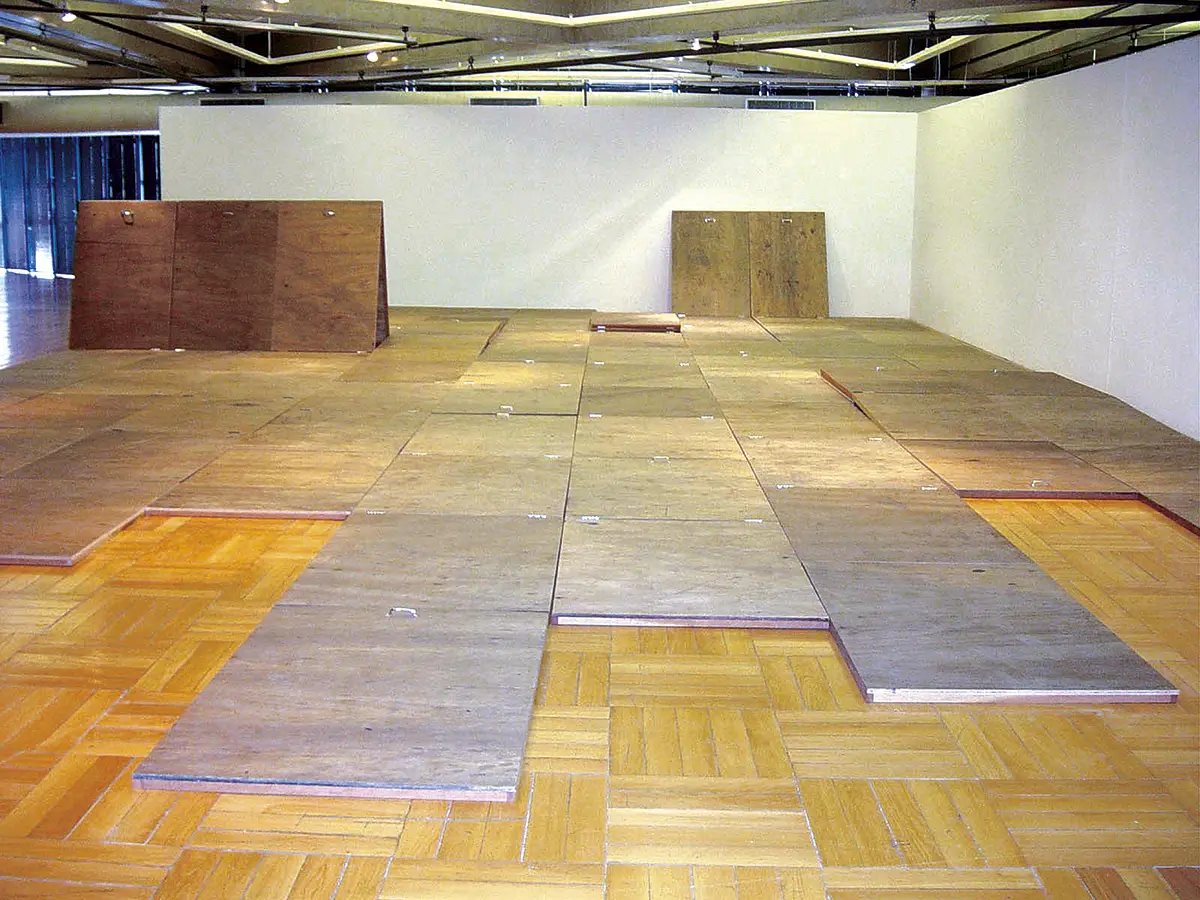
Part of the Palace’s floor was similarly subjected to the same asphyxiation by Falha (2003). This installation covers the floor with a large structure made of wood planks outfitted with switches, joined by hinges that can be rearranged vertically or horizontally. The piece proposes another game of “editing” doors; this time around, the viewer can modify the gallery’s dimensions. It is 10 x 15 meters of wood, arranged in layers or not, suggesting traps hidden underneath. The measurements correspond to the section of the exhibition space assigned to each artist selected for the “Project Season” shows at the Paço das Artes, a series devoted to young artists. However, when the planks are suspended, they reveal nothing by the museum’s surface.
Leaving aside any symbolic reading carried out despite their literalness, these two works hark back to the most evident aspect of Renata Lucas’s oeuvre: an intervention in the architecture of the space for which they have been conceived. Since 2001, the artist has developed proposals that alter the internal order of the places where she exhibits her works, in order to understand the possible relationships established between a body and the area it occupies. Lucas’ investigation starts with the transposition into a sculpture of the antinomy between, on the one hand, the “content” (that which is contained) and, on the other, the container (that which contains.)
Barravento (2001) covers the gallery’s concrete walls 10, 20 x 3, 60, with panels of the same dimensions, reproducing a gallery inside its own original. The wood panels that usually cover the exterior of a building in progress, are articulated by hinges that allow the visitor to move the temporary walls and redistribute the space. In Comun de Dois (2002), the artist superposes a new architecture to an existing one, building mud-brick walls between the two galleries, separated by a hallway. A distance of 26 centimeters between the original walls and the provisional ones allows access to the piece’s peripheral space, this is to say, to its surroundings.
The character of something created by chance and to be provisional is found often in Renata Lucas’ work. Another of her interests centers around passageways, in their concrete manifestation in architecture and also in their psychological component. An interest in passageways, recurring in contemporary art (Richard Serra, Bruce Nauman, Michael Heizer, and Dan Grahan) indicates not only the transition from a static sculpture but also brings forth, in its essence, important issues related to the viewer’s participation. The subject of Renata Lucas’ work is equally involuntary, those who pass by Anti-Fogo without perceiving that their steps and gestures give meaning to the work, like those who strive to transform the configurations of Barravento or Falha. In other words, Lucas’ works leave aside modern autonomy and inscribe themselves in common space, in the world, while at the same time guaranteeing for the viewer the otherness necessary to pursue this space, which, for a time, is also the space of the work.
JOSÉ AUGUSTO RIBEIRO