Despite what you might think or hear, the discussion of art in New York City hardly rises above a whisper with the exceptions of scandal or the biennial exhibition of American art at the Whitney Museum. The murmurs change to arguments, and less surprisingly, everyone has an opinion, whether or not they have seen the show. This year the street has taken up opinion against the New York Times critic Michael Kimmelman, who called it easily the best Biennial in years. The gallery professionals (or not), teachers, and art students call it tepid and rather uninteresting. But then yawns are considered a relatively normal, urbane posture in New York and are not to be trusted. Everyone truly loves matching their tastes, opinions, knowledge, and sense of history against the curators and directors. And that is generally what the Whitney Biennial comes down to interesting bits and pieces.
As is typical, many artists (108) were represented, making the exhibition a formidable undertaking. It operated under the new rules for “americanization”: anyone born in the United States and working in another country, and anyone working in the United States regardless of their nationality. The definition was announced to great fanfare and statistics in 2002 and I wrote at the time that we should follow the consequences with interest. Unfortunately, the 2004 Biennial did not choose to pursue the opening for diversity in the Americas, but collapsed it into a bicoastal, U.S. exhibition that was not especially national or global in distribution.
An informal count places almost all the artists (except for eight) working in the United States with about sixty of those in the Northeast area, the same number as in 2002. Of the roughly fifty remaining artists, representing twelve states, about thirty are from California, mostly from Los Angeles. Fortunately, thirty of the artists were born in twenty countries outside the United States and several l—but not enough for this reviewer— brought fragments of an international perspective. Generally, the exhibition reflects internal U.S. concerns at a time in history when globalization has presented numerous challenging corridors into a larger world. It would not be unfair to suggest that internalization is a natural part of a conservative U.S. reaction to the forces and issues swirling around it today. In that sense, the Whitney Biennial, seen as a snapshot of a conservative and tentative culture, maybe the most honest show in the nation.
A second initiative established in 2002, the decision to include architecture and design, was kept alive but barely. Architects were not exhibited but an artists’ collaborative known as SIMPARCH constructed a large walk-in structure from prefabricated metal as a viewing and multi-media space. One designer, Andrea Zittel, showed a videotape of the work that has absorbed her since the early 1990s, designing mobile, modular structures for compact living, but now occupies her from a new twenty-five-acre compound (named Z-West) in the high desert of California. This reviewer is a fan of both their past efforts and their orientation to design as a practical intersection with life. But these two projects, by nature and context, seemed more a cartoonish display of artistic ego than practical applications of technologies to resolve or intersect real-time cultural problems. Instead, the “survivor” mentality vaguely communicated in Zittel’s desert enclave and SIMPARCH’s metal media-center container appeared more as distant disdain rather than their usual, relevant practicality, as if the culture has yet to awaken and become serious. Many other works in the exhibition embodied this ambiguity, which comes as a surprise appearing at a time in U.S. history that is so overtly polarized.
Overall, technology and digital art, which emerged as strengths at the Whitney under the support of the outgoing director, Maxwell Anderson, were present, but in a limited fashion. The curators argued that the absence of technology in the exhibition was indicative of a “low-tech” approach they find in the arts today. They felt that artists now hold a skeptical attitude toward technology and “the utopian hopes for its positive global impact” and chose instead to place greater emphasis on materialism and process.
I read the absence of technology differently since no tech- or science-based artists I know ever considered utopia as more than an option for the simple-minded. The recent strength and complexity of science as a paradigm and the emergence of what is currently called the “new grotesque” —recognition in the arts of the downside of science, technology, and culture— argues a different and more complex case than the curators present. But if low-tech is the dominant approach today rather than simply one development among many, then where is the design and architecture that should follow?
One exception to low-tech was the work of the so-called Velvet Strike team for their online video game intervention. It follows Anne Marie Schleiner’s long-standing commitment to the development of “modifications” that can be inserted into the codes of commercially produced games to change their orientation. She and Brody Condon (from Tuxpan, Mexico, living in Los Angeles) and Joan Leandre (from Barcelona) teamed here to allow players of the internet combat game Counter-Strike to spray protest posters for peace into its matrix while playing. For more gender-bending fun, see Schleiner’s female inserts for “male” games at www.opensorcery.net.
Two other delightful innovations from 2002 continued: the off-site installations and the Friday night performances. Both continue to argue for art as diverse, expansive, and social. The best place to experience the cultural vitality of the synthesis between art and technology was at the Friday night musical performances of the collaborative known as Beige (founded by Cory Arcangel) and their off-site conjunction with the techno-punk Tracy and the Plastics and the techno-engineers Golan Levin and Zachary Lieberman. Of course, when it comes to raw energy, it seems impossible to top the collaborative performance and musical cabaret team from Los Angeles, Los Super Elegantes, Martiniano López Crozet, and Milena Muzquiz, who returned from the 2002 Biennial with several works in 2004.
The film and video components of the Biennial continued to be prominent, and now with greater success in their availability, the fourteen separate viewing programs of 2002 were reduced to five. Although it also meant a reduction in the number of films and videos shown, I did not find the offerings as strong and influential this year. However, there was an extensive homage to the recently deceased (2003), Canadian-based experimental film legend, Stan Brakhage. His hand-manipulated, often cameraless, films did as much as anyone in the second half of the twentieth century to liberate film from preconceptions of representation and narrative. His work also proved its timeliness once again, given the recent return of abstraction in much art of the past two years.
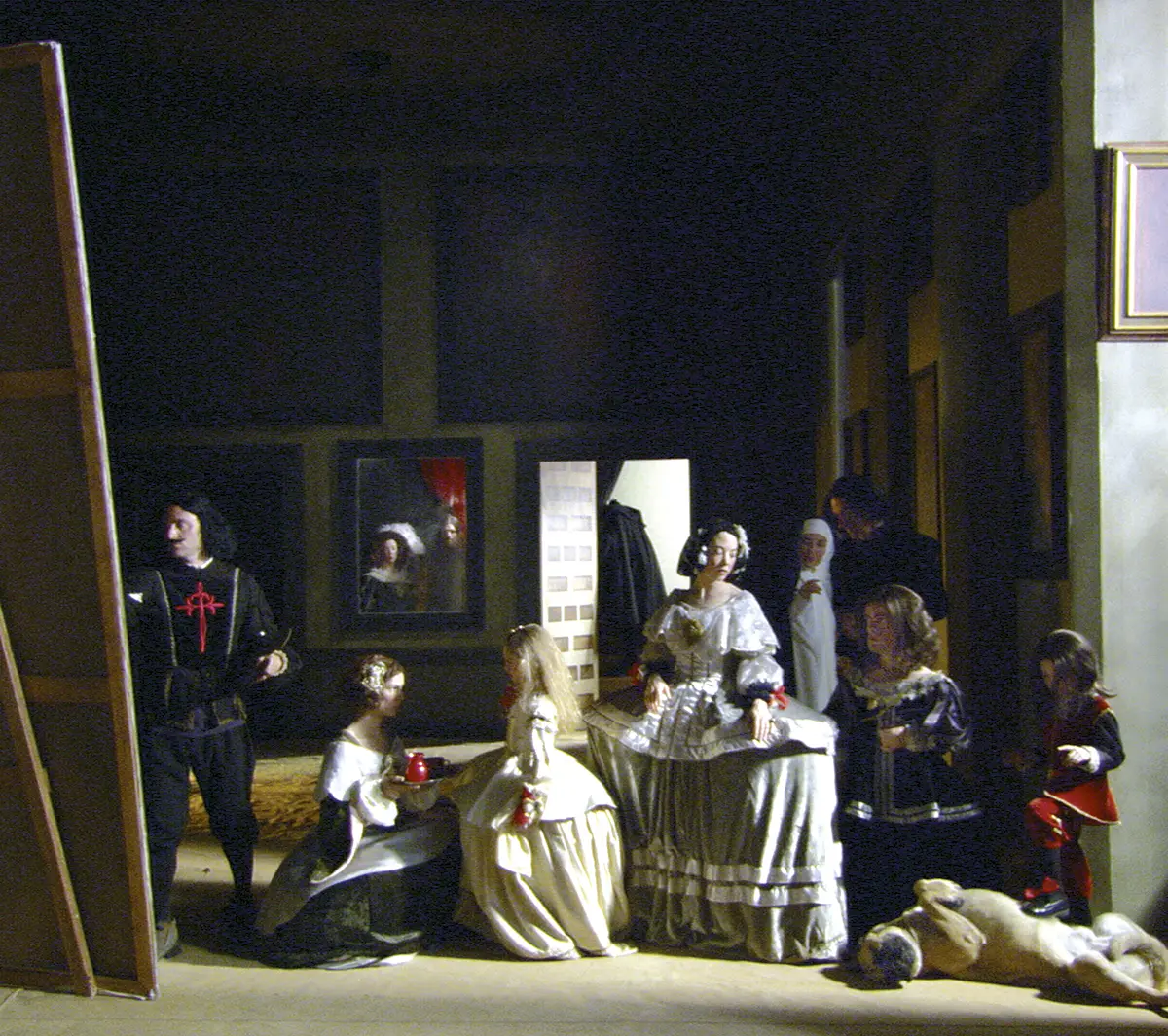
One of the more remarkable videos titled 89 Seconds at Alcázar was from the London-born Eve Sussman. Her twelve-minute high-definition and color-saturated projection recreated what might have been the activity before and after the much debated moment represented in Velázquez’s painting, Las Meninas. It reminded us of what we often forget: paintings, hence art, are also slices of life whose meaning at the time is unclear. A second video I found effective was the last part of Deborah Stratman’s thirty-three-minute film In Order Not to Be Here. The many references to emptiness and surveillance cameras at the beginning were less effective than the last seven minutes of helicopter footage shot in the night-vision green of a figure running from we know not what, while a radio broadcast of an unrelated arson report plays over it. When the figure “escapes” by jumping into the river, we silently cheer for every man/woman running from “here” at this point in history.
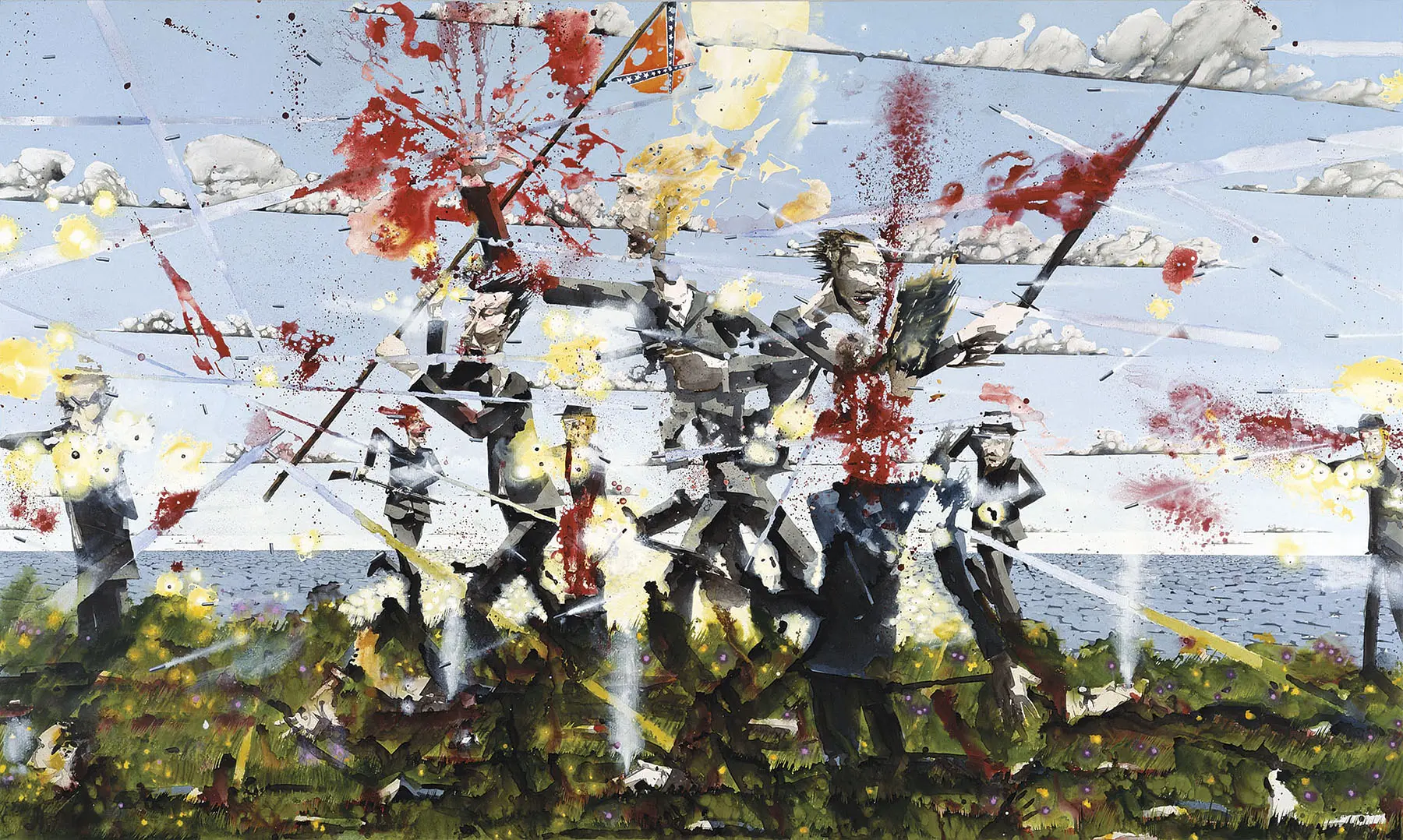
The most remarked, even heralded, change from previous Biennials has been the return of a large number of paintings and drawings. Their strength or weakness remains open to heated debate, but for many, it is a popular inclusion and reflects the fact that painting studios in art schools across the United States are filled. Their return may be interpreted as conservative, but the curators were correct to stress the two media as a result of the renewed nationwide interest in the manipulation of materials. Painting and drawing never die but only establish interesting rebirths. However, few believed this was a moment of rebirth based on what Whitney presented. I found especially poignant the inclusion of Barnaby Furnas’s paintings. Hamburger Hill (2002), for example, portrays all the bloody mayhem and confusion of war precisely because its style is unbelievable: history painting updated through video game animation. I remember having my class of twenty-year-olds on the streets of New York the morning of 9/11/01 discussing the nature of the unbelievable real-time video played out before their eyes.
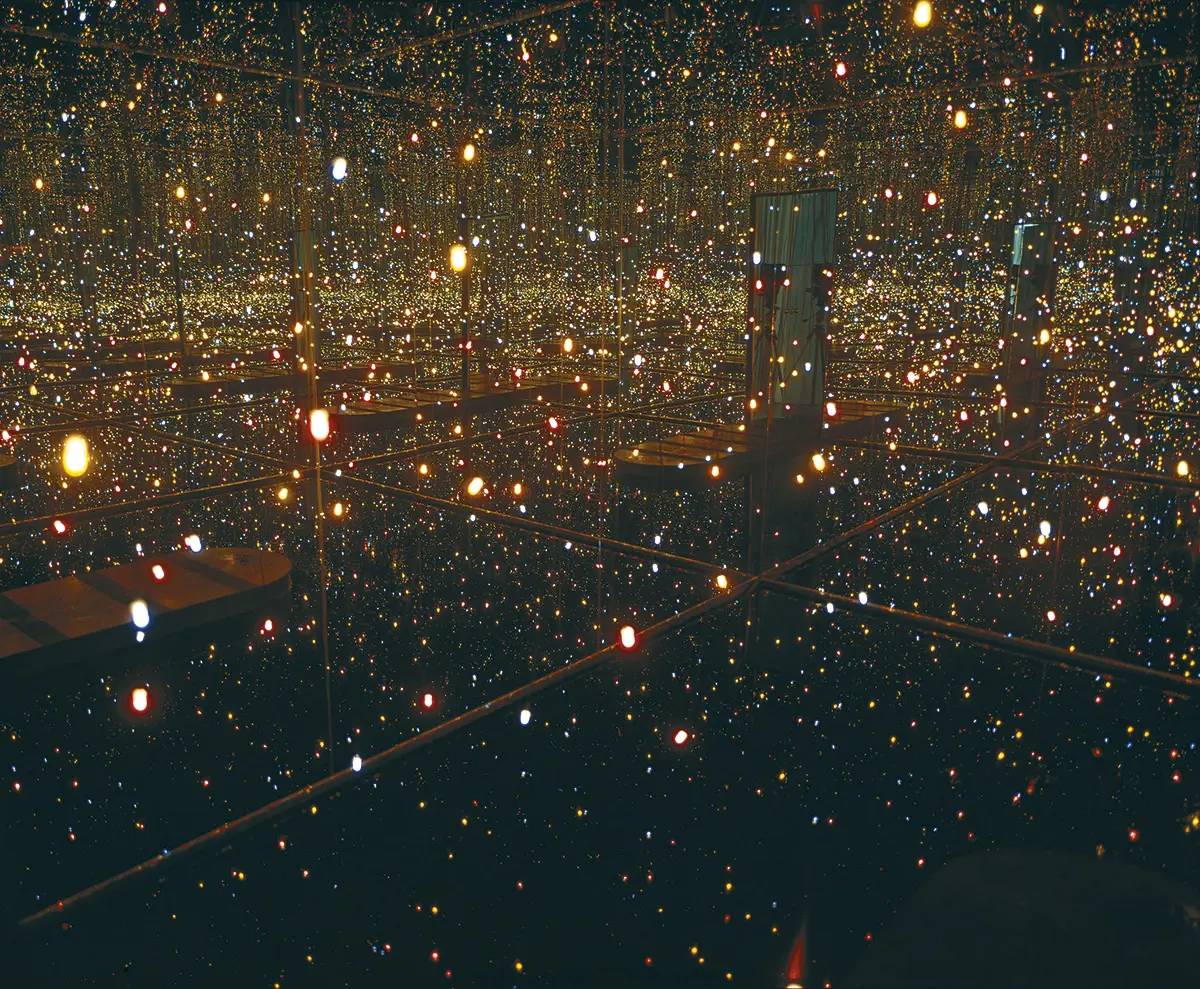
The U.S. population, and not just its youth, has a problem with the perception of such realities. By consensus, the most popular installation in the exhibition was Yayoi Kusama’s mirrored room Fireflies on the Water (2002), whose continuous reflective interior walls and pool of water beneath the viewer’s feet bounced the 150 suspended, colored lights into disconcerting but beautiful and ethereal non-sense: the loss of the body in aesthetics. But at the same time, her Central Park installation of hundreds of silver balls flowing across the water with the wind and sun reminds us that this beauty emerges out of systems moving together. The sense of escape in both works may not be on mere aesthetics but is equally rooted in the concept of our own powerlessness.
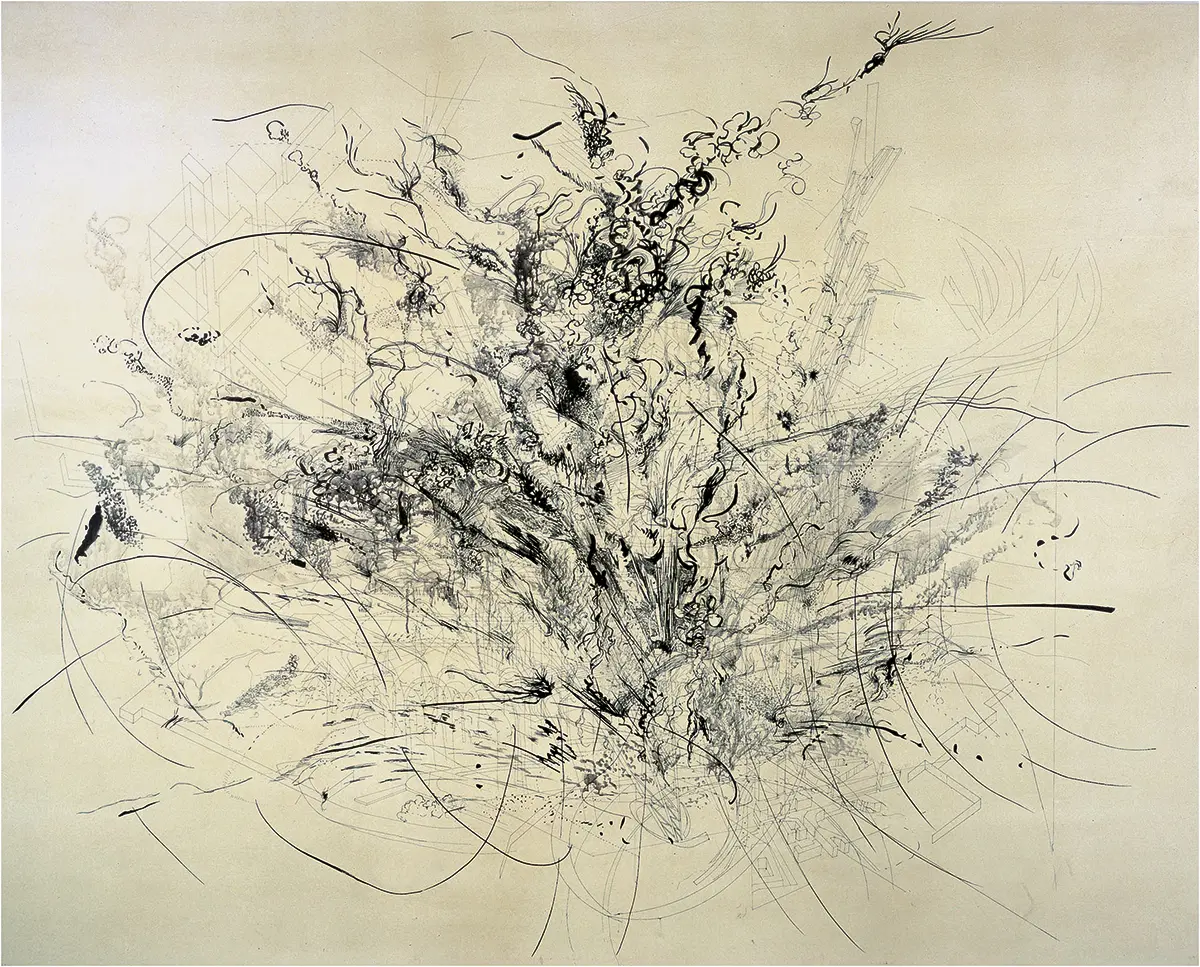
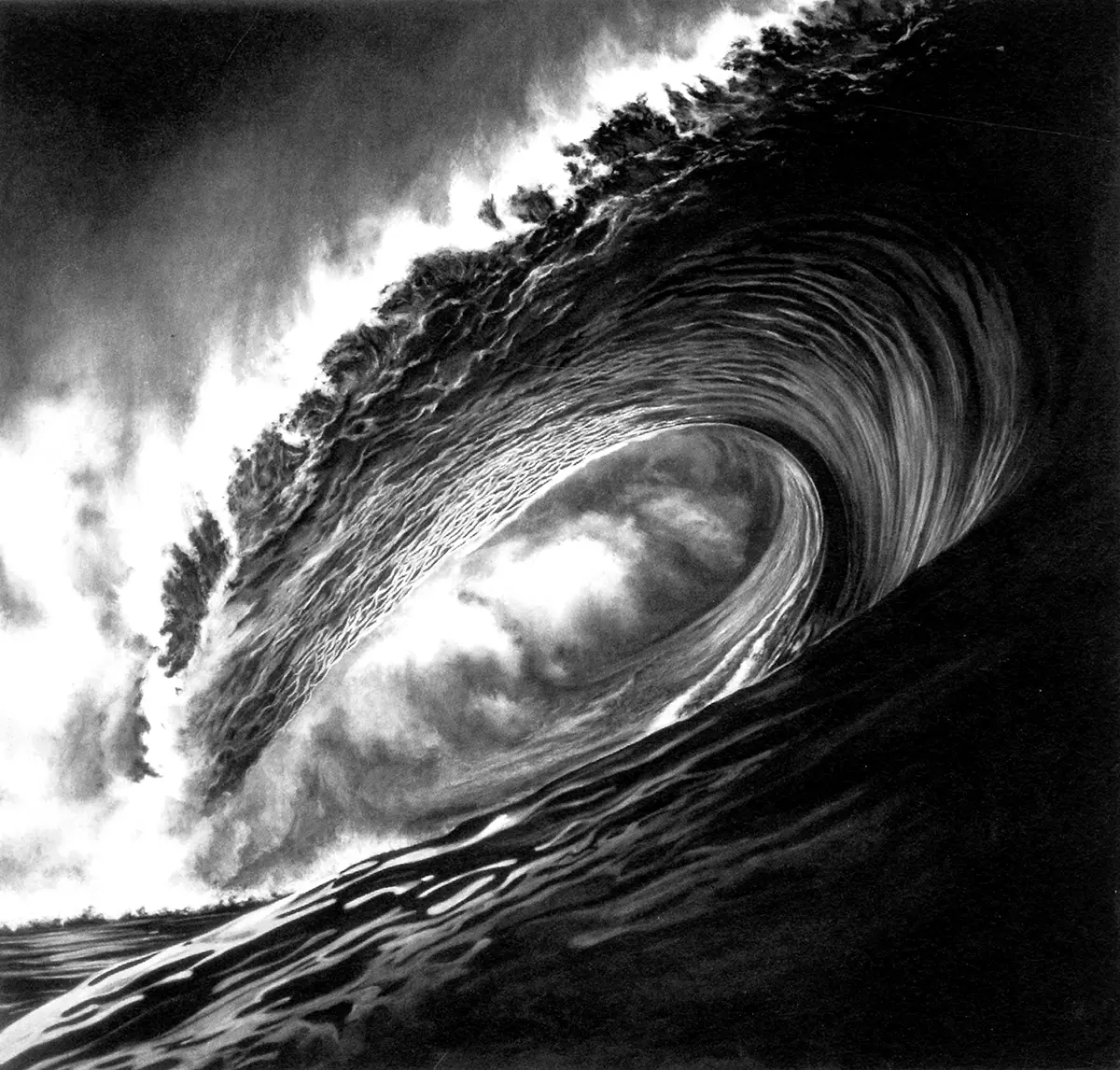
In the return to drawings, it was the older artists who seemed more powerful in today’s socio-political context. Robert Longo’s three large waves were exquisitely rendered in charcoal and continued his life-long interest in the intersections of power and powerlessness, control and loss of control. They become perfect meditations of contemporary culture and history. Raymond Pettibone’s long-established, energetic ink scrawls clustered on walls were harnessed specifically by the artist to a war waged by America and seemed to be the only truly explosive work in the exhibition. However, the younger Julie Mehretu’s layered and compressed combinations of drawings and paintings, such as Empirical Construction, Istanbul were fascinating and not only charged with complex undertones, but also were structures gone awry, as if feeding off themselves, but so solid they were not likely to dissipate.
The few photographs displayed continued their 2002 return to documentary and social commentary rather than being the vehicle for postmodernist conceptualism. Indeed, there was little of what one could consider “pure” conceptual art anywhere, although the sculpture and installations remained driven by concepts as much as by materialism. One touching example was the photographs and text of Emily Jacir’s recent project Where We Come From (2001–03). By using her American passport and asking Palestinians what she could do for them that they most wanted, she made personal the simple facts, differences, and consequences of the confinement of a people. Her photos and text recorded tasks from paying bills to visiting and experiencing graves, towns, and families in place of the displaced: rights of (non)passage born of an accident of birth and specific historical forces that are all too real.
Diversity was one of the claims made by the curators, although this reviewer found less of it than in the past. Older, established artists were included whereas it is usually the young and underrepresented who are stressed in the Biennial. While many of the artists were born in the 1970s, the presence of the older artists strengthened the exhibition overall and generally supported the curator’s claim of an “intergenerational dialogue” taking place in parts of the American art world at this moment. Whether there is synergy across three generations remains an open question that future exhibitions can answer.
The socio-political claims made for the exhibition were twofold: first, a number of artists are concerned with examining the political activism of the 1960s and 1970s, a fact that was apparent in several of the works selected. The second claim was that much of the American art world is related to “the cultural climate of post-9/11 America” and motivated “by the seismic global political and economic shifts” of the 1990s and the end-of-millennium. Made more dramatic, the curators claimed that the “anxiety, fear, and an uncertainty…has triggered a profound response.” Leaving the question of profundity for the judgment of history, the curators did select works that reflect the uncertainty of generalized fear that is abroad in the United States. But both they and the works left open the deeper questions and possible consequences of such a climate.
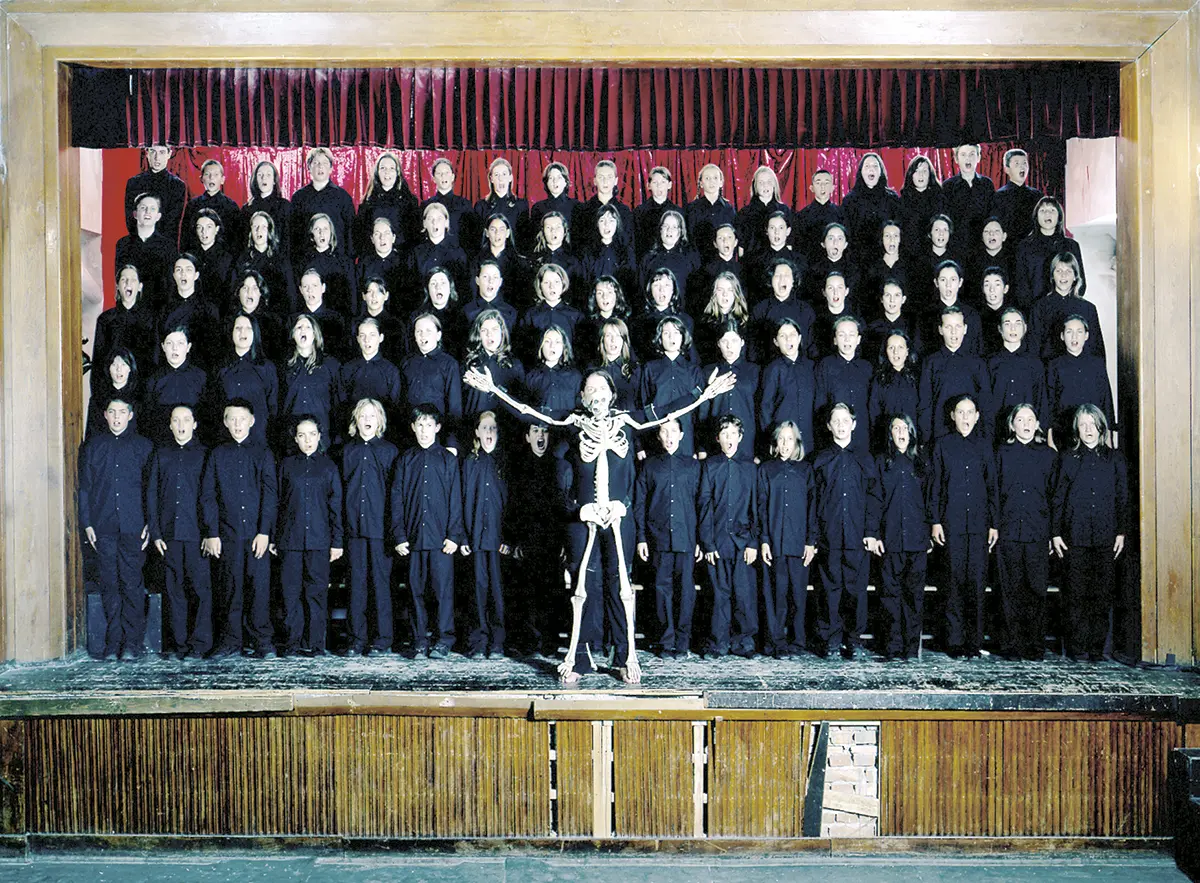
Art that reflects upon past political activism could be a prescient indicator when advanced by experienced and progressive artists such as Mary Kelly. She projected a composite picture of the street actions in Paris in May 1968 —a time and acts that galvanized many through the temporary union of workers and intellectuals— made from her now familiar blocks of ephemeral lint. But its purposeful degree of abstraction and the flickering projection lamp delayed the viewer’s pattern recognition in order to have the picture and our vision function in the same way as memory. I read it as the art world trying to remember a vague call to arms that was effective, a time when artists actually helped script political street action. Hopefully, we can look back to see this —along with the documentary film by Sam Green and Bill Siegel on the history of the Weather Underground, and Andrea Bowers’s drawings after photos of old political photographs— as the art world rubbing sleep from its eyes as it looks to the past in order to formulate the future. Yet when one compares these to a more global perspective, they seem pale. Marina Abramovic’s five-screen video projection, Count on Us (2003), was a response to the failure of the United Nations to aid Yugoslavia. Her powerful symbolism, which included the artist dressed as a skeleton, leading a children’s choir from the United Nations in hope for the future, brought history crashing down on unfulfilled promises.
The reflection of fear and anxiety is far more complex. There is little in the exhibition that is overtly political, but that admits the simple truth: there is and should be problematic and mediated relations between art and socio-political activism. This is not the place to develop such an extended essay, but the organizing curators —Chrissie Iles, Shamim M. Momin, and Debra Singer— were right to see much art poised between, rather than galvanized into, action at a time when the relation of the individual to monolithic forces is somewhat terrifying to contemplate. However, the present, more reticent position of art does not relinquish the crucial function of the art world to create spaces to subjectively consider what passes as objective facts.
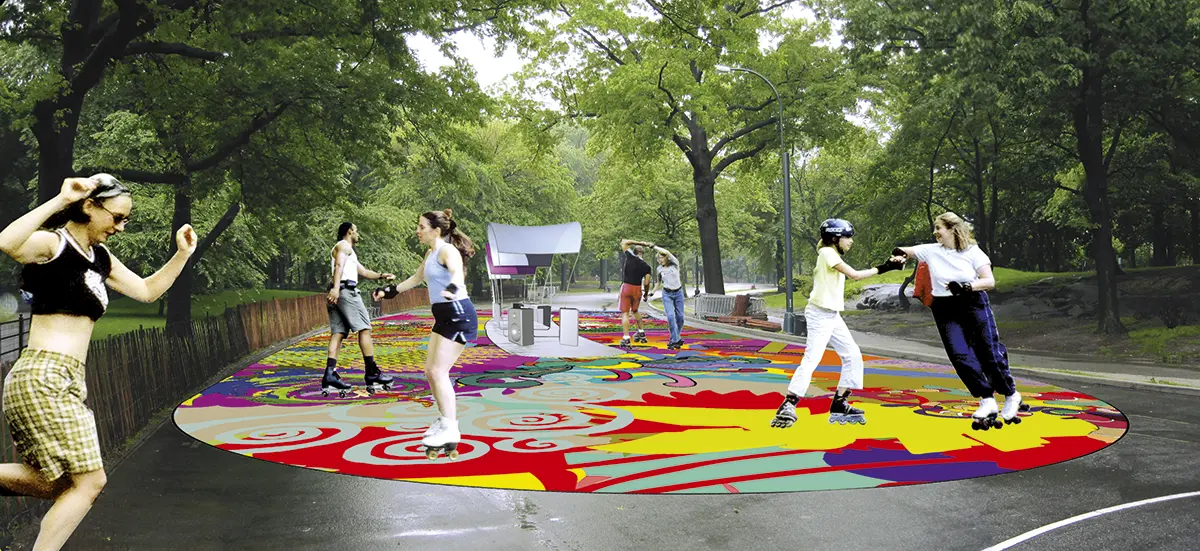
David Almejd’s installation used desiccated monsters, mostly the heads and body parts of wolves, to reference the mythical transformation of man to beast, but its title, Delicate Men in Positions of Power (2003), pointed to contemporary U.S. politics. Dario Robleto of San Antonio created sculptural forms from admixtures of materials that literally embody the narrative from the physical manifestations of past cultural moments —old, melted records; glass formed from atomic bomb tests; garbled audio recordings; dust from human bones— using death and decay to carry indirect but charged messages and warnings to the future now alive in the present. The work of the Argentine-born, Minneapolis-based Santiago Cucullu was also direct in its circumspection. His large, site-specific wall mural made from contact paper Untitled ... the gestation of anarchism in the New World Schlaraffenland (2004), typically references several historical events and characters that mix with personal reminiscences to remind us that it is our narratives, the ones we build from these mixtures of the real and the imagined that construct the world and its meaning. Even the light-heartedness of the brightly colored pop-a-delic installations of the Brazilian-born artist known as “assume vivid astro focus” (a.k.a. Eli Sudbrack) could be made to intersect local histories. While his mixed media room at the Whitney is happy, bright, and relatively trivial, his printed vinyl flooring for the skate circle in Central Park assumed socio-cultural weight. With the help of Rama Chorpasm, who designed the DJ Booth, they examined the contentious ten-year relationship between the Central Park Dance Skate Association and the park authorities and consciously intervened to help ease those tensions. Resigned to the temporality of their installation, they used it to help reshape community dynamics.
Commentary
This is a time when the issue of globalization has been brought home to the United States for all the wrong reasons: terrorism, expanded markets, and neo-colonialist wars. The 2002 Whitney Biennial recognized that fact when they changed their criteria to include an internationalist perspective in a survey of “American” art to engage that crucial conversation. Thankfully the discussion is not over. Even political observers now recognize that culture is an important part of their world systems theory. Simply translated, that means artists and cultural mavens have important roles to play.
The 2004 Biennial organizers are to be complimented for their efforts to include works that embody an American sense of fearfulness and reticence as an accurate pulse beat. But for this viewer that is insufficient because there are more direct and engaging issues in our time of immense historical importance that have been addressed in powerful ways by artists and designers who are not in the exhibition. Their issues and contributions, and most importantly their dialogues on globalization and the role of culture, are represented in the arts through smaller, progressive exhibitions across the nation and the world. I find the absence of these issues and some of these artists disturbing. It is Whitney’s prerogative to be a conservative institution. And it is a common belief among many, not all, curators that they objectively sample the environment for what is already present: curator as a reporter. But that neatly overlooks their own subjectivities and their own role in shaping the future by declaring the present.
This is a time when the stakes are high and the contemporary art institution’s claims to relevancy are the ones made within what is supposedly a cultural domain that represents itself in the world as dynamic, progressive, and yes, even liberal. (We no longer use the extremist term “leftist.”) There are issues present in our world beyond our internalized fearfulness, reticence, warnings, and digressions on how the political activists of the 1960s and 1970s were represented in news media. I would like to see more of the art that actively positions itself in the more dynamic and global dialogue.
RICHARD LESLIE
Historian, critic, and curator living in New York.