
Artist and photographer Antonio Briceño carried out an investigation into the oral traditions of ethnic groups that have preserved their ancestral beliefs (intangible patrimony), with the purpose of creating a contemporary archive of beliefs in the Americas. Between 2001 and 2003, Briceño lived in communities of different ethnicities: Huichol in Mexico (thanks to a residential fellowship for artistic creation given by that country’s government); Piaroa and Pemon in southern Venezuela; Kogui and Wiwa in the Sierra Nevada of Santa Marta, in Colombia (thanks to a residential fellowship from Colombia’s Cultural Ministry and Venezuela’s National Council on Culture, through the Arts Residence Program of the Group of Three). A biologist by profession, Briceño is conversant with the scientific method of isolating and differentiating the object of study. His approach to the magic world of the ethnic groups he explored is poetic and artistic, one of discovery and closeness. The source of his images is found in oral tradition. “The Huichol word for shaman is marakaame, which means a singer. Early during my stay with the Huichol in the western Sierra Madre, a shaman said to me: ‘We don’t have books like your Bible. We have songs. That's where everything is.”
The artist did a graphic development of the myths he compiled during his time with those communities by combining the techniques of documentary photography with digital photomontage. The show presents fifteen cytochrome prints ranging in format from 120 x 120 to 100 x 230 cm. These images are American allegories of great plastic beauty: gods, lords, owners, and sons of the great forces that, with their attributes, move from oral tradition to contemporary art representations. The show’s curator, Luis Ángel Duque, highlights Briceño’s work as “mythographer,” comparable to the work of many other compilers of beliefs, legends, and songs from Hesiod in antiquity to the work of Fray Cesáreo de Armellada and Marc de Civrieuxºon the Pemón and Yekuana ethnic groups in the twentieth century.
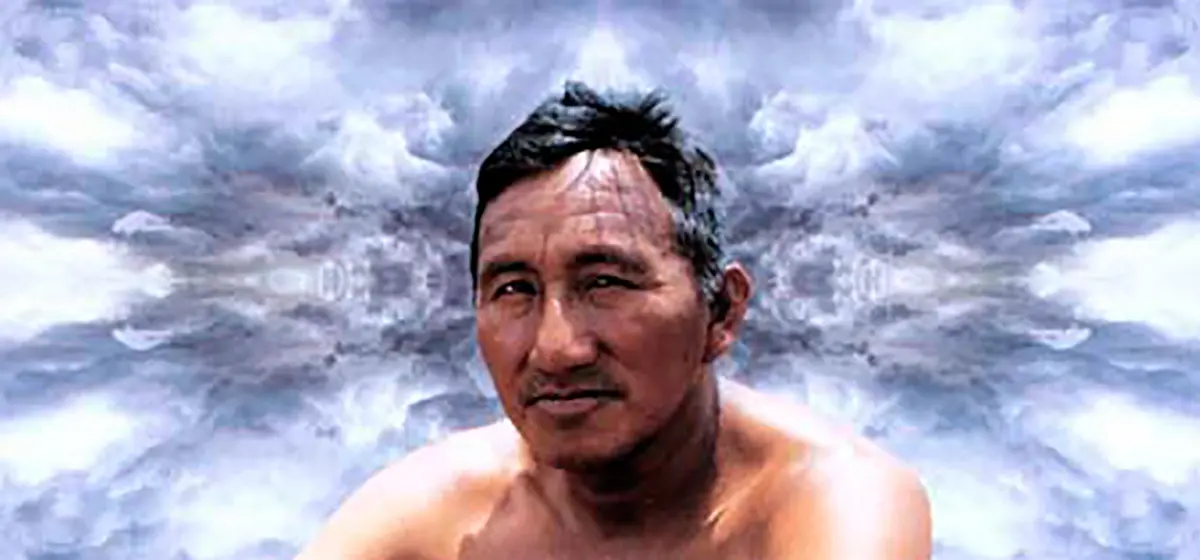
Briceño’s efforts do not result in a representation but in an interpretation, through technological media, of the images that came to him in words. They are free interpretations that stand at varying degrees of closeness to the stories from which they originate. For example, the story of the lady of coca, who sprouted leaves from her hair, is textual, and Briceño represents her just like that, like a Roman flora. Buka is the Piaroa god of creation and imagination, who arises from the thoughts and visions of the wind. Before him, nothing existed, and Briceño represents him amidst a nebulous and chaotic movement that starts to self-organize. But the attributes of the daughter of the chili pepper, a Pemona narrative, are not specific; they are an invention of the artist, within his spirit of reverence towards natural phenomena. Briceño brings Western viewers closer to the Piaroa, Pemona, Huichol, Kogui, and Wiwa cosmologies, in that way facilitating understanding of the existence of a magic world. Digital photography allows him to perform such acts of magic as rendering heavy things light, or having rocks float, ethereal, above the head of the God of Peyote. The images we observe emerge from Antonio Briceño’s imagination, stimulated by ancestral stories and materialized through digital photography. Briceño’s poetic images of ancestral beliefs have titles in the corresponding language and in Spanish. The lords and ladies (of cotton, of coca, of forests) correspond to the Wiwa and the Kogui, from Colombia. Briceño explains: “The Kogui think that there are lords and ladies—fathers and mothers—not only of the big natural forces but also of each and every resource. Tribute must be paid to them, both asking for their permission to use the resource and as a payment after the use. In this way, they maintain a permanent relationship of respect and exchange with the infinite generosity of Mother Earth, and the awareness that nothing should be destroyed or wasted.
It is this awareness that allows the Kogui to think of themselves as the guardians of life on the planet.” The gods and goddesses of fertility, of creation, of water, and of purification, are images from Piaroa thought; those of fire, corn, water, and the “wisest one,” come from Huichol culture. In each case, the composition presents a central figure belonging to the corresponding ethnic group, and an intervened natural background, generally with axial symmetry. They are large figures against backgrounds of a supernatural appearance: skies in a heavily saturated blue, symmetrical forests, white backgrounds in reference to cold and snow, or black to highlight the figure with the chili pepper necklace. They are also somewhat hallucinatory images as if taken from a dream, that agitate the subconscious with their symbolic charge.
SONIA CASANOVA