The distribution of the work in series allows for a focus on the different emphases of signification that have found an exact translation in his form and technique. Photographs, strange metallic murals, objects, and re-signified papers are all links in a possible reading of contemporary reality. A reading that is, at any rate, poetic, never nostalgic.
A nomadic artist linked to photography, design, the graphic arts, and set design, Gallardo needed another, more unnervingly inquisitive form of creativity in order to account for his haunting questions: Who, what, when, where, why? Aware of the impossibility of answering, Gallardo makes his questions explicit in a disquieting series where a rare coming together of heterogeneous materials provokes the viewer with a singular strategy. Nothing is what it seems, he seems to be saying, but at the same time, nothing is what it seems in his work, either. The formal perfection of Gallardo’s work, the balance achieved in its display, and the suggestive serenity of our walk through the exhibition, all hide an abysmal existential preoccupation that startles and activates us, placing us in the communicative plane demanded by the artist.
Abismal is the title of one of the series exhibited, in which photographs, the backs of mailboxes, clock quadrants, and pieces of typewriters reveal Gallardo as a tireless gatherer of objects, of urban refuse, of artificial human products that order themselves rigorously in order to dis-order us. This internal disorder forces us to seek in the other series the thread that connects them and the issues that tie them to one another.
The series Erratum, also photography, of piers in Antwerp, is linked in matching registers with poems by Olga Orozco, fragmented as epigraphs. Cranes, lamps, inscriptions, hooks, and the presence of death in a cross with attached text, all play with sentences like Pero jamás consigo estar completo (“But I can never be complete”) or No logro aparecer de cuerpo entero (“I can’t appear in full figure”) where, as in a two-voice chorus, today’s most pressing questions assume a desolate presence.
The rigorously composed murals of Perpetual motion, reliefs created with photographs, aluminum tubes, clips, chains, springs, and rubber tubes, show, amplified, the artist’s material repertoire and extrapolate the initial objective of its components, now resignified but which, like those lonely, docked boats in Antwerp, reiterate the question: What happens to that which no longer works?
A no-longer-working that comes either with the wear derived from the passage of time—a permanent obsession of this artist—or from the evidence of industrialization that doesn’t always coincide with the needs of man. Once again, a penetrating reading of the work undoes the mask of apparent calm of its presentation.
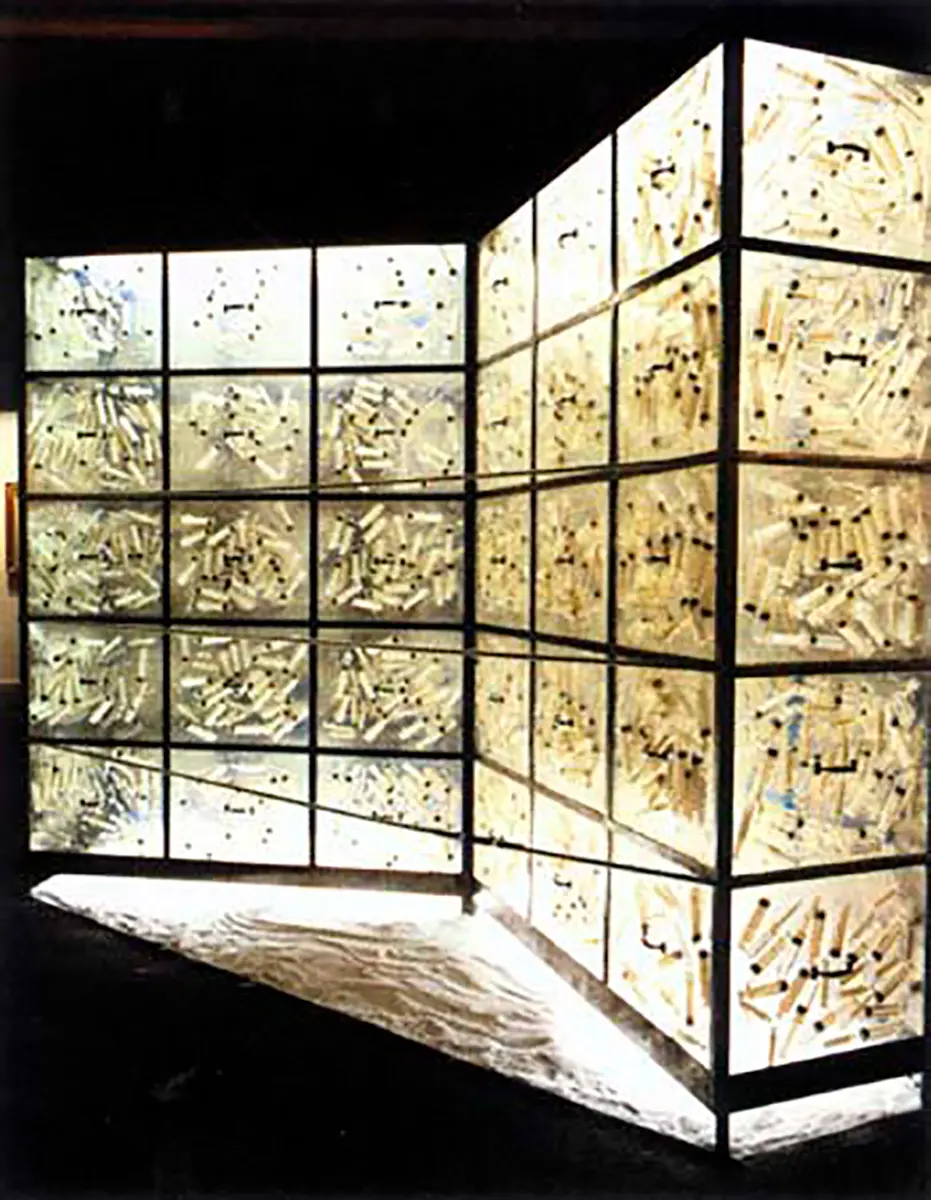
Chupasangre consists of a translucent screen, lit with 4,000 syringes beautifully arranged in quadrangles, rising from a slat-covered floor and surrounded by cables that advise against approach. This is an imposing work whose features tend to blur any excessively explicit allusion.
Speaking at the show’s inauguration, Dore Ashton located Gallardo as "one of those artists who keep alive for us the memory of fear and tragedy.” Whether personal or social, local or universal, fear and tragedy tell of the notion of loss, an allusion that hovers over a large part of the artist’s work (perhaps all of it?)
In Kronos, almanacs (are they still the ones he found years ago in Antwerp?) are sometimes joined to springs, and sometimes, as in Kronos Diáspora, to passport pages covered in acrylic gelatin. Similarly covered are the letters exhibited in the thirteen easels of the installation Finale. The passage of time, exile, loss, and the written register of a hand that fades away, strips cross-hatched cell bars—which we can’t tell whether they are internal or external—are some of the aspects of the space for reflection generated by the show. Gallardo helps us with a measure of humor. We find the metaphorical elements in the series Queen Size: La generosa; La fugitiva; La precavida are tense with parallel springs.
The show boasts an excellent catalog with interesting texts by architects Alberto Belucci, Dore Ashton, and Professor Lucas Fragasso.
NELLY PERAZZO