
Chagoya’s biography sheds light on the consistent conjunction of past and present seen in this and previous exhibitions of his art. Chagoya was born in Mexico in 1953 and has lived in the United States since 1978. He studied at the San Francisco Art Institute and the University of California at Berkeley and lives on the West Coast, working as an Associate Professor of Art and Art History at Stanford University. The iconography of Central America and the history of art form the structure of his aesthetic thinking. Various parameters observed in these sources are used freely, among them popular storytelling, a natural perception of myths and rituals, as well as a reflection on epic themes of history. In terms of immediate reality, the contemporary elements in his art come from the work of modern authors, pop culture, and a questioning impulse. The author does not deal specifically with Chicano issues, but with wider expressive visions that imply a universal vision. The idea of “yesterday/today” also interacts with the formal presentation of his work. The concept of the monumental, muralism, the billboard, and the spareness of the work coalesce in the large drawings. In the small drawings, the artist executes an appropriation or tribute to a 1971 series by Philip Guston with Richard Nixon caricatures; Chagoya switches presidents, and in the group of twelve drawings George W. Bush and his team constitute a tragically hilarious band. In both dimensions, we find a mastery of clean, simple, expressive drawing. The value of paper and its whiteness is an important element used to highlight pointed situations.
In his small format works (14 x 16 inches)—all titled Pobre George and numbered for their identification—political satire is achieved through various means. We find allusions to the comic strip and are faced with the elegance of the formal polyptych with which some professionals, especially in the field of medicine, cover their offices with diplomas. The viewer must read the need and the will that all those captured in the drawings of “poor George,” which include, without naming them, millions or more unfortunate beings, soon will be no more than a memory.
A highlight in the show is Desventuras de los Salvajes Liberados, a modern-day codex that confirms the artist’s academic background alongside his drive to be contemporary. This 8 x 16-inch piece approaches the codex—the pre-Columbian book—in a narrative, sequential vision, if not a mythical one. In the codex (which is read left to right,) Enrique Chagoya works on drawings, collages, and paintings on amate (a typical Mexican paper manufactured by weaving and pressing parts of a tree of the same name). In this piece, Chagoya posits real albeit altered histories. Although by different expressive means, this work deals with the same thesis of the show: the fragility of human memory, which seems unable to recall the unforgettable, thus historically promoting or accepting inhuman situations. In his iconography, Chagoya is a refined author, even when using the resource of caricature. He is undoubtedly familiar with the masterful caricatures of José Clemente Orozco, Guston himself, George Grosz, and other European artists during the World Wars. His description of the images is not insulting but rather points out situations that can not be ignored. In this format, and given the way in which it is displayed in the gallery, this piece acts as a historical referent, as reference materials placed on a long desk in a library, or almost as a window through which the remaining eighteen works from 2004 are pressing situations that this “stained-glass window” could shed some light on.
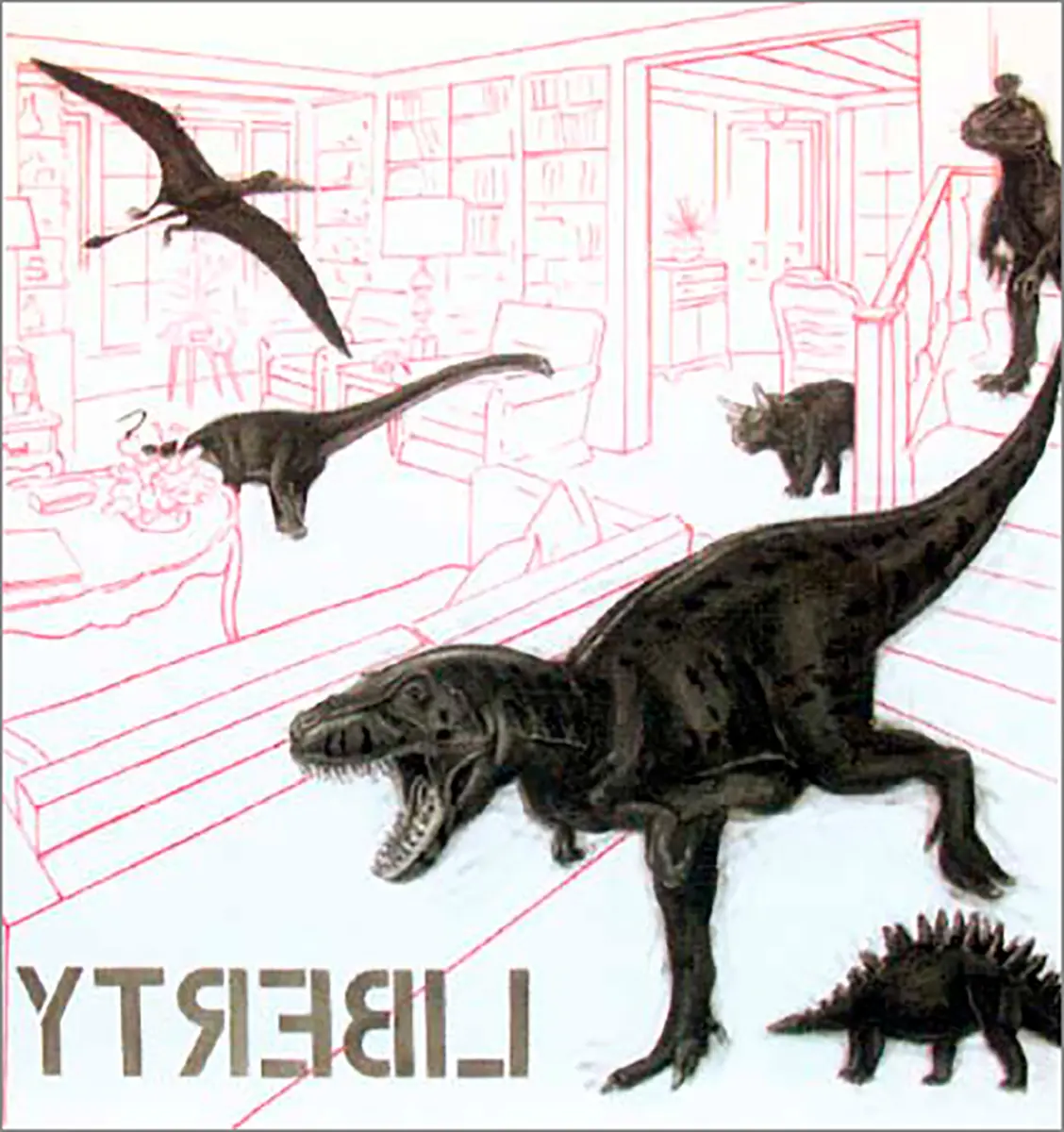
Throughout the exhibition the artist develops a metalanguage through which current political evidence is presented using various resources. This is understood as an aesthetic contribution and serves the purpose of allowing the viewer to think rather than to feel overwhelmed. In that sense, Chagoya uses various resources or filters, one of them being the naiveté of children’s stories. The most direct example is the piece identified with the story, Snow White and the Seven Dwarfs, in which George W. Bush appears accompanied by his staff and political companions. Some interesting elements in other works exhibited are the Bedouins, Arabic letters, and other elements that share their space in one work with a portrait of the current U.S. president depicted as a “cone head”; the word liberty also appears here, although inverted as if seen in a mirror, indicating that the flow of liberty has been altered, its course changed.
The codex is polychromed, the small drawings tend towards black and white, and the larger pieces are filled with red and black (the reds are used with particular care). The latter are executed on paper mounted on canvas; the codex includes transfers of water-based oil inks, acrylic, pencil, and collage on amate; the small drawings are ink on paper. There is coincidence in the use of materials and in the general ironic tone; everything is impeccable, clear, and profound. All markings seem to be charged with a wish: to see the historical memory of the people become active at some point. These drawings are intended to be didactic in the short and the long run. Part of the implicit wish here is the desire that at some point, in some measure, the orbit of historical repetition can be modified and redirected towards the good. The courage and the quality of this proposal are parallel to that of Tim Robbins in his play, Embedded, presented almost concurrently in New York. From their different fields, both artists remind us that with clear concepts and authorial quality, we can make a double commitment: to art and to life.
GRACIELA KARTOFEL