
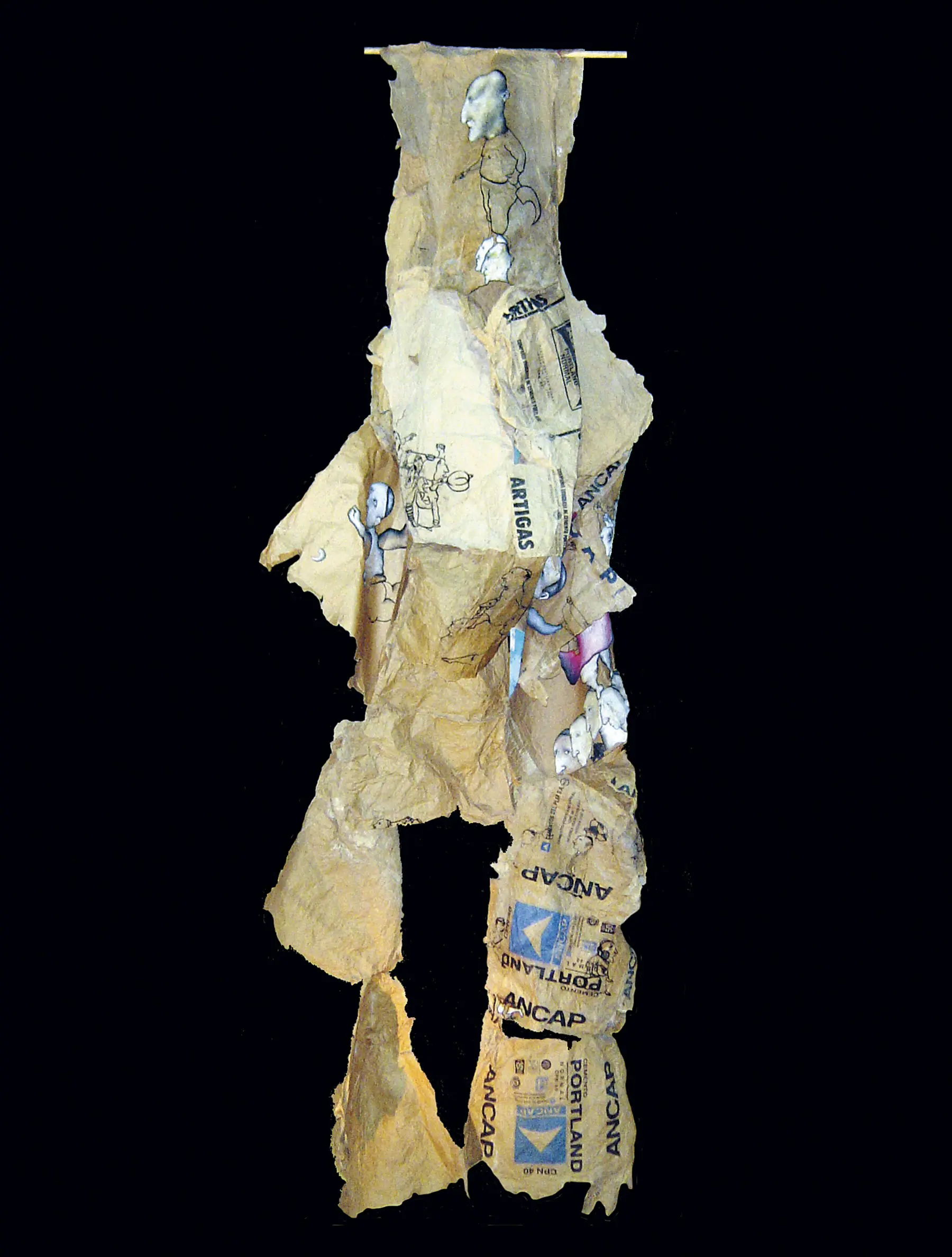
“By literally ripping the format established for this competition, the artist revitalizes the expressive possibilities of the standard, transforming it into an object that is also sculptural, powerfully articulated with the poetics of decay and recycling, especially in their most political versions. The resulting piece offers a suggestive commentary on the artist’s renewed interest in urban and industrial issues, starting with the piece’s very materiality. This fragments the apparent solidity of cement by configuring an unusual support for the caricature and salvages the most primary drawing as just another recycled item.”
With these words, the jury at ES 2004—III Bienal Internacional de Estandartes, VI Salón (3rd International Banner Biennial, 6th Salon), comprised of José Luis Barrios, Gustavo Buntix, and Yu Yeon Kim, announced its decision to award first prize to El muro de las promesas de trabajo, by Uruguayan artist Ricardo Lanzarini.
The piece was made using some twenty paper bags of the kind used for cement and concrete; it was these sacks that Lanzarini ripped and attached to one another in order to fill the space allotted for the Salon’s entries. The established measurements are 200 x 180 cm, and the standards have to be visible from both sides.
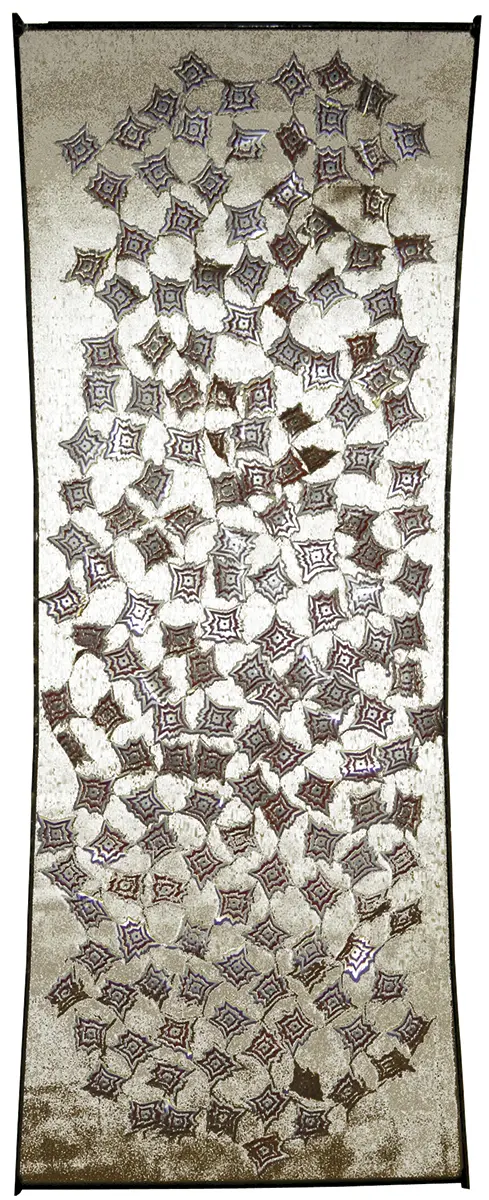
The second prize went to Mariana Gullco for Trans, one of the most impressive pieces seen at ES 2004, made with more than four thousand tea bags. “This discipline is part of the work I have been carrying out since 1995. I have worked many pieces with tea bags, pieces having to do with the recycling of everyday objects I consume, and with the reinterpretation of something that is garbage transformed into something else."1 It bears pointing out that Trans is the only piece in this version, and the first that includes smell, since the tea bags, which contain a variety of herbs, emit aromas that range from ginger to mint, chamomile, and anise.
Mariana Gullco, an Argentinean-born artist, had already achieved international recognition, in Mexico for instance, at the I Bienal Nacional de Yucatán, and earlier, at the Bienal de Monterrey, both significant events with important artists among their audience. Gullco is developing a body of work that wavers between the intimate and the public. By using tea bags, as she does in Trans, she not only reverses the object’s ephemeral character but also suggests an itinerary for the bags’ remaining life, as they are situated on the Mexico/U.S. border, in the city of Tijuana (the title of the piece adds to this as well).
This edition of the biennial event has included the most female participants: twenty out of a total of thirty-five artists. Among the more established artists, Betsabeé Romero stood out. She presented an untitled work that acidly commented on the dangerous conditions in Tijuana and also in Mexico City, where she lives, creating numerous “bullet holes” joined together to form an impressive chromatic group. These bullet holes originate in a series of decorative decals that are in fashion in the country’s capital, and which when affixed to a car’s body, simulate bullet holes left after a firefight. Romero revisits them, places those lines around them as visual echoes, and places them repeatedly on the cars of friends and acquaintances. Printed in Jan Hendrix’s workshop, these pieces are becoming better known every day precisely because of their ambiguous nature and their ability to redirect our reading of the popular bullet-hole decals.
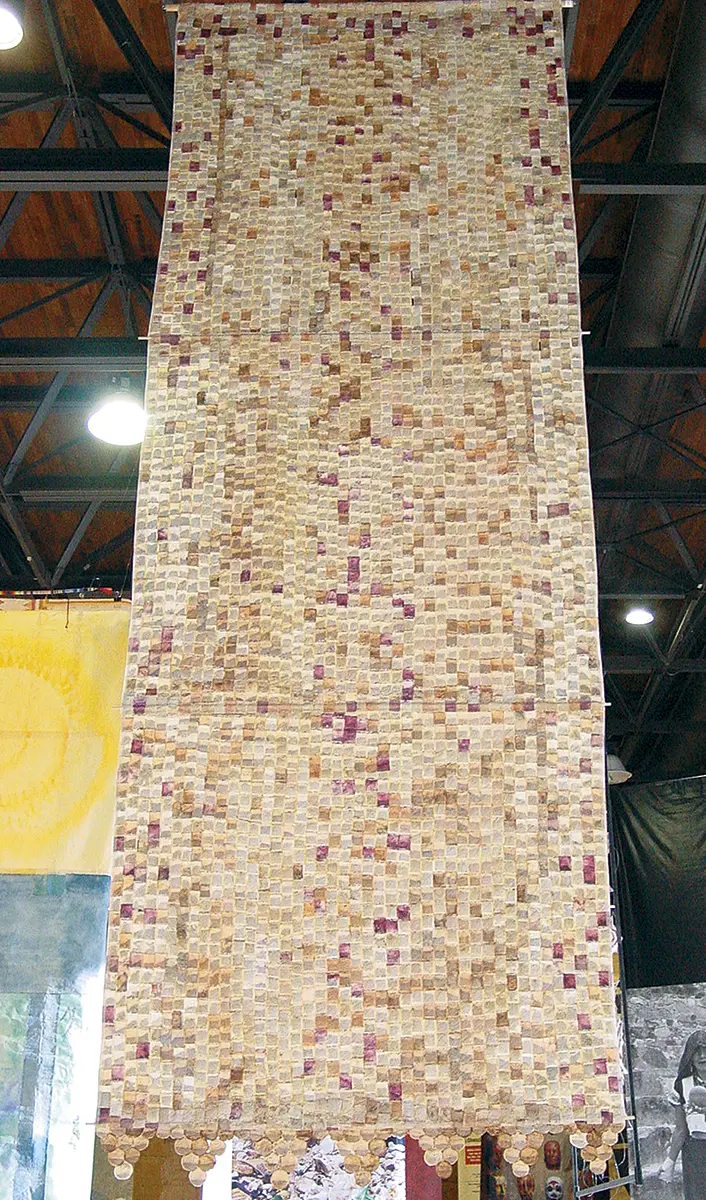
Esther Hernández revisits a piece she created some years ago and magnifies it to standard formats to propose a critical commentary (still valid) about the contamination of crops, the use of pesticides, and the insalubrious condition of the land. Hernández takes the well-known image of the Sun Maid raisins and renames them Sun Mad, replacing the young and healthy peasant maiden with a grape-picking skeleton.
Entering an important debate of unquestionable currency, Celia Herrera presents Un rezo para cuatro caminos. Using mainly watercolor on hand-made paper, the piece possesses an uncommon ritual and emotional charge. According to Herrera, the dialogue of indigenous cultures has existed for thousands of years, and current borders are only temporary spaces dividing the wide lands that in the past saw entire communities come and go freely. The colors blue and green, she says, are the sacred colors of the American continent. This piece, she has explained, is a prayer to water.
From perhaps a different perspective, but one that also points towards urgent ecological issues, Tomás Castelazo presented Globalización. This piece, whose title is self-explanatory, denounces with great clarity the pauperization of the desert and shows it filled with garbage complemented by the image of a little girl who smiles as she throws away an empty plastic bottle.
In recent years, this biennial has become an important space for a variety of artistic expressions, originally centered on border issues, and later on a wider variety of topics; its latest edition is perhaps a significant hinge between the former approach in the selection and evaluation of artists, and a new, emerging way of representing the most contemporary artistic expressions. These are well known to the curator, Marta Palau, thanks to her extensive experience in the selection of artists from different latitudes.
ES 2003 thus becomes an eclectic show that, precisely because of this character, gives us a clear notion of the artistic scene first in Latin America, and second in Mexico, especially in Tijuana, since the Centro Cultural Tijuana contributed a special incentive so that local artists “have an equal opportunity to participate” alongside creators from abroad (the thirty-five artists represent fourteen countries).
This is a very healthy biennial event, and many locals throughout Mexico are vying for a chance to host the show. In terms of the curatorship, this might be one of Marta Palau’s last attempts to select artists who normally work in traditional media and support them. Upcoming editions will open spaces for new technologies, new narratives, and new ways to approach whatever topics hold our attention, but above all—if the directive is to hang on firmly to the contemporary—the topics that impact the life of one of Mexico’s most vital and potent communities, the city of Tijuana, itself a border between our country and the United States.
NOTA
1. Cita tomada de la nota de Miguel Ángel Ceballos del periódico El Universal, México, Sección F (Cultura) del domingo 2 de mayo de 2004.
SANTIAGO ESPINOSA DE LOS MONTEROS