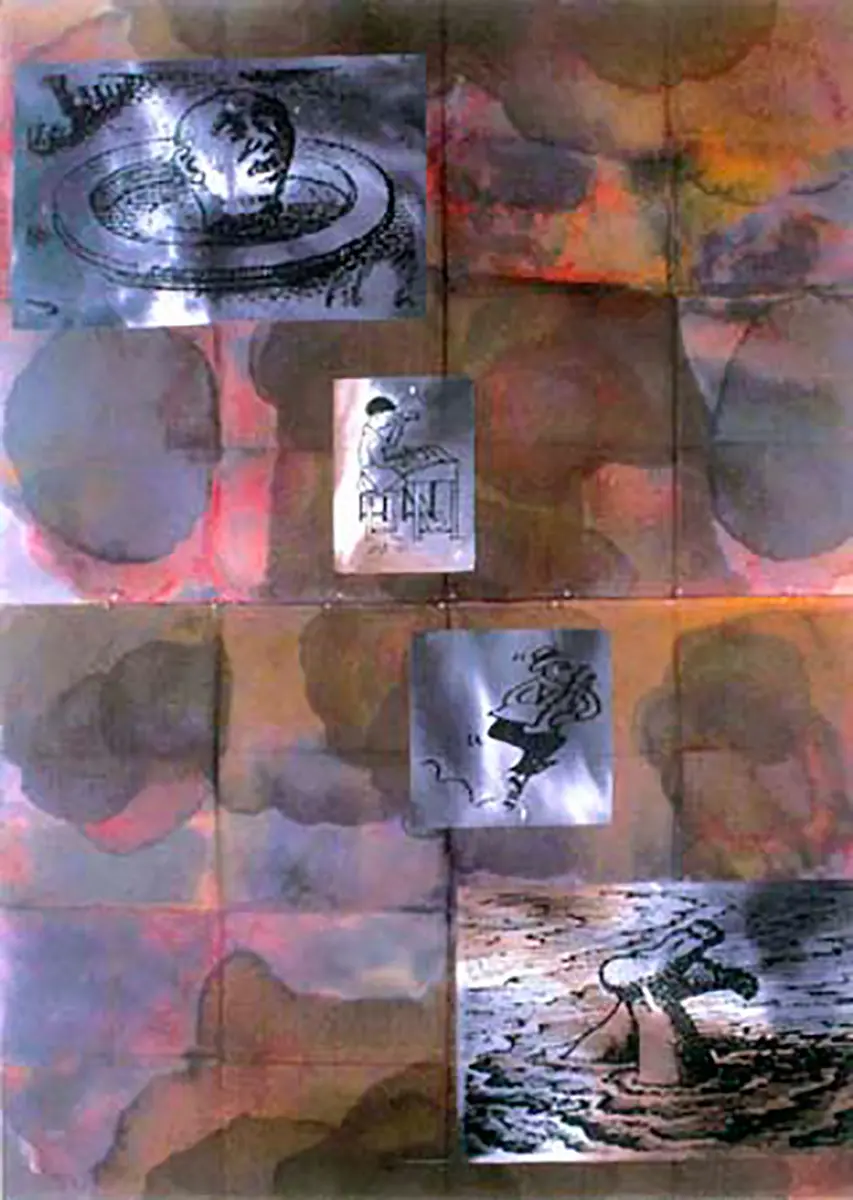
For close to twenty years Eugenio Dittborn has been working on his now classic and very recognizable Airmail Paintings. To call them paintings is, in one sense, an understatement, for these “paintings” made on fabric, consist of photo-based reproductions plundered from a vast image bank of diverse sources. What also broadens Dittborn’s definition of painting is that the Airmail Paintings are often individual panels that are stitched together. Since the individual paintings are folded and mailed via individual envelopes, but in tandem are one work, one may conclude that stitching well serves the process of keeping the creases uniform and thus accommodates their exhibition itinerary.
Anyone who has critically looked at the Airmail Paintings and noted their polysemous quality, where narratives have an idiosyncratic capacity to fold into each other, will observe that Dittborn’s paintings also incorporate the context of where they will be shown. This, in turn, becomes part of the work itself. His recent exhibition titled Tinctura at Alexander and Bonin continued his signature modus operandi but targeted diverse subject matter, including the painting’s modernist history.
Dittborn’s work has always had a political valence, though his politics operate and are articulated in an expansive purview that is more often literary and open-ended rather than literal and unambiguous. In other words, what separates Dittborn from those whose work is political in orientation is his deft way of side-stepping the overbearing weight of didacticism that political art can occasionally engender. This is partially due to his formal and conceptual use of vehicles of dissemination, such as the postal system, which broadens the narratives in his pictures to include actual social space, not usually the province of painting or art. Consequently, these paintings can also be construed as a form of social sculpture by incorporating space beyond the frame as part of their aesthetic and conceptual armature. Furthermore, as the works travel from exhibition to exhibition, mobility becomes an intrinsic ontological aspect, and they are thus inflected with a performance-like style as they make their way through the labyrinth of social circuits. And it is this movement in networks that has generally been the converging axis of the Airmail Paintings.
This time around, however, Dittborn has unified his Airmail Paintings via materiality exemplified in the process of tincture to create a staining effect. This emphasis on tincture as it encompasses staining and other modes of painterly execution increases the aesthetic dimension of the work in interesting ways, yet to assume that the primacy of these new paintings amounts to formalism or is a way for Dittborn to diversify his artistic practice for its own sake is to undermine both the heterogeneity of formalist frameworks as well as to misunderstand the works that makeup Tinctura. For as these paintings make quite clear, form is inscribed with meaning, which in and of itself is something that has been lost to some critics who view form strictly as a question of aesthetics. Staining in Dittborn’s paintings, then, is employed not only for its chromatic richness that infuses the work with a particular aesthetic but also as a way to signal the politics of form. Dittborn’s mode of painterly application is part of the modernist legacy that includes the Color-Field painters. What compels the reading of staining as more than an aesthetic decision alone is that some of the images that Dittborn uses in his paintings are taken from how-to-paint books, engravings, and so forth. Moreover, what adds a dimension to these works beyond issues of painting is that Dittborn conflates aesthetic discourse with poetic tension as images are placed in formal and narrative counterpoint, and enter into dialogue with each other that allows and motivates numerous readings.
In Algún (2003-2004), for example, one is overwhelmed by a monumental, horizontal work that is executed in a Pollock-like style of splattering and staining. The tincture that morphs into technique, in turn, veers into the critical, for the picture taints modernism’s fetish for the specificity of medium. Dittborn’s use of photo-silkscreen, as well as signifiers that point to the world outside of the picture, exemplifies this. The clash of titans is not only between modernism and its other, but also between what can be construed as their extensions found in numerous artistic, social, and political disparities. This is underscored, for instance, in the convergence of the artisan—via stitching and the hand-made—and the high modernist’s use of splattered paint across the surface of the fabric that tropes Pollock’s emphasis on the distance between hand and canvas, and the phenomenological aspect of the drip painting method that negates the easel altogether. Apart from the aesthetic presence and critical poetics of the works that in themselves mark Tinctura’s success, the exhibition proves the protean nature of the Airmail Paintings and how well Dittborn extends his style on the level of both form and content into new and fresh configurations.
RAÚL ZAMUDIO