
Indeed, the group of eighteen pieces (acrylics and metal oxidations on canvas, in small, medium, and large formats) brought together under the title of Exoticism has Cachet, which refers to the shortening of distances, the speed of contact, the simultaneity of information, immediacy of geography, and the impregnation of time, memory, and the imaginary. When conceiving this work, Fernando Barata had in mind the fact that the revolution in telecommunications (confirmed by the global span of the Internet and of cell phones) brings forth inevitable problems or disappearances. It is the disappearance, in the first place, of the gesture of writing that creates an always singular graphic expression, at once intellectual and emotional. But it is also the disappearance of the envelope’s paper, color, and form, as well as the postage stamp, the kind of postmark (cachet), the geographical origins, and the specific markings that account for an origin, a history, or an epoch. Entire symbolic typography, capable of communicating the mystery and the magic of far-away countries (often that of anonymity), vanishes from our epistolary horizon, becomes rare in human communication, and seems exclusively circumscribed to the world of commerce and business.
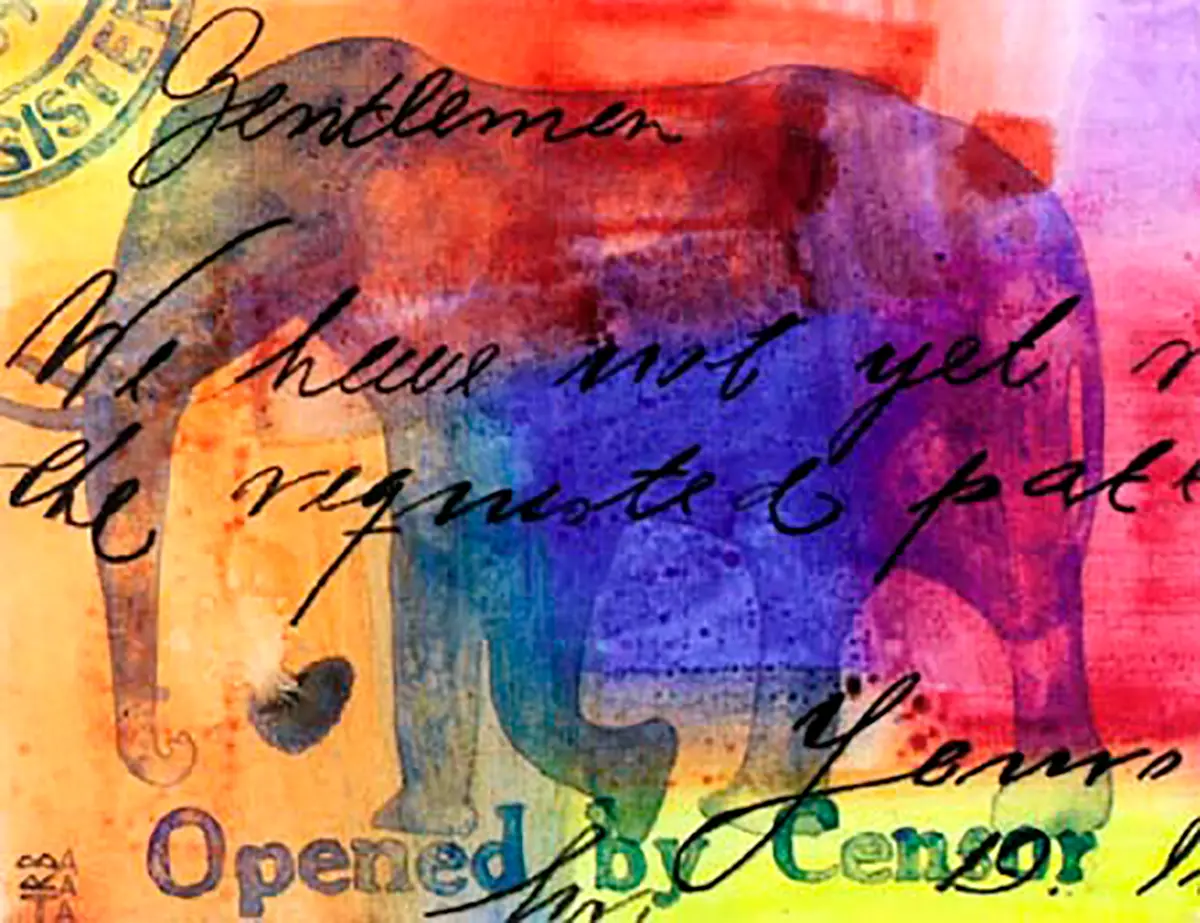
The Brazilian artist wants to talk about dematerialization, the existence of a system of relationships whose coherence consists of virtuality and “immateriality.” The space of his painting wants to account, plastically, for this shift, valuing different signs whose graphics and typography (hand-written postal addresses, postmarks, etc.) organize the (humanized) structure of the postal service. These written elements are also a weaving of the sensible and of meaning in a discourse where images intermix with words or fragments from phrases and texts. In this, it refers to a tradition, that of the relationship between image and writing, that has existed for centuries in the West. The hierarchy of one language over another (or its negation) has to do not only with the conditioning of the pictorial space but also with the visibility and readability of the image in relation to writing, at the same time as the painting’s unique and dominant event. Does what is written need to be “read” or “seen” separately in the painting and/or in relation to the image’s visibility? Is there a difference between the “mental image” (the act of reading) and the “eye image” (the act of seeing)? Does the movement of our gaze create a possible fusion of image and text by “creating a second entity”? These questions about the interconnected roles of image and text are concerned with Barata’s creative attitude as the impregnation of color, transparencies, and superimpositions are pressed on the pictorial space. These diverse layers of “reading,” different in nature, contribute to the construction of the whole of his pictorial, visual, and intellectual discourse.
Recovering, trimming, gathering, and building: a whole series of gestures and intentions are mediated by the computer. Barata works in a perspective of perseverance (of painting and of its many discursive possibilities, as well as of signs and symbols), but at the same time, he wants to inscribe himself in the modernity of his times using technical media that allow for the manufacture of a new image. This work on memory (that which the artist recovers from others and builds moment by moment with his computer) attempts to value the unique object that is, according to Barata, the letter (or the postcard), whose circulation has progressively diminished. Such is his first ambition, the one that guides his work as an artist. In this case, we are confronted with a productive contradiction derived from his creative attitude, since at the same time he pushes for hand manufacturing (in all its stages of recovery and recomposition) and combines it with the use of media that, thanks to the computer, allow for the infinite reproduction of images or signs selected from the internet, and for their deformation according to the artist’s will.
Barata has always practiced a kind of fusion of realistic images evoking distance, the opposite margin, and a different place (shells, hippos, fish, birds, suns, etc.) with the pictorial density or lightness he seeks for his space, using highly diluted acrylics, watercolored backgrounds, or materials that highlight the texture of pure color on smooth spaces. The real or virtual cut of the canvas is characteristic of Barata’s organization of space. Two paintings (both untitled acrylics and oxidations on canvas, 2003) attest to that constructive work. They link fragments of canvas covered in pure color to fragments on which writing appears, for example, a postmark, the name of a city, or a postal address. It is in the opposition of the small gathered canvases (five or six), the alternation of dense color and transparency, of writing and image, of handwriting and mechanized writing, of the printed to the virtual, that the artist carries on with his journey of memory. A lucid admirer of the I-Ching and the notion of yin and yang, Barata works with both opposition and metaphor, a fusion of times and appearances in which the interplay between what is visible and what is hidden is but a pretext to communicate the desire that has never abandoned him, the desire to paint.
CHRISTINE FRÉROT