
Although since its first edition in 1986, FotoFest had never had a theme, the 2004 edition changed the record by focusing on water. It is not an overstatement to say that nothing is more important on this planet than the prodigious liquid usually referred to by its scientific formula, H2O, or by its epithet, the universal solvent. Acknowledging this importance Fred Baldwin and Wendy Watriss labored for six years to put together the 29 exhibits and installations curated by FotoFest; the 35 independently curated exhibits; the film and video series; and the Global Forum that addressed different issues concerning water. In their own words, “For scientists, technicians, artists, urban designers, economists, and ecologists studying Water around the world, there is no question that there is a crisis.” The crisis is spelled out in the FotoFest catalog with a handful of facts: water consumption is growing at twice the rate of the population; over 20% of the world’s population lack access to safe drinking water; by 2025 about 50% of the world’s population will face water scarcity; half the world’s rivers and lakes are seriously polluted; 90% of large fish populations in the oceans are gone due to commercial fishing; and 20% of the earth’s 10,000 freshwater fish species are now endangered, threatened with extinction, or already extinct.
Notwithstanding the gravity of the situation, the official exhibits of FotoFest 2004 strike a tactical balance between factual studies and whimsical visions of water. The scientific images in the Language of Water exhibit were produced at the German Institute of Flow Sciences. In spite of their strictly technical origin, these are playful and formally interesting images, but most importantly, they eloquently show how water’s mobility and its capacity to arrange itself into complex forms are essential to its life-sustaining role. These properties are diminished when water is polluted. To claim that these mantra-like images of minute drops of water succeed or fail as art—as one local critic intimated—is to miss the point. While it is true that attempts to turn scientific data into art, or art into scientific evidence are usually misguided or trivial, neither attempt was intended here. Moreover, whether an image belongs to the accepted corpus of art, science, photojournalism, or commercial photography may be a less important question than how revealing it is. What is astounding about the images of the German Institute of Flow Sciences is that the role of water as a catalyst, as a solvent, and as a major reactant in some of life’s most essential processes is shown to be related to its capacity to “play” different physical-chemical “games.”
At the Williams Tower Gallery the exhibit Water in the West gathered the work of eleven photographers (Laurie Brown, Robert Dawson, Terry Evans, Geoffrey Fricker, Peter Goin, Wanda Hammerbeck, Sant Khalsa, Mark Klett, Ellen Land-Weber, Sharon Stewart, and Martin Stupich) who have collaboratively studied the use and abuse of water in the western United States for twenty-four years.
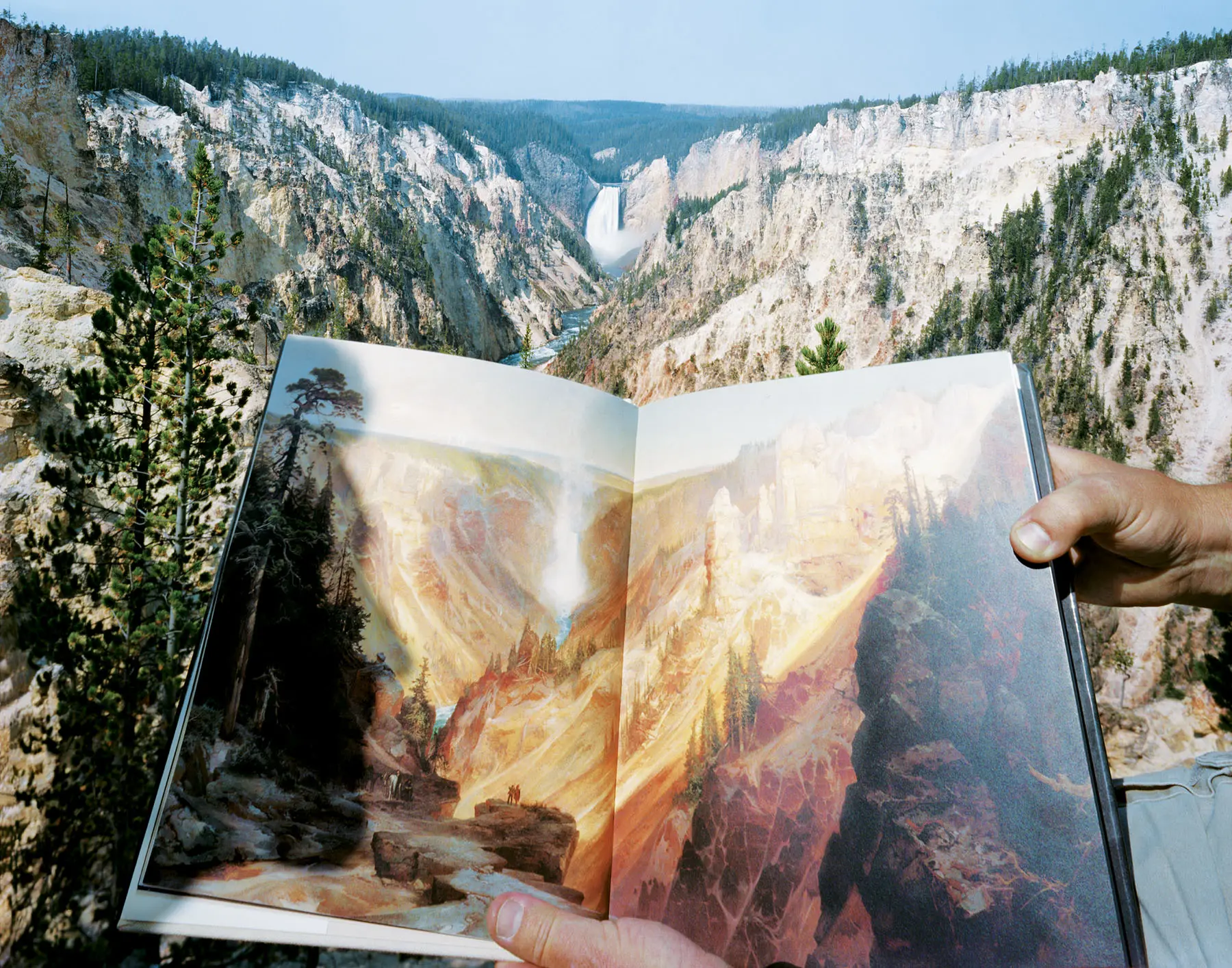
One of them, Mark Klett, asked, “What if the past changes depending on how we see it?” Revising official history is not only a concern of those whom it has injured but also of images it has misused. Klett underscores this point in his work, Viewing Thomas Moran at the Source, Artist’s Point, Yellowstone (2000). Moran was one of many nineteenth-century painters of the western United States whose images both celebrated the sublime grandeur of the land and invited its exploitation. In the same exhibit, Laurie Brown’s series Las Vegas Peripheries showed the artificial shaping of the desert landscape around Las Vegas that often implies the wanton use of water for golf courses and artificial ponds. In the work of Ellen Land-Weber, digital manipulation is used to introduce fictional fauna into the actual wetlands of the Arcata Marsh. The latter was built on an abandoned industrial dump site in the 1970s and has since evolved into a successful wildlife sanctuary.
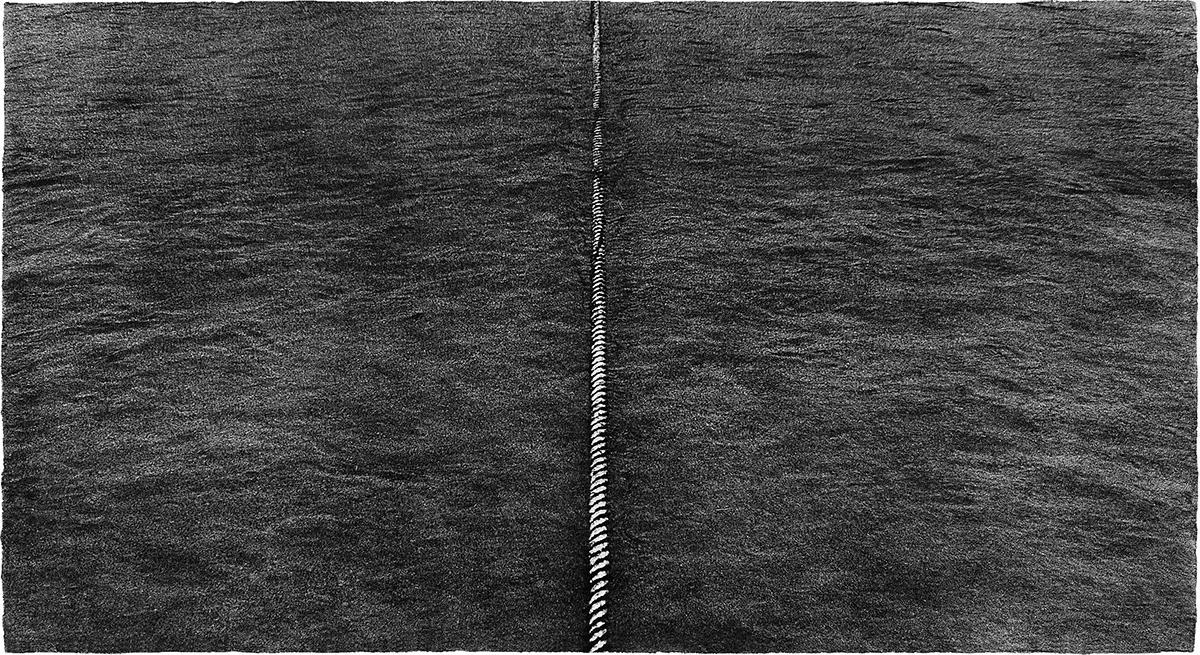
Several exhibits included the work of artists whose vision of water was more poetic than factual. Kevin Griffin’s Waves consisted of very minimal images of wave crests. Very seldom is a telephoto lens used to produce compelling fine art photography. Griffin managed to do this by capturing waves at the decisive moment when—brushed by the wind and urged by their potential energy—their beauty lies in their ephemeral equilibrium and their uniqueness at the brink of dissolution. In contrast, the waves in DoDo Jin Ming’s exhibit Free Element have collapsed into threatening entropy. The comparison that is usually drawn between DoDo’s works and romantic paintings issues from that mixture of fear and admiration that the theoreticians of the experience of the sublime attribute to it. Coined in a radically different aesthetic tradition—modern yet meditative—Jungjin Lee’s serene images in her Ocean exhibit render the texture and shapes of ripples in a way that is tactile as well as visual.
Printed on delicate hanji paper, their matte charcoal-drawn appearance dispels the photographic illusion of depth and brings the viewer back to the realization that her images are not windows to the oceanic vastness but the end-products of contemplation.
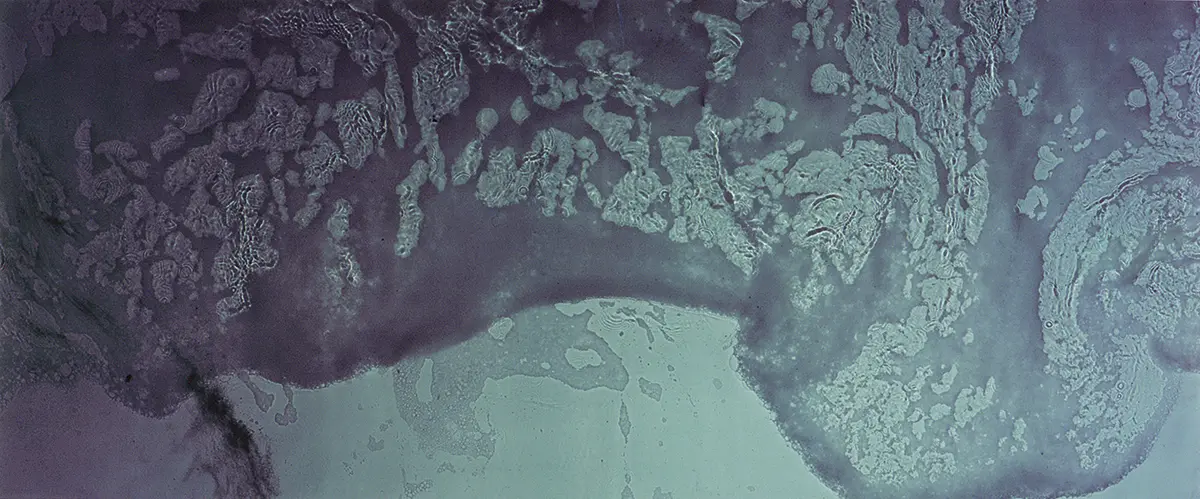
Two new Houston art spaces—the New World Museum and The Station—made their FotoFest debut with unorthodox exhibits: Susan Derges’s River and Shorelines, and Edgar Moreno’s Memories of Water: The Orinoco, respectively. Derges’s works are plein-air photograms—photographs obtained without a camera; Moreno’s work subverts the standards of documentary photography with tools of current artistic practice like installation, manipulation, collage, and assemblage (or the other way around; current artistic practice is suffused with documentary photography). Susan Derges’s oversized color images were produced by submerging photographic paper—under cover of nocturnal darkness—into the shallow waters of rivers and seashores. She then flicked an electronic flash in order to register the ripples and gravel. These subtly-colored monochromatic images register the shapes and rhythm of water by direct contact with it. One wants to believe that the pastel hues result from the color of the water and/or the moonlight rather than any premeditated filtering.
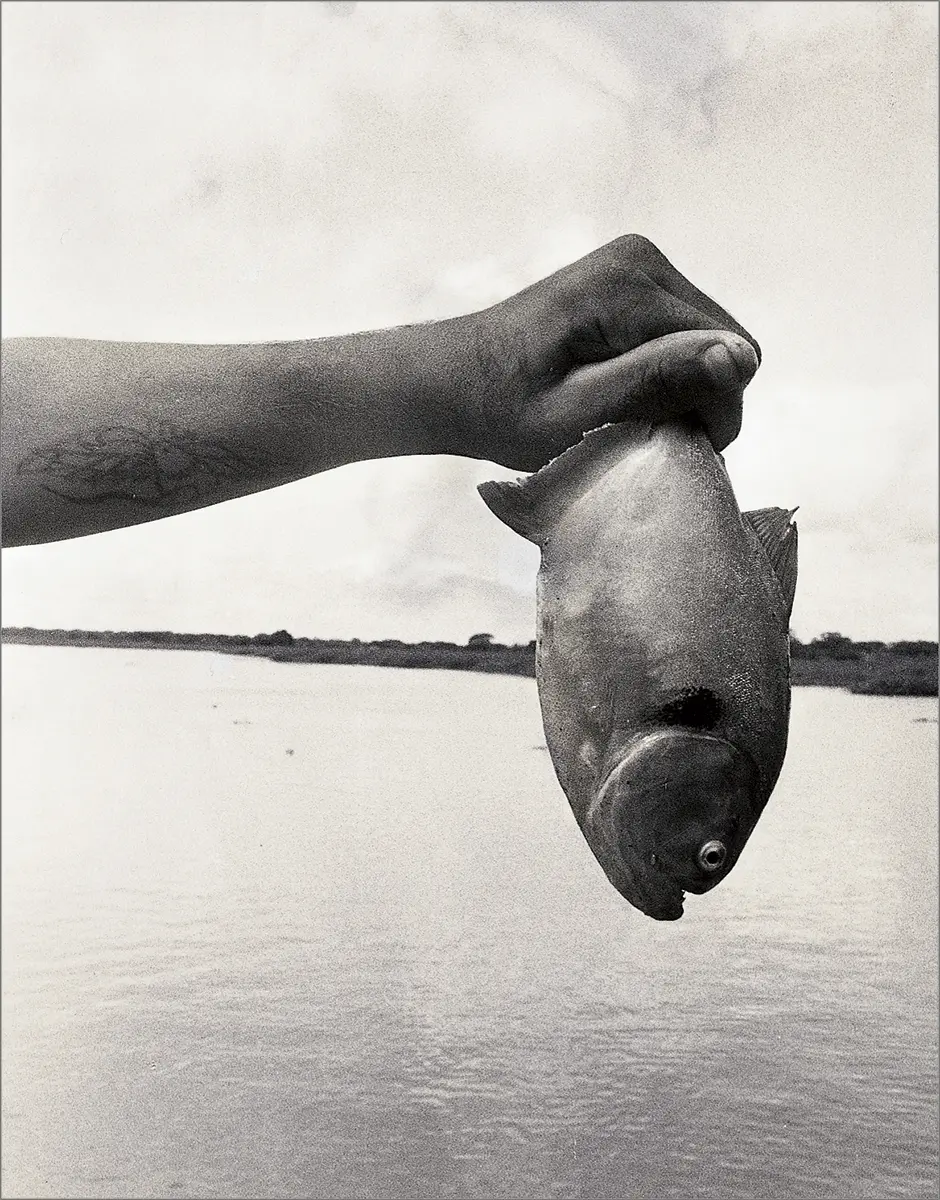
Behind Edgar Moreno’s subversion of documentary chronicling is the intention to underscore the notion that memories (and observations) are tainted by imagination; and vice versa. The purpose is to dismantle European accounts of the New World, in particular, of the life and landscape along the Orinoco River basin. Moreno engages a seventeenth-century account by Theodor Von Bry, Grand Voyages-Americae. The engravings in Von Bry’s original book depicting Native Americans were not made from observation but by imagining them from reading accounts by European explorers. Moreno’s project annotates Von Bry’s pseudo-chronicle with the authority of his first-hand experience of the Orinoco region and its inhabitants.
It is interesting to compare Álvaro Leiva’s exhibit The River People, which was shown at the Rice Media Center, with Moreno’s show. Leiva’s is at once more conservative (it follows a more traditional documentary vein) and more ambitious (it is about human life along not one but four major rivers: the Amazon, the Ganges, the Mississippi, and the Niger). While Moreno’s project brings forth the ideology of documentation and its implicit violence on people and facts, Leiva adopts the position of the objective observer. The former launches a critique of the tools of observation while the latter uses those very tools critically in the humanist tradition of modern documentary photography. The comparison evidences the optimism of the modern vision of the medium (and of modernity itself) to effect positive social change and the fragility of any medium as a vehicle of objectivity.
In fact, no exhibit made the above parenthetical remark more poignant than The Cost of Power in China: The Three Gorges Dam and the Yangtzé River Valley by Steven Benson. To quote Benson himself, “This immense dam, the largest concrete object on the planet, will ultimately force more than two million people to vacate their ancestral homes and will disrupt the lives of the 30 million people living in the reservoir region. In addition to this social cost, the reservoir will cover 8,000 known archaeological sites, 250,000 acres of China’s most fertile farmland, and 1,600 factories that have been burying toxic materials in the ground for the past 50 years.” The Chinese government’s reasons for building the dam include generating 11% of the electricity needed by the country; controlling the devastating annual floods that have claimed thousands of lives; and improving the standard of living of one of China’s most impoverished regions.
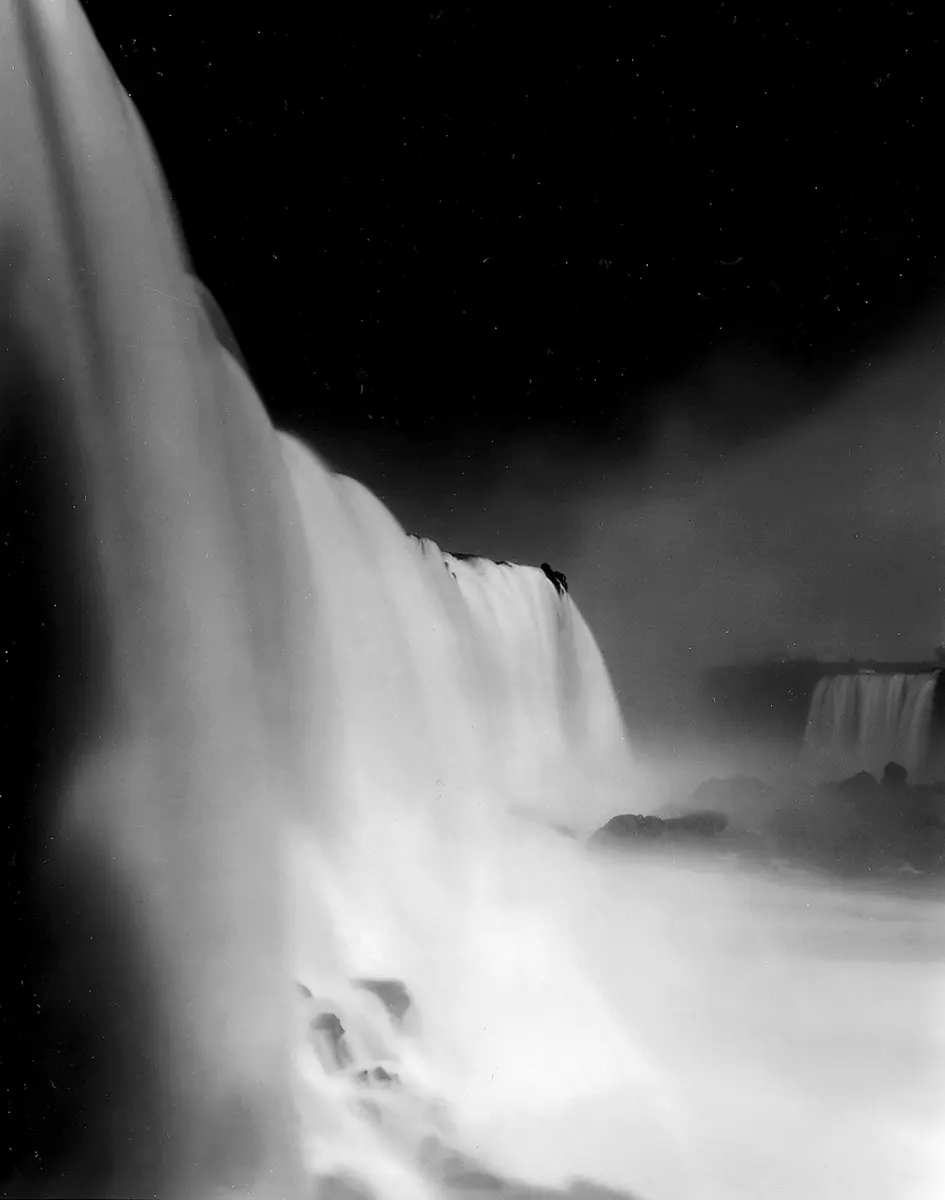
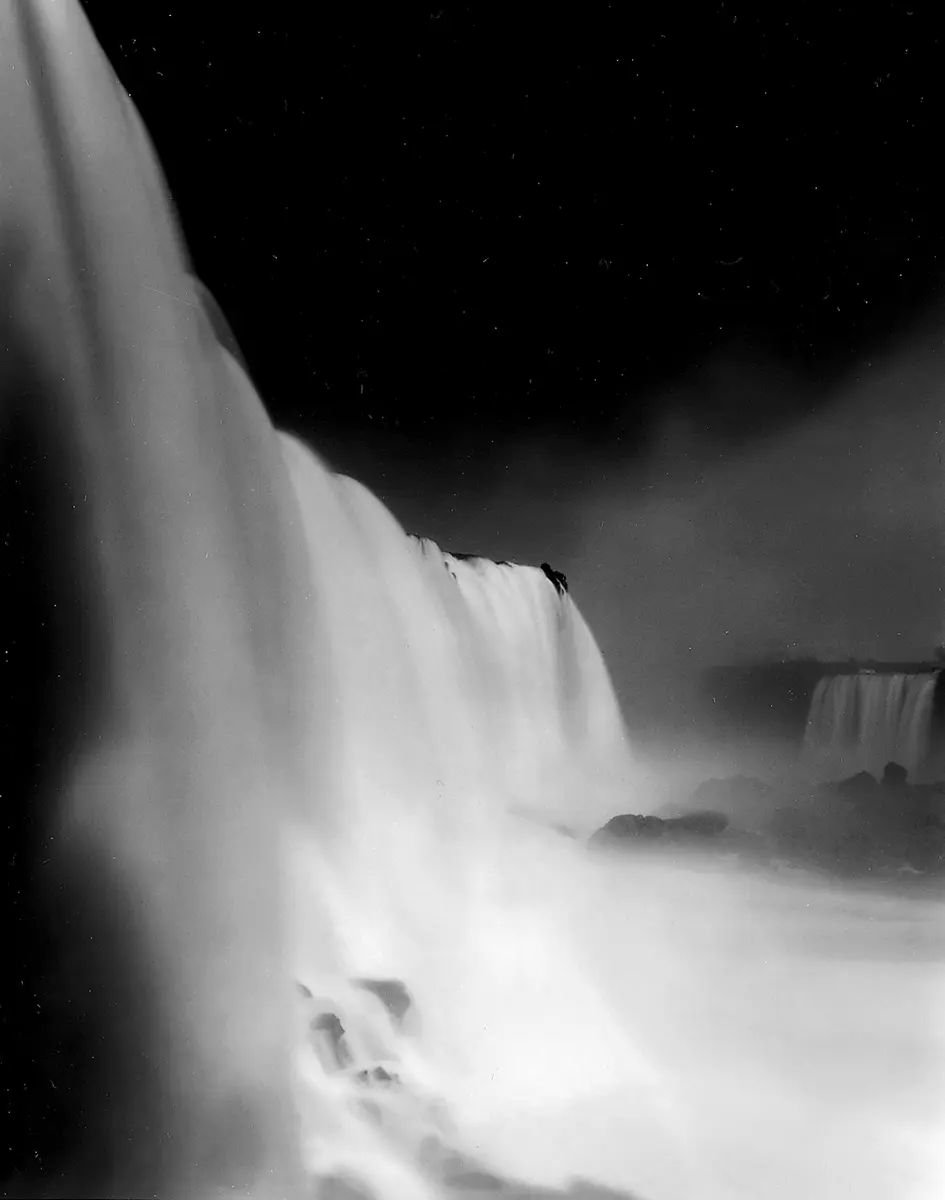
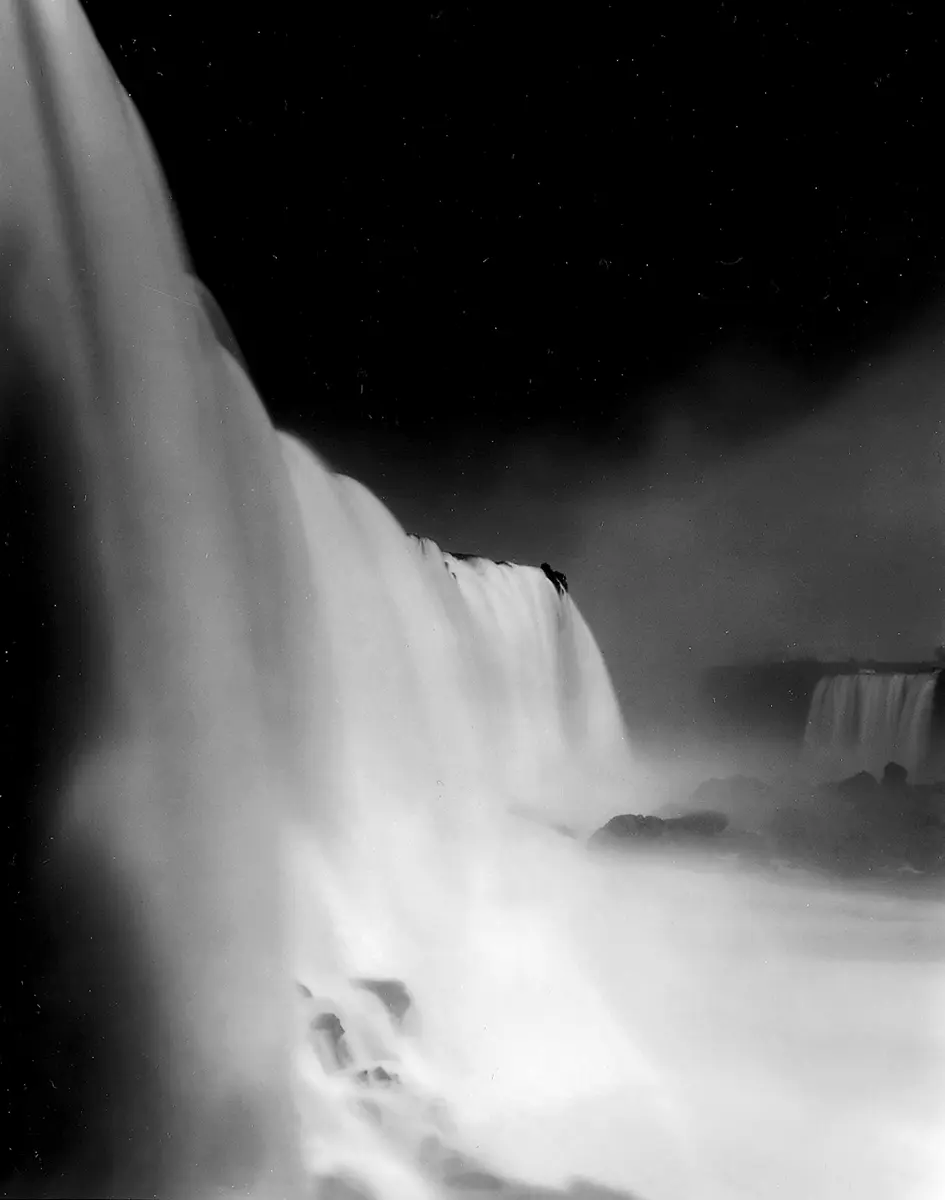
Indeed, one of the lessons of contemporary ecological wisdom about water is that dams create as many problems (if not more) as they solve. Although Brazilian photographer Valdir Cruz appreciates the positive impact the Itaipu power plant has had on the southern state of Parana where he was born, the backdrop of his O Caminho das Aguas exhibit is the role it plays in the disappearance of waterfalls in the region. Cruz’s black-and-white images of waterfalls are not straightforward documents. The deliberate use of long exposure to render flowing water as luscious white clouds evidences the long-lived relationship of the medium to river landscapes, as well as their threatened longevity. Cruz’s plea for the survival of waterfalls is to make beauty their swan song. Is there a way to save them in the face of “progress”? More importantly, is there a rationale for saving them?
Although beauty often persuades more effectively than mere facts, it has been argued that it is an obstacle to documentation. The enormous color prints of Edward Burtynsky’s exhibit Shipbreaking are about the butchering of ships on the coasts of Bangladesh. Once again there is something sublime about the rusted color of the ship hulls and the apocalyptic scenery of minute workers dismantling them. But it is precisely the exquisiteness of the images that urges the viewer to want to know more about these decommissioned vessels and the people who are tearing them apart. There is indeed a story of environmental damage and dangerous working conditions behind the scenes.
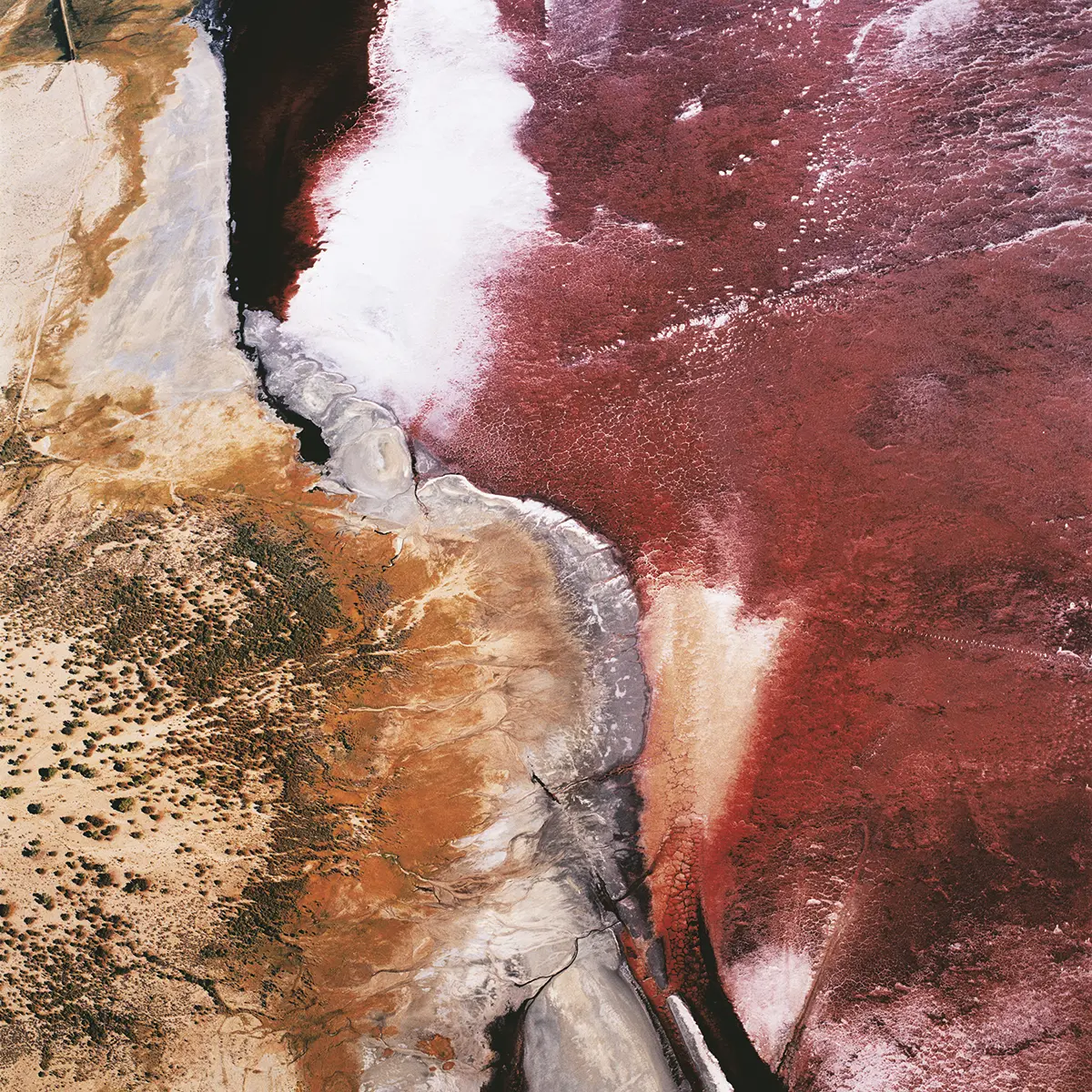
Similarly, the images of David Meisel’s The Lake Project use color as bait and warning. Bright color is the very primitive signal that nature employs to warn animals of noxious substances. The abstract expressionist look of Meisel’s images camouflages the fact that they are about the depletion and contamination of Owens Lake with a palette of cadmium, chromium, arsenic, and other toxic yet colorful substances. Meisel himself states, “It is a contemporary version of the sublime that I find compelling.”
As difficult as it is to take photographs that are about something other than what they appear to be, the realization that the interpretation of all images requires previous knowledge is not always understood by even perspicacious minds. Helen Zout’s images in her series, El Agua como Tumba (water as graveyard), demand that we know some facts about the period of recent Argentine history often referred to as “the Dirty War.” It was a period (1976-1983) when the military dictatorship and its fascist cronies would abduct anyone under suspicion of being a leftist from his/her home, job, university, coffee shop, or bookstore. Zout’s images of water and airplanes flying at dusk are innocent enough but they are unabashedly political. Many of her images are about the so-called vuelos de la muerte (death flights) from which political prisoners were dropped to their deaths into the freezing ocean waters. Moving freely from documenting, to staging, to revisiting crime scenes, Zout’s denunciatory work keeps alive the memory of the desaparecidos.
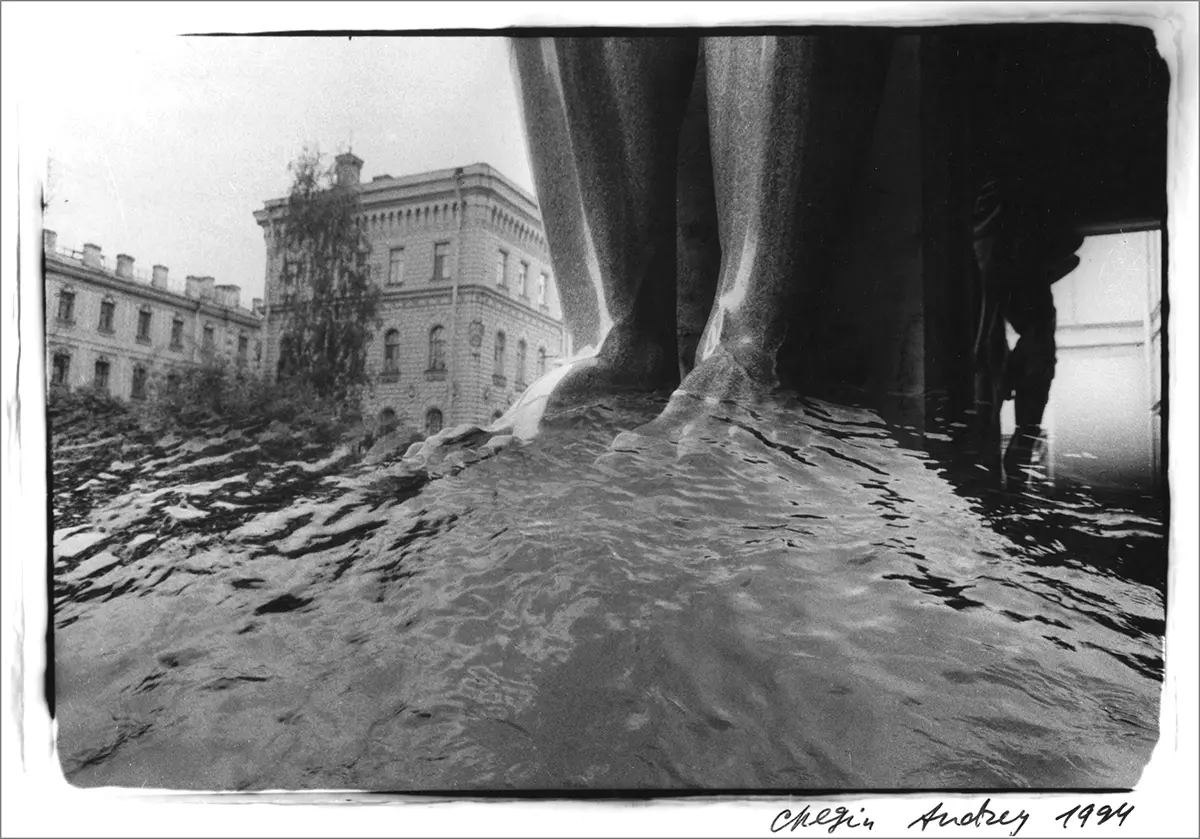
The images of Andrey Chezhin in The Eternal Baptistry have been called “phantasmagoric” by curator Irina Tchmyreva. They depict the city of Saint Petersburg submerged under a few meters of water. Tchmyreva ties these apocalyptic images to a Russian yearning for redemption and to a legend that prophesizes that Saint Petersburg is fated to endure the kind of cataclysmic flooding depicted in the hyperbolic images of Chezhin. Ominous visions aside, however, there is something darkly humorous and perhaps cautionary about these images of a drowning city.
But all was not about water at FotoFest 2004. Some important exhibition spaces did not join in the hydro-festivities, while some that did join in, should have abstained because the literal approach of their exhibits often trivialized the theme. Among the venues that chose to sidestep water was the Holocaust Museum which featured the exhibit John Heartfield: Photomontage and the Art of Resistance. In the 1930s Heartfield’s photographic collages were in the avant-garde of the anti-fascist struggle. The Museum of Fine Arts, Houston, presented the retrospective exhibit of two local artists: Manual: Two Worlds: the Collaboration of Ed Hill and Suzanne Bloom. Bloom and Hill were pioneers in the field of environmentally conscious digital photography. At the Rice Gallery British artists Heather Ackroyd and Dan Harvey did a most unusual installation that used chlorophyll as the basis for a photographic medium. For ten days at the rate of twelve hours a day, Ackroyd and Harvey projected an image onto a patch of grass until the chlorophyll recorded it. One of the resulting images was of a brick wall and the other of a dollar bill.
When FotoFest ends we are usually left with important insights about the state of the medium and occasionally with new revelations about the world. But given the theme of FotoFest 2004, we are perhaps left with higher expectations. Will this event in the world of image-making (“art” is too narrow a term) have any impact on the water crisis it has addressed?
FERNANDO CASTRO R.
Peruvian art critic based in Houston, Texas.