The first and largest series includes pencil drawings with some interventions in watercolor, oil, ink, or colored pencils. The images are of hurt, wounded, mutilated, blindfolded children showing hematomas, some wearing rabbit masks, costumes, their underwear, playing or simply gazing at the horizon. The pain these children could be feeling is not perceived by us, since their eyes are tearless and their faces are not strained; on the contrary, their faces and gazes are tender, childish, unconnected to their wounds, alien to the horror that caused the lesions. The children —nude, in their underwear, or wearing diapers— dance happily or share their space with an animal —often a deer— or an element of the landscape, unaware that next to them a couple of conjoined adolescents wearing clown shoes are making an obscene gesture. They don’t understand either why is there an adult, his back turned to us, holding a baby, while at the same time, the adult figure is embraced by a terrifying skeleton.
The next series shows chromogenic impressions of children/dolls, situated in idyllic, almost caricaturesque fictional landscapes, with worried expressions on their faces, under beautiful blue skies, colorful flowers, and pink clouds. All the children carry in their hand a rosary with a cross or wear it around their neck, and there is a skull at their feet. On a different aside, some horizontal digital photographs present plants and animals in a landscape that is full of light, flowers, and butterflies fluttering about, and seemingly hidden there are two individuals with rifles (in one photograph) or baseball bats (in another,) involved in a fight, without indication of its cause.
Larios’ videos are exhibited on two monitors that are placed on the floor without a pedestal or support. Again, a beautiful fantasy landscape is portrayed with grasses and flowers in the foreground and with a pink sky in the background, showing the different lights of a sunset. The video remains practically static for two minutes, except for a few seconds when a character dressed as a guardian/hunter and carrying a rifle crosses the screen from side to side. The second video is practically identical to the first one, but the screen is traversed, in the opposite direction, by an apparently harmless deer.
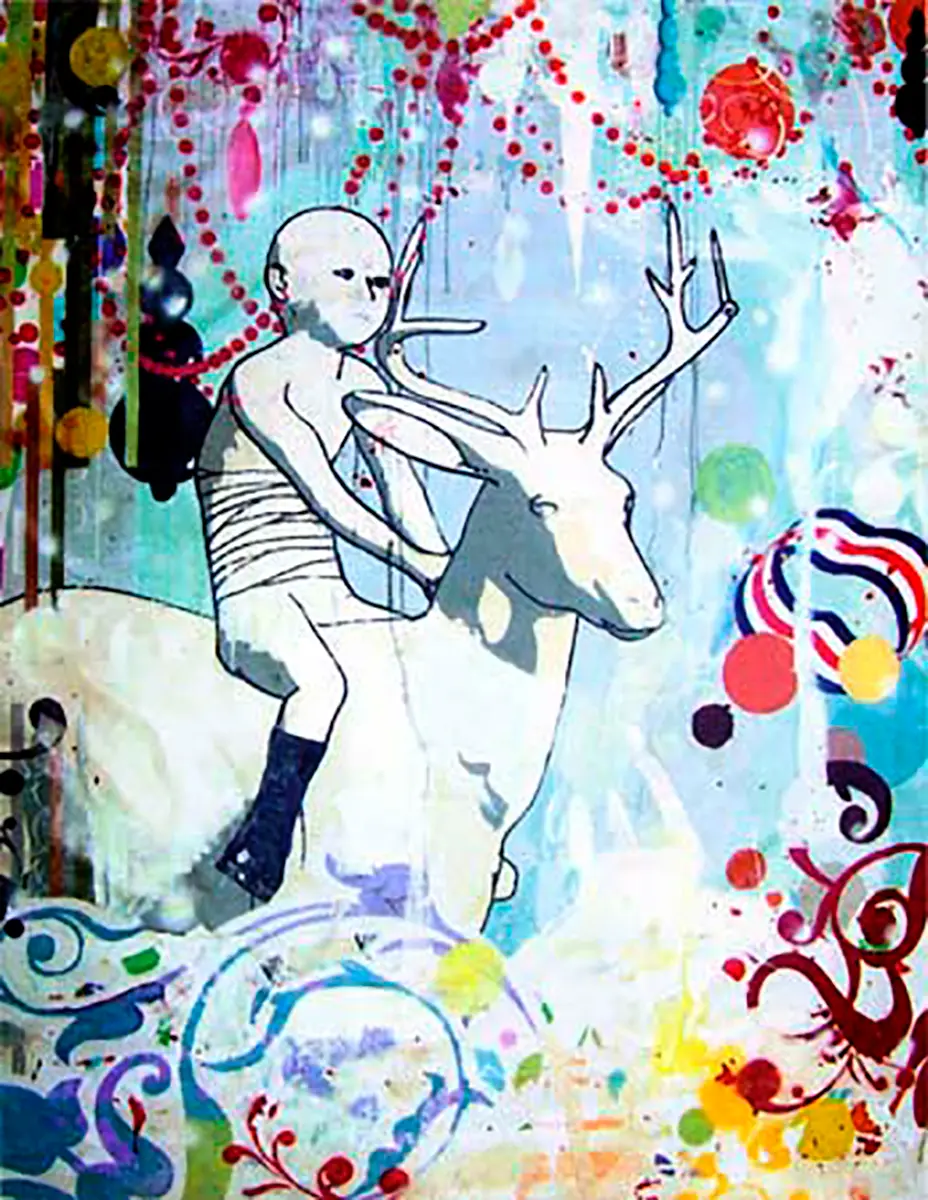
Another series is comprised of oil-and-barnish-on-canvas paintings in small and large formats. They represent fable-like animals in human dress, or children in costume carrying out various feats in outdoor settings. The standout in this series is a large-format canvas whose main figure is a bear, behind whom a deer stars; both are surrounded by colors, spheres, wreaths and other decorative elements. Two other works from this series deserve mention: two digital works painted on vinyl with varnish. A deer emerges between frets, lines, spheres, and a variety of colorful ornamental motifs, which bring to mind the iconographic freshness of the decorative painters of the Pattern & Decoration movement of the mid-1970s, but with an infographic technique and distinctively contemporary topics. In another composite painting of the same series, a child mounts a deer, as one does with a domesticated pet.
The show is well-rounded, displaying a pictorial diversity that reveals Francisco Larios as a mature artist capable of surprising us with his technical mastery and solid formats and themes, which places him among the best of his generation.
LUZ SEPÚLVEDA