In his introduction to the Futurist Manifesto (1909), F.T. Marinetti observed that in the middle of his nocturnal street ecstasy on the night he and his colleagues wrote the manifesto, “there were two cyclists disapproving of me and tottering in front of me like two persuasive but contradictory reasons. Their stupid swaying got in my way. What a bore! Pouah!”
Having declared that “...the splendor of the world has been enriched... by the beauty of speed... a roaring motor car which seems to run on machine-gun fire...” (item 4 of the manifesto), it makes one wonder what the futurists’ view of war and the supremacy of the machine would be almost one hundred years later, at a time when technological obsession and the unmanageable terrors of war determine society’s next steps the world over.
For Jarbas Lopes (Nova Iguaçu, Rio de Janeiro, 1964), one of the answers to the unconstructive consequences wrought by technological advances and their substitution of human force and labor is precisely contrary to Marinetti’s: the development of slower systems that will function as antidotes to power-driven progression and speed, focusing on the reintegration of the body in everyday life—what fellow artist and writer Luis Andrade called, Tecnologia do Corpo (Technology of the Body), which “places the issue of physical contact with the production of the context at the center of creative action.”
Some of these systems are conceived for real execution, others for the beneficial effects that their idea can bring to the human imaginary. Investing in more precarious physical structures, the unnecessary speed of current life would be substituted by reflective pauses, along with which come poetry, music, play, leisure, and, by way of a synonymous interpretation of all four of these, art. An art that stresses the importance of touch, intuition, spontaneity, and above all, vivência (life experience) and collective collaboration—in a way not unlike the creative and participative process of the Brazilian Carnival, an important and inspirational experience for Jarbas Lopes.
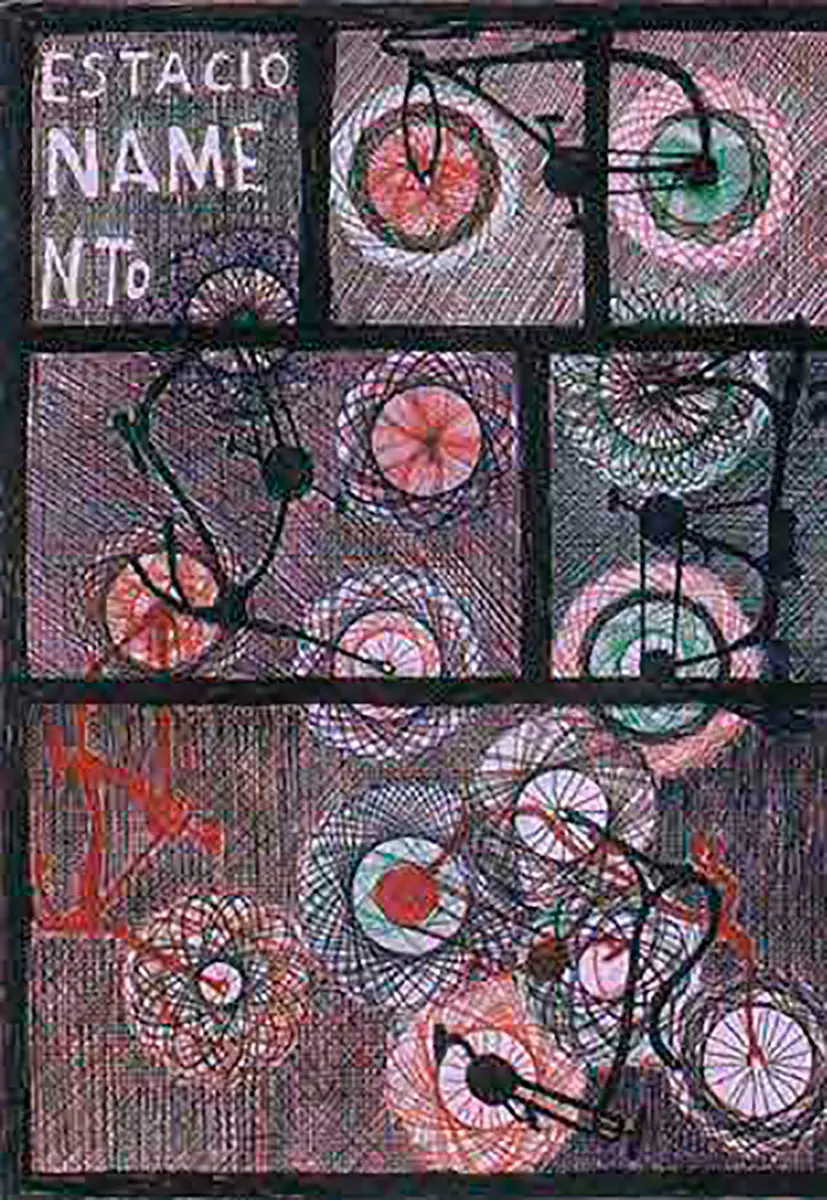
Two of these recent “inventions” constitute the core of the artist’s last solo exhibition at Galeria André Millan: an imaginary aerial bikeway—Ciclovía Aérea, composed of drawings and handcrafted bicycles that offer a poetic alternative to the fast lane; and the mimetic construction of Brazilian scientist, geologist, and formulator of private and public energy politics, Marcello Guimarães’s micro-distillery.
Ciclovía Aérea gradually takes shape in the spectator’s mind through the drawings made with common ballpoint pens that reflect the associative process of their making. Departing from more concise illustrations of bicycle wheels, spinning movements, random paths, and parking devices, they unfold from the artist’s imagination into other parallel worlds, such as an upturned wheel alluding to Duchamp’s readymade, or the role of money in relation to the natural elements used to illustrate Brazilian bills (such as the tortoise on the 2 Real bill), with no iconic or formal hierarchy.
The bikeway exists as a light downhill bridge or mountain path, something of a Calvino fable, a sort of dream that would turn life into a much freer experience. But the bikeway is also a resistance to gas fumes, noise, rush, and the harshness of everyday street life. The exhibition included four beautifully handcrafted wicker bikes, the first of which had been paraded on São Paulo’s main landmark financial avenue, the Avenida Paulista, in 2002.
During the exhibition opening this year, Lopes’s ten-year-old daughter, Janaína, whose signature claims authorship of two drawings included in the show (the artist’s children would join in the making while he created his drawings), enjoyed some rides on the bikes both inside the gallery and on its outside porch.
Far from conventional wine and canapé openings, this was a full daylight samba party and performance led by traditional samba composer and singer, Jorge Melodia and his percussionists, all from Rio. Visitors were invited to join in and were handed a clapper, bell, drum, or some other instrument, and a good dose of exquisite cachaça (Brazilian sugar-cane liquor), as well as an audio CD with songs produced by Melodia over lyrics taken from an art critical text by Andrade on Lopes’s work. After warming up outside for a few hours, the musicians, Lopes, his family, and friends, carried sound and moving bodies through the exhibition, stopping at the micro-distillery in the main room.
Lopes recreated Guimarães’ distillery as an “Allegorical Distillery;” it is a replica of the real project, made with polystyrene, silver paint, PVC, and paper. Further drawings displayed along with the Ciclovia Aérea drawings show the artist’s studied comprehension of its functioning. The micro-distillery is part of a program of decentralization of alcohol production in Brazil, with the aim of producing energy in an adequate manner with the environment, distributing income, and broadening the country’s internal market.
One cannot help but contemplate upon the irony of this replica: if the aerial bikeway is a futuristic invention (with the opposite ideological objectives of the Futurists), Lopes’s materialization of the micro-distillery—a real proposal in tandem with variants of alternative economics—reveals the eternal flaw of the country’s political visionary possibilities. It is a real project offering real solutions to gas expenses, extinction, and toxic waste, but who will take it on board?
VERONICA CORDEIRO