
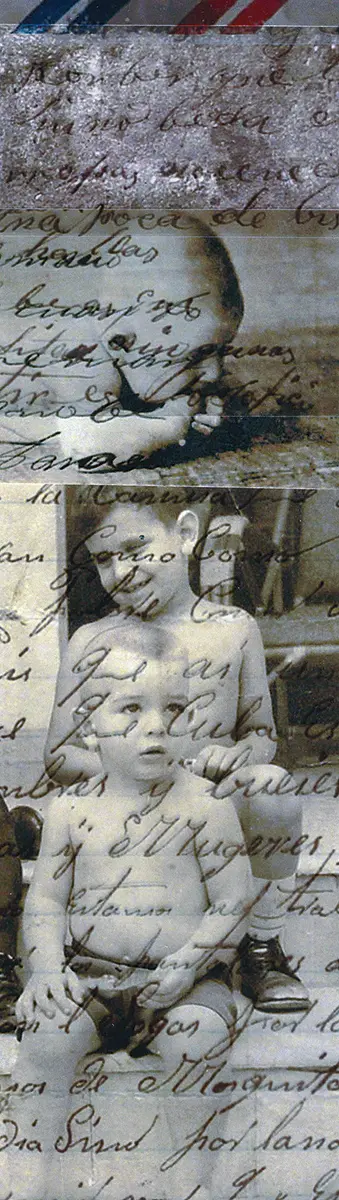
Indeed, Las cartas was the title of his exhibition. “I have used letters for a time now,” Fors has said, “as part of my interest in memory, but I never devoted an exclusive space to them. I reproduced many of the ones I keep from my family and friends, combining them with photographs. At times I superimposed the image to what is written in the back. I used transparencies for these prints, which contributed to creating a sensation of layers or superpositions of images, or of memories. Everything was conceived as a single, continuous work, like an installation. The idea was very simple and very personal, and despite the fact that events such as migrations, exile, isolation, and distance —events that are happy, or not— are revealed through these letters, my intention was only to recreate that world of calligraphies and bent or stained papers.”
Fors, 48, was the single child of a couple who lived surrounded by a large number of relatives. Of them, the artist is the only one who remains in Cuba, sharing his time between Vigo and Havana. The rest are dead or have emigrated. Although he has not lived locked in his house, the universe of his works has been confined to his inner world. When it comes to creating, what comes to his mind is not external perceptions, but what is inside his home.
A strong anchor, in terms of working material, has been the figure of the artist’s grandfather, Alberto José Fors (1885-1965), considered the father of Cuban forestry. A man who in the 1940s devoted his efforts to reforestation, to introducing tree species that were unknown in Cuba, to writing books, to putting together a showcase of different woods, and to taking numerous photographs processed by himself.
For Alberto José, it was difficult to find in the forests one tree whose existence was not dependent on other trees. He saw trees as friendly neighbors who coexist without fear or prejudice, in a cooperative fashion. For him, walking through a forest implied feeling the atmosphere of a powerful influence, as if the soul found a point of rest.
His grandson discovered soon in his own house the technical resources necessary to take photographs, and he started photographing everything in sight (inside the house) and manipulating the photographs and family letters, strongly tied to memory. Nevertheless, when one sees Fors’ works, one doesn’t think of him as a photograph in a strict sense, he comes across as an artist, period... someone who possesses great sensibility, capable of finding plasticity in the most insignificant, unexpected things.
Perhaps due to his education as a museographer, Fors is a stickler for space and form. Although he still occasionally uses traditional photographic means, he is more prone to work with the possibilities open by the computer, especially when the commitments to different exhibitions start piling up and he needs to save time. But Fors is not interested in being regarded as the creator of digital works. He wants viewers to encounter his images and not be able to determine exactly how they were made. And that is precisely what happens.
Fors, who was a member of the group that presented the historic Volumen I exhibition in 1981, has painted, created assemblages with found objects (from his own home,) and has done landscapes and installations using fallen leaves found throughout the forest, or has photographed trees or manipulated his grandfather wood showcase. For a long time now, he has also incorporated objects into his photographs.
In Las cartas, as in other exhibitions, is not interested in whether the viewer unveils the content of his images, nor in this case what the correspondence, handwritten on a transparent material, actually says. He is attracted only to visual impact. He tries to make his works almost abstract., always privileging white, black, ochre, dark green, and sepia. Just as he finds value in the design of a simple domestic object, he is fascinated by the powerful effect of geometric forms, which dominate his compositions.
Although Fors’ themes and resources come —besides his private world— basically from nature, he cannot be labeled an ecologically motivated artist, just as he can’t be labeled a digital artist. Fors is just a creator whose motivation is perhaps to have us understand, like he does, that plasticity and beauty (not decorativism) can be on our side, and generate in us the same atmosphere of well-being and harmony his grandfather saw among the trees in the forest.
ERENA HERNÁNDEZ