
With their usual self-assurance, Peña’s calaveras have received continental and even global honors: first prize at La Joven Estampa (Casa de las Américas, 1999) and at the International Engraving Triennial (Kunagawa, Japan, 2001), as well as a mention at the Latin American and Caribbean Engraving Biennale held in San Juan, Puerto Rico, in 2001. These are in addition to many national-level prizes and accolades.
Calavereando in this way, his figures have starred in a series of exhibitions, the most recent of which was held at Diago Gallery from January 29 to March 19 under the title Calavereando VIII. Fiesta en mi casa. For the occasion, a calavereo, a visual feast of skulls took over the space’s first floor, which was turned into an environnment that reproduced the spatial distribution of a humble dwelling, with the eclecticism, the promiscuity, the clutter that develops in a narrow perimeter, the austerity of resources touching on precariousness, the dissimilar provenance of domestic objects (furniture and cooking utensils in equally varied materials) that is the improvised, peremptory, and elemental division of “rooms” in the house. And all that while keeping an appearance of decorum, a spatial delimitation that would seem to attempt to “make an order out of a mess,” following a popular Cuban expression.
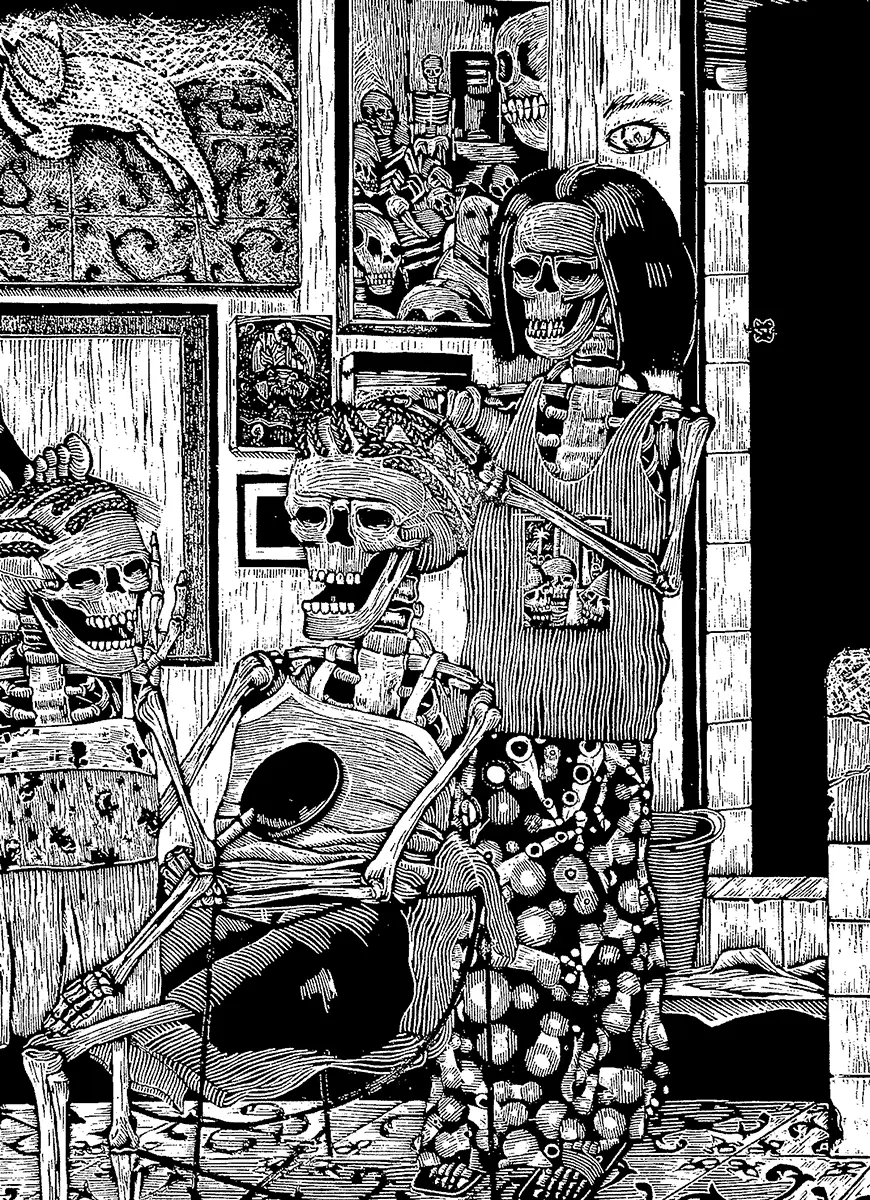
Peña’s formal experimentation is linked to his spatial play, and not only because he employs different engraving methods, at times hybridizing them (woodcut, etching, aquatint, mezzotint, lithography, and serigraphy) and displaying a wide technical range. His formal experiments also break the usual communion of wall and engraving, situating the flat surface as exemption: it is just a façade, mere frontality. It is a naïve but ingenious solution, and it coheres with the accomplished environnment of improvisation and flimsiness, in tune with yet another popular expression, this one sung in the key of salsa: “Take it down, it is just cardboard.”
But the relationship between space and representation is not absent from the man and the engravings that cover the walls and partitions he has incorporated into the environnment. They depict scenes in heterogeneous, also interior, places, on whose walls original works appear—to the extent his techniques allow—by the artist. This is the intertextuality of works-within-works, but also the intertext of spaces within spaces. It is a kind of serial cloistering. Intimate events are inscribed in the interior space, which, paradoxically, is made extroverted by the show itself and by the character’s projections.
Engraving allows Peña to fix, print, and “reproduce” fragments of the everyday reality lived by sociable, common people. There is an element of graphic chronicle and costumbrismo in his work, but not picturesque. Only some very punctual appearances of red and ochre break the complete dominance of black and white. With his skulls, which bring to mind fellow-engraver José Guadalupe Posada’s catrinas, discovered by the Cuban artist sometime after developing his own—Julio César Peña registers events of daily existence, events “inside four walls.” Although the artist renders all notions of life and death relative, it is not so much that the dead come back to life or enjoy an “afterlife,” or that the living have fun while always aware of carrying with them the seeds of death, the framework that will be their own transfiguration in “the great beyond.” Rather, these calaveras seem to be x-rays of living human beings. In their sarcastic fashion, they dissect and illustrate human attitudes, displaying them from our innermost supporting structure, our interior architecture. The border between “inside” and “out,” phenomenon and essence, appearance, and reality, thus become blurred.
ISRAEL CASTELLANOS LEÓN