
We will not write here about beauty in order to avoid stereotypes or debates about changes in the canon. Waisman’s work evokes certain moments in the history of ornamentation. There isn’t, nor should there be, any fear in working with the ornamental, with pink hues, with that which crumbles, with that which is subtle, with that which is sensual. An artist’s gaze is the field where new epics are forged. In the last two decades architecture has paid attention to the intimate relationship between function and harmony through new materials and technological uses. The visual arts establish new languages, various harmonies, and dissonances.
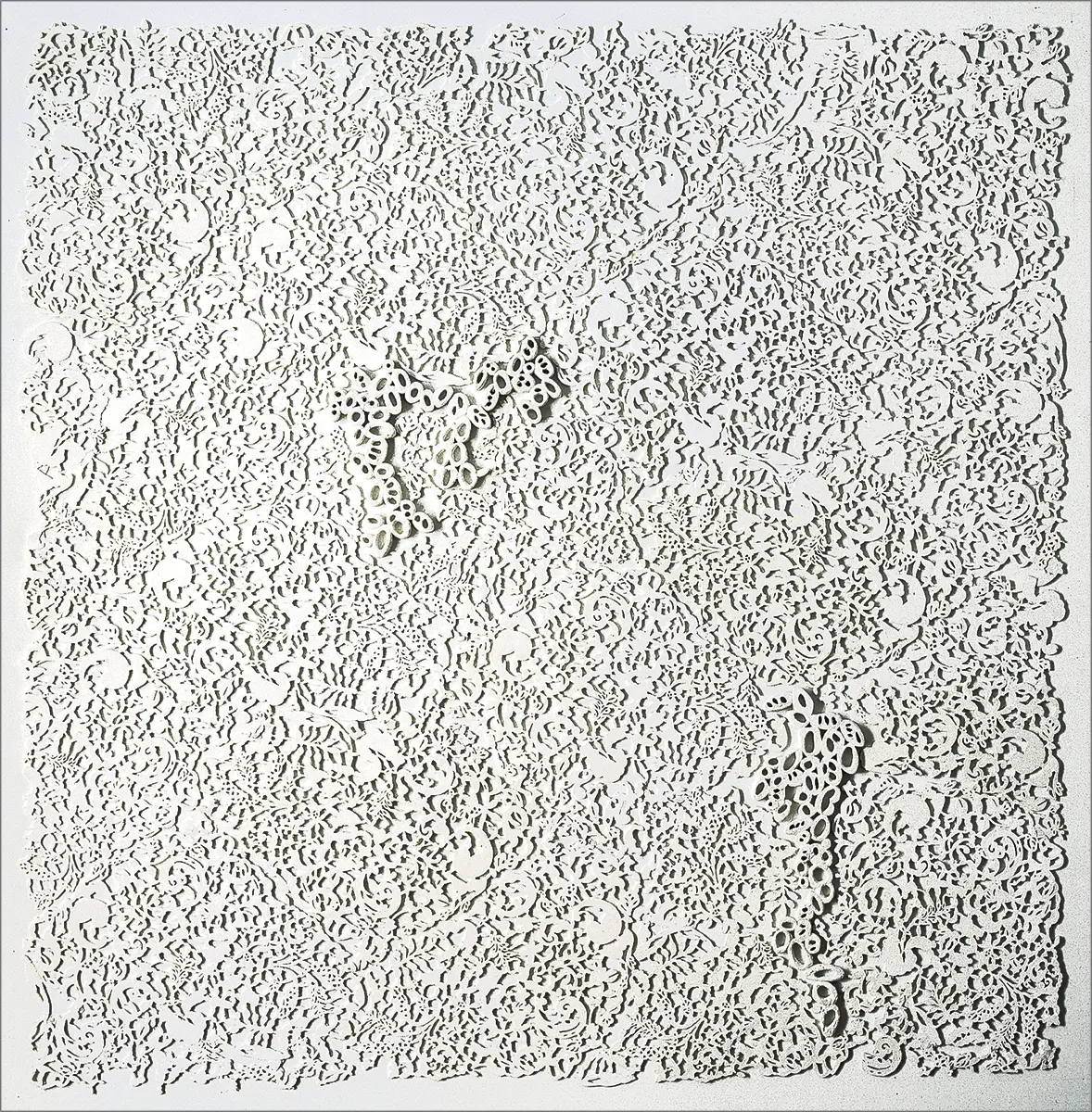
In the concatenation of thought and execution, the author develops her interest in certain ornamental aspects of architecture, comparable to Sixteenth and Seventeenth-Century brocades, and germination. All of these elements coincide in painstaking works expressed by Karin Waisman with absolute matteric levity, even if they present large dimensions. In 2001, the artist executed a project that is the antecedent of the Garden of Eden, the centerpiece in the current show. In all her works, the artist manifests with specifications and subtleties a baroque, feminine, analytical language organized by geometric means, with intricate motifs where the germinal subrogates the erotic.
This is the artist’s first New York solo show, The Garden of Eden. Here we could see current works that attend to diverse intertwinings of harmonies between the past and the present. It is comprised of the following set of pieces: an installation in the form of a cube, relieves, and drawings. The pink cube that lends its title to the exhibition as a whole is a 3 x 3 x 3 m (10 x 10 x 10 in) installation of pink Styrofoam panels that are cut and coupled constructively. In the gallery, The Garden of Eden was placed at a slant, welcoming visitors while at the same time limiting their movements a few steps from the entrance. Despite that, and despite the piece’s dimensions and stable appearance, Gaden of Eden opens to several de-materializing readings due to its pink hue, the contrasting light, and its terse exterior surface, which presented a series of inviting peepholes. Through the many peepholes or perforations set at various heights —“with the idea that children can also have access to interior views”— the perceptions received at the entrance of the gallery: opacity/light, flatness/relief, synthetic exterior/organic interior, hiding/unveiling, bare/saturated... Through the small openings, each one of the silent panels generated a different, overtly opposite communication. A gaze at the interior showed each panel had been worked in reality, with a resolved horror vacuis. Even today, when symbolic readings are not as significant as they once were, it is important to mention that in parallel to the aesthetics of The Garden of Eden, the viewer perceives the cube’s interior symbolic life impulses, which can also be characterized as warm organic labyrinths. In all, Karin Wasiman relieves the saturation of space is marked by the zigzag of her work on the piece’s surface... Going back to the theme of perforations, which traverse the styrofoam from side to side, these are solced in small sizes, so that we can see sections of the cube but not its whole interior. Given the placement of the installation, the viewer who peeps through one of the holes in the face that is closest to the gallery entrance discovers that thanks to an alignment of peepholes he was able to see, partially, another of the pieces exhibited in the show, el Relieve II, white, located in the back.
Waisman’s drawings and relieves allude to invented, seen, and dreamed decorations and gardens. There is a growing freedom of gesture and the obsessive forms thus obtained establish a variety of linkages; certain crustacean forms and butterfly-like expansions coexist, camouflaged, in abstraction. The carvings allow for the background planes to breathe; the labyrinthine linear discourse fights with the blank spaces that defend themselves from the jungle. In terms of the relieves, the density of the material varies, continuums and vacuums alternate, and filled spaces are infrequent. In Waisman’s relief, an irregular contour promotes certain virtues, although the square dominates the general form.
The being of non-being appears in tracings of life and death... Penelope is invoked in the intimate arabesques of the weaving of History, and of its counterpart, the weaving of Nature. The romantic aspect is undeniable; its resolution in synthetic materials is interesting: resin, vellum, and styrofoam. They have in common their being light and disposable, two adjectives that also fit the author’s practice: evident and ethereal.
GRACIELA KARTOFEL