
This constant dynamism is a reflection of the artist’s intellectual mechanism: her works are solved after having the pieces of the puzzle floating around for a long time. Azout gathers objects, textures, calligraphies, and images without apparent connection to each other, and brings them into a specific “system,” which is not pre-conceived but evinces an intelligent and intuitive coherence.
The entrance to one of the exhibition halls is dominated by a series of coupling nets (La llave mística,) which can be described as metal grids with triangular ends pointing to the back of the gallery. These objects represent forces that emerge from the earth and direct our gaze toward a specific point, like arrows on a map. They also lick into each other, reiterating the logic of linked ideas and of objects that are parts of a whole.
The directionality of these pieces takes us to Memoria colectiva, placed at the back of the room. This work was presented months ago at the Bogotá club El Nogal, as part of a group show titled Desde la tridimensionalidad, which also included works by John Castles, Hugo Zapata, and Ronny Vayda. The club, which was the recipient of one of the many terrorist attacks suffered by Colombia’s civilian population, went through a process of reconstruction only recently ended, and that is what the exhibition highlighted. It is charged with symbolisms that evoke tragedy, destruction, chaos, and the reflection that comes in their wake.
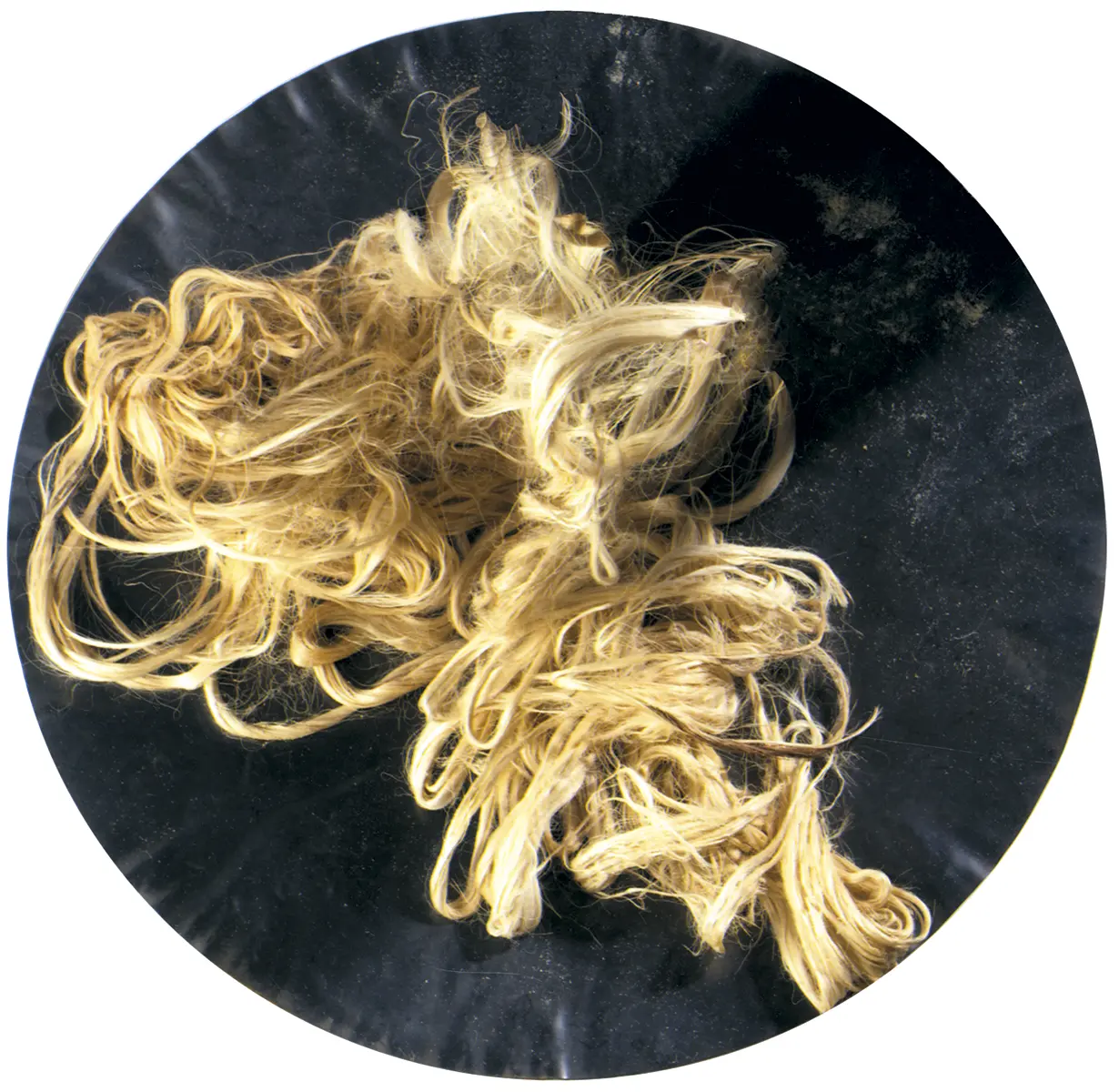
A large central piece of oxidized metal stands as the exhibition’s “guardian.” An angular base, similar in shape to the nets mentioned before, supports a vertical metallic trunk, on the top portion of which we find a circle formed by two facets. These are joined together on their concave sides. A series of crossing weldings appear as yet another triangular grid, very careful and calculated, giving structure to the piece’s interior. Around the piece and on the floor there are five round bowls, also in metal, containing various materials: charcoal, fibers, lime, dirt, and water.
At El Nogal, this work acquired a special meaning, as charcoal symbolized the fire that raged and what was left afterward; the natural, uncombed fiber referred to the raw material used in the manufacturing of rope, in this case, a simile of the human line formed by the rescue workers at the scene in their attempt to rescue the victims. We need to mention Azout’s tangible approach to textiles, which justifies those plottings, weavings, and fibers. In the words of Piedad Casas, Azout’s artistic coach, “that movement made by weavers of cabuya (rope), as if swinging to organize the fibers, resembles that of people laboriously stretching their arms to bring out the bodies from under the debris at El Nogal.” Many visual allusions could be derived from that evocation, yet Azout’s is concrete and doesn’t want to be excessively personal.
Pulverized lime in another bowl symbolizes with its whiteness the antithesis of charcoal and invites us to think of a material that builds and seals securely as if purifying and erasing the precious destruction.
The dirt in the next bowl is red and it's placed there as a fistful of ground. It symbolizes the blood spilled that returns to the Earth to become part of a world that remains alive.
Finally, water acts as an underworld that is unknown to us, be that of the natural Ocean or that of a metaphysical realm. It is not colorless fresh water, since it must have contained the Earth's minerals as they are found in the sea, a sensation the artist achieved using blue food colorant.
Memoria colectiva was conceived for the altar to the Fatherland in the city of Santa Marta, but when Azout learned of the exhibition at El Nogal, she wanted to be part of that offering with something of substance, thus partaking of Colombia’s conceptual reconstruction. All the containers in this work are “served” in the manner of offerings, and they sacralize the gallery. What is interesting here is the way in which the piece adapts to the place where it is exhibited, rather than remaining static. It is not circumscribed to a single context; it is constantly being reinvented. Its offerings can be understood as a-temporal commentaries.
There is a noticeable evolution from previous works to those presented in this exhibition. From paper-like plates not entirely free of two-dimensionality we move to sculptures with structural backgrounds, with additions of visual perspectives, controlled by and at the same time determinant of, space. What is rigid and heavy becomes mobile and flows in a controlled way.
It also bears mention of Azout’s mastery of her materials and the proficiency of the piece’s execution. Metal as a volatile mater loses rigidity, with the evidence of imperfect human action on its hammered surfaces. Each piece is dominated by the artist’s will. Contrary to the experience of other sculptures working with metal, Azout does not limit herself to the piece’s design and conceptualization but gets involved in the entire process and takes part in smelting, welding, cutting, and assembling. Her relationship with the material has become closer to the point of not requiring diagrams or mathematical calculations. Empirically, she achieves well-established axes that are intentionally imperfect and site-specific solutions.
Other standouts at the show at Diners are a series of multiple pieces that are like exploding suns. In them, Azout has begun an exploration that varies the size of ads and simultaneously manipulates projects for public spaces or small areas, into sculptures in small and medium formats.
She moves from the macro- to the micro- in her models, which are complete works in themselves. In the details of the smallest models, we see formations that are similar to those in the interior of the guardian in Memoria colectiva, but in this case, the inner world is becoming more complex. With wide perforations in the center, it is possible to contemplate them as though through a kaleidoscope, perceiving axis, knots of tension, inverted forces, etc. The trapezoidal bases give these pieces solid support not only as a technical solution but also as conceptual emphasis. They represent the world and the universe that supports it.
Although they are all different, they are still related to one another. They resemble totems, large Stars of David, tribal objects for the adoration of the sun, and they have even been linked to Catholic tabernacles. We are talking about a certain religious syncretism. Yet Azout’s work does not refer to the sacred as a stigmatized interpretation of the divine but as an expansion of consciousness. It deals subtly with the issue of creation in one of its infinite processes.
MARÍA JOSÉ RAMÍREZ