
This extensive exhibition of prints by Mexican photographer Manuel Álvarez Bravo demonstrated the singular talent of this twentieth-century master. Known by many as the father of modern photography in Mexico, Bravo influenced the country’s most important photographers. This striking and carefully organized show, one of the best to be mounted since the artist’s death in 2002, provided viewers a rare glimpse of early photographs from André Breton’s collection, in addition to vintage prints of his most famous works such as Portrait of the Eternal (1935). The latter photograph epitomizes Álvarez Bravo’s visual language. In it, a moment of daily life is frozen in a composition that at once emphasizes the drama of abstraction, a shadow against light, and line versus ambiguous shapes, along with the minute details of hair strands, the weave of a textile, or the crease marking a face. A woman with long, wavy black hair sits in sun and shadow, her gaze fixed upon the mirror she grasps in one hand, while her fingers smooth her tresses away from the other side of her face. Sunlight illuminates her nose, lips, and chin as well as a portion of her flowing locks and legs. The rest of the room is dark, save for a section of the wooden floor lit by the sun’s reflection. One is first drawn to the stark contrasts of light and shadow, and then engrossed by the absorbing details of her sun-drenched profile, the vividly striped, white-on-black huipil beneath her, and the luster of her painted fingernails. It is a seductive, mysterious photograph that once seen cannot be forgotten.
The exhibition was organized into the themes that spanned Bravo’s career, such as nudes, landscapes, and portraits of famous individuals, and in the principal gallery, a collection of iconic photographs capturing the peculiarities of daily life. In particular, one wall evocatively juxtaposed Instrumental (1931), Somewhat Gay and Graceful (1942), and Girl Looking at Birds (1931). Instrumental is an early print that suggests the influence of American photographer Edward Weston, whose close-ups of peppers and seashells are both magnified views and abstract plays of light and form. The arm and end of a crescent wrench, the head of another, and a loose bolt lie against each other; bold shapes defined by strong lines, their surfaces are palpable, softly worn, and illuminated against the rough adobe wall behind. Although we recognize these tools, we lose sight of their purpose, becoming instead wrapped up in the charged interplay of shapes and textures, shadows and light.
In Somewhat Gay and Graceful, Bravo again creates an abstract image composed of finely detailed elements. Upon a sun-drenched brick patio, a white muslin slip is drying. Nearby, a circular basin upon a stand holds a mass of thick, dried grass, like fettuccini in a pan. Just above, we see only the back of a girl’s slender legs, from knees to feet, as she stands coyly, one foot on tiptoe, her dress raised slightly. Each disparate element is in visual dialogue with the next: the circle of grasses with the lines of languid legs, with the triangular shape of slip, all against the backdrop of a sun-soaked pavement. The thematic link of elements remains decidedly ambiguous, thus emphasizing the abstract and enigmatic themes of the photograph.
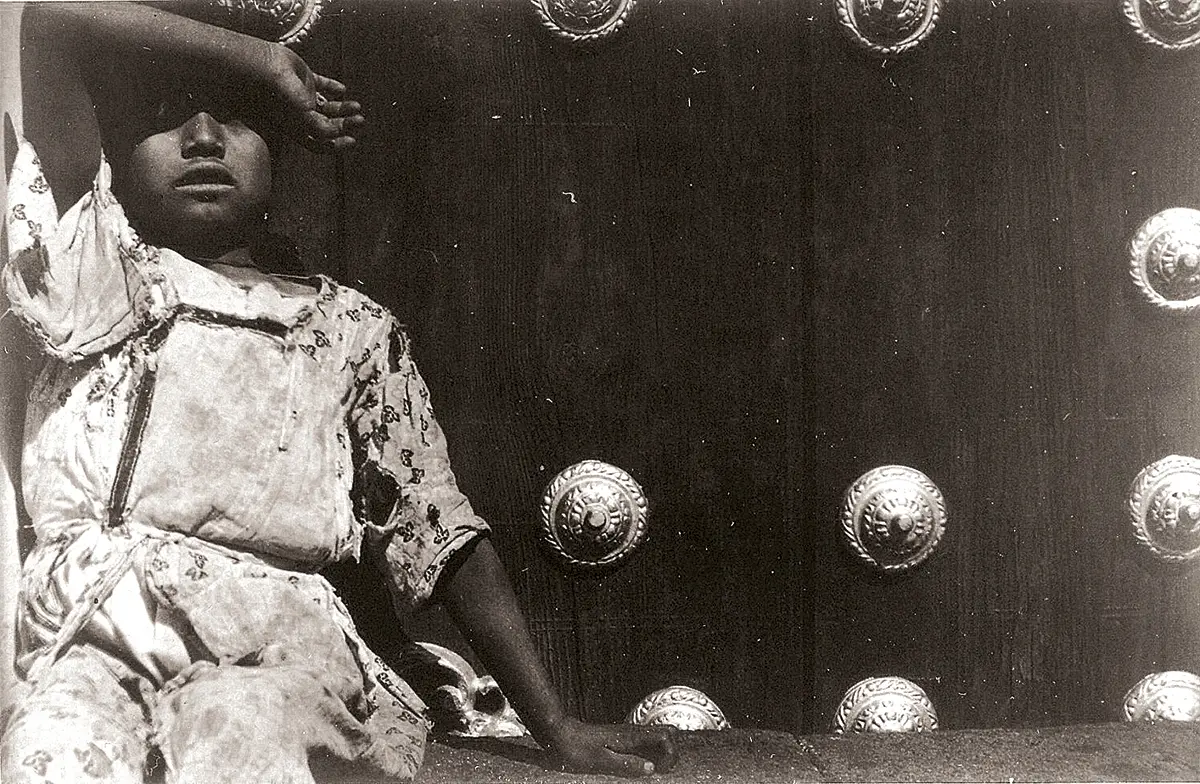
Girl Looking at Birds incorporates a vividly detailed human presence into the abstract dialogue of shapes and lines. Sitting against the side of an unwieldy colonial door, a young indigenous girl scans her surroundings, her arm across her forehead shielding her eyes from the harsh sun. Against her back, the door’s wide, wooden planks are marked by a series of shiny, round silver decorations that accentuate the disparity between the wealth of those living behind the door and the girl sitting outside, her clothes torn and frayed and held together by repeated mending. This is a bewitching photograph in which the quiet curiosity of the child in pale cotton contrasts boldly on visual and emotional levels with the dark, imposing door and its ornate details.
Although Manuel Álvarez Bravo’s photographs have been exhibited repeatedly over the last ten years, this exhibition confirmed that with each viewing of his work, the power of his vision is reaffirmed. The Good Reputation Sleeping (1939) exemplifies the startling freshness conveyed by many of the prints in this show. The artist composed this nude portrait of a young woman lying upon a blanket with nothing except white bandages wrapped around her thighs and hips, her dark, pubic hair visible against the white of her bent leg. Although she lies peacefully, with eyes closed and hand behind her head, lurking alongside her are four cactus “fruits” with long, vicious thorns that threaten to lacerate her flesh if she moves. This evocative portrait is both strange and beautiful, an image of clear blacks and whites. Like many of Álvarez Bravo’s photographs, it sears the memory.
With more than 100 years of background in photography, Manuel Álvarez Bravo is one of the most important references in the field and this view of a large part of very significant works is an opportunity to review his valuable contribution to Latin American visual arts.
MARY SCHNEIDER ENRIQUEZ