La Casa Del Árbol, Miguel Meza’s show at Juan Ruiz Gallery in Maracaibo, is a new encounter with the artist whose fantastic beings populate his memory and inhabit his imagination. This young Maracaibo painter has moved through several manners of formal expression during his career. His earliest works were large-format pieces in which floating figures, possessed of aerial qualities, were drawn against monochromatic, dripping blue backgrounds. The human figure as an image tending towards lightness reappeared in later works where the blue monochrome moved toward earth tones. In both proposals, the artist used symbolic elements related to ascent, change, and childhood memories. Still later he produced a series of large monochromatic canvases—in which only one or two characters appeared—on which he placed wooden boxes filled with small objects arranged according to a personal narrative that related to the painted character, and that were presented as a suggestion for the viewer. The next step was complete assemblage, and he produced small-format works where the main element was a pictorially intervened doll surrounded by toys, lace, artificial flowers, or puzzle pieces, in a formal discourse that is very close to Mario Abreu’s Objetos Mágicos, but motivated more by the recovery of memory than by a search for metaphysical meaning.
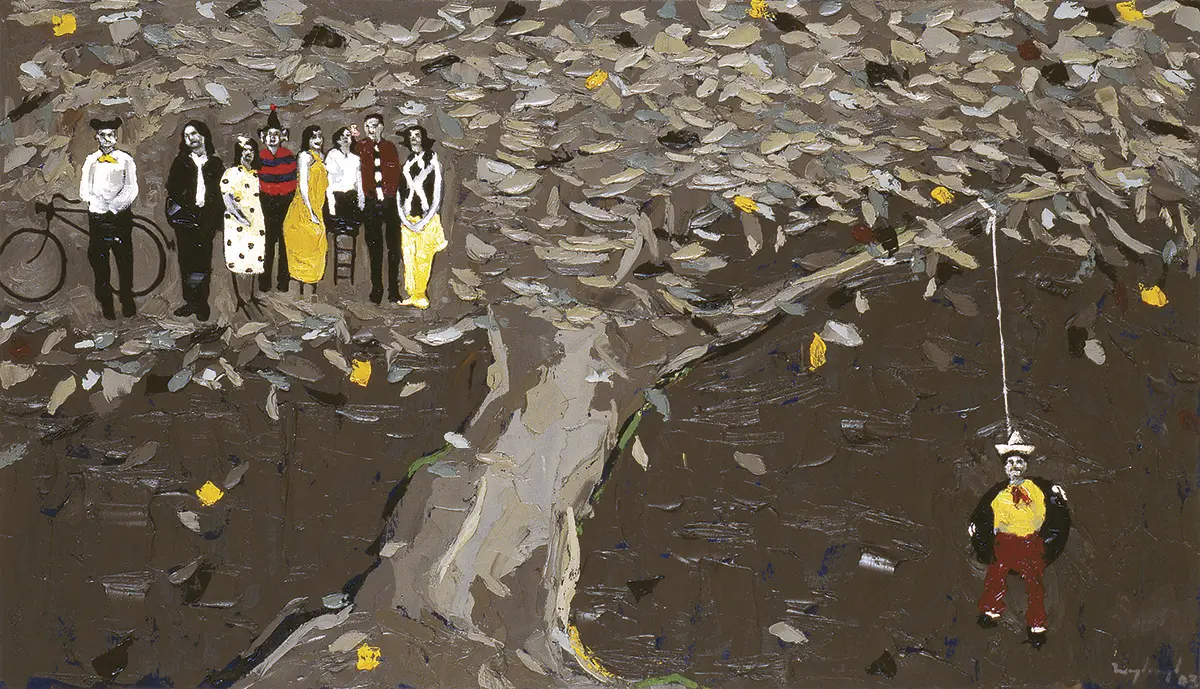
Now Meza returns to painting with a proposal that retains direct links to his previous work while presenting deep formal and symbolic innovations. The artist’s palette continues to be circumscribed to sepia tones and some touches of primary colors, with heavy applications of paint where the oil, in thick layers and short brushstrokes, gives the piece a dense, enveloping texture in which backgrounds are no longer entirely flat, nor are the characters scarce. The new element in Meza’s work is the tree, which acts as a compositional axis and even lends its name to the show as a whole. It is through the tree that a new pictorial space is constructed, where the trunk insinuates the idea of verticality, marking an “up” and a “down” in opposition to the strong horizontality of the foliage that divides the work from left to right, organizing it in horizontal registers. In this series, Meza also explores the representation of large groups of characters—who are almost caricatures—gathered under the tree or supported on its leaves.
Friends, ghosts, and memories, all convoked and transfigured with tenderness and humor, gather in an unreal landscape, strongly marked by the material elements of the formal, plastic construction. As the artist explains in the text included in the exhibition catalog, “The craft of seeing is so elemental that we often overlook the simplest stuff, the basics, that which lends magic to things.” In his work, Meza attempts to connect with those visions that are sometimes discarded as apparently insignificant. The image of the tree and the fantastic human beings that inhabit Meza’s paintings speak of both a symbolic universe related to individual memory and the image of life as an unlimited identity hosting within itself all human dreams and deliriums. This sensation extends through the whole gallery and covers not only the visual aspect of the work, but also the tactile, thanks to the wealth of textures, and the olfactory, by filling the air with the smell of oil paint. La Casa Del Árbol, the presentation of Miguel Meza’s recent paintings, is also the physical evocation of the magical universe he attempts to represent.
SUSANA QUINTERO BOROWIAK