The objects and the nude images are arranged against painted backgrounds that resemble landscapes, wallpaper-covered walls, or game-board designs. This unusual combination suggests the possibility of transforming the painted nude, which possesses a different genealogy than the other components of the series, into an object like any other, one that expands the typology of objects. Some of the found objects are manipulated into establishing formal and conceptual relationships with the nude images in the upper registers. The objects, which are homologous to the nude images since the latter do not extend beyond the triviality of the former, are meaningful inasmuch as they define the relationship between subject and object. This relationship is important in Invocaciones because it not only establishes a link between what is painted and what is collected but also because it points to the centrality of objects in our times. Jean Baudrillard has elaborated on the fact that human beings are not surrounded by other human beings, as they were in the past, but by objects.1 It would seem that our search for identity and for the meaning of existence is guided by them.
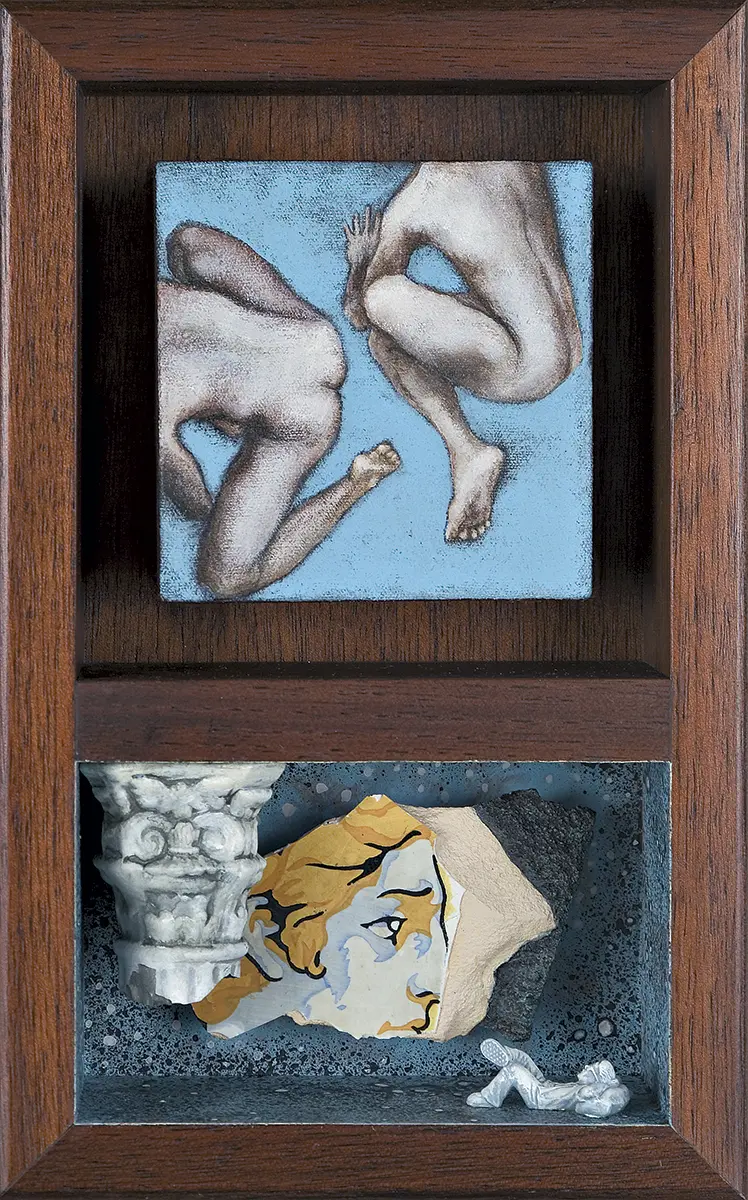
The objects in Invocaciones are a reference to the practice of collecting, which has interested Millán since his youth. He collects like his grandmother, who kept objects of little monetary value in a handbag, but unlike her Millán cuts them out, and pastes or transforms them in order to show them later as part of a group of objects that, next to the painted nudes, acquire the status of art. Insignificant objects reappear transformed but retain the aura of the old. It would seem that through the practice of cutting them up, pasting, or painting them, the artist adds more artificiality; a lack becomes an excess of that which the objects already possess. Signs of passion, of nostalgia, make it possible to face the passage of time as well as to confront the impossibility of physically returning to the past, and the ability to enter into an imaginary temporal cycle organized around the collection.
Millán, like a postmodern Linnaeus or Mendeleïev, organizes and relates the residues of the past, creating a new, hybrid species, the result of everyday life. Within this new species of art objects the personal and the intimate are reaffirmed and highlighted as examples of the process of personalization that, according to Gilles Lipovetsky, constitutes the new logic remodeling all sectors of social life.2
Millán relates the components of his pieces but doesn’t mix them. The placement of his nudes on the upper register imposes a hierarchy in spatial terms regarding the manipulated objects. Nevertheless, the placement of the nudes, as in Pequeña invocación #2, and Pequeña invocación #7, doesn’t render them more important than the objects. The represented youngsters, postmodern kouroi, lean back, tilt, and sit down, but do not surpass the floor. In fact, their closeness to the floor could be interpreted as a metaphor for unheroic, insignificant acts. The triviality of these young figures connects them to the objects, reaffirming the gravity and, in some cases marking the humor of these works. They are examples of an art that has integrated humor as one of its constitutive parts.
The ignudi erode the possibility of transcendence. Yet, some of the pieces resemble altars that evoke, in a poetic fashion, topics of profound meaning, such as the human dilemma in the face of chance or fate. Examples of this are Ixis Afixis and Invocaciones. A constellation of cloned faces, copies of a single individual, covers the background in both these pieces. The series of faces manipulated by a pictorial extreme makeover was taken from a photograph recycled by the artist. A small wooden man, a three-dimensional figure on a hybrid support gives his back to the viewer in Ixis Afixis, and the bust of a figure, also offering its back to the viewer in the piece titled Invocaciones is placed atop a column bought at some discount store. The figures gaze at the cloned faces in the background of both works. The faces, like modern sphinxes, evoke a new version of the old dilemma of identity. The small man and the back-turned figure interpolated in representation by the enigma that also confronts the viewer, are forced to face questions raised by art, questions that philosophy attempts to answer. Millán doesn’t necessarily want to overcome the slavery of those trivial objects; yet, in his painting, these objects seek a more dignified function than that to which they are subjected by the logic of consumerist society: they attempt to inscribe themselves in the complex dimension of art and to be part of the metaphysics of being.
NOTES
1. Jean Baudrillard, The Consumer Society, Myths and Structures, Chris Turner, trans. (London: Thousand Oaks and New Delhi: SAGE Publications, 1999), p. 27.
2. Gilles Lipovetsky, La era del vacío. Ensayos sobre el individualismo contemporáneo, Joan Vinyoli and Michele Pendanx, trans. (Barcelona: Editorial Anagrama, 2000), p. 5.
INGRID MARÍA JIMÉNEZ MARTÍNEZ