
rain drips. The walls
that saw men die,
that saw gold flee,
that saw the end of the kingdom,
that saw, saw again, saw
no longer see.
They also died.
This
fragment from The Death of the Houses of Ouro Preto,1 a poem by Carlos
Drummond de Andrade (whose centennial was celebrated not too long ago,) was
written on a second-floor wall at CCBB in São Paulo for Nuno Ramos’s recent
show there. Those same verses were repeated by amplified male voices coming
through speakers on the first floor, by the show’s entrance. Yet, they were
almost impossible to hear for any visitor. The noise and the vision of an
incessant rain coming down one of the building skylights, 20 meters high over
free space, had a hypnotic effect. The first impression was very strong,
provoking a mixture of bewilderment and bedazzlement. Later, after the initial
moments, the viewer perceives a “pool” formed by the accumulation of water at a
lower level of the doorway, on a delicate tile floor. It could be guessed that
a mechanism was pumping water from there and letting it flow through several
faucets installed around the skylight. The jumps, the unity, the noise,
everything provoked a feeling of imminent destruction, which, in a building
finished in 1901 and carefully preserved, gave the scene a much more dramatic
dimension. Drummond’s melancholy verses and the cathartic effect of Ramos’s
work function together in perfect consonance.
The show brought together four unseen installations. While the piece located on the ground floor, A morte das casas, is based on a close relationship to literature, the basement circular gallery was given to an installation whose dominant idea was based on Brazilian popular music, under the title of Alvorada (Dawn). Blocks of pressed sand, resembling large bricks, were piled up to form walls lining the sides of the hallway that runs around the building’s Treasury Room (this is an old bank in the center of São Paulo): they refer to the precarious materials used in construction in peripheral areas around the large metropolis. As visitors advance through the gallery, they discover carved letters in bass relief on one side and in relief on the other, in the end forming the phrase Alvorada lá no morro que.2 And it is there, on that improbable point, where the lyrics of the old and well known Samba de Cartola is interrupted: Alvorada lá no morro que beleza, ninguém chora, não há tristeza, ninguém sente dissabor….3 The piece is completed by a video shown inside the Treasury Room. There, several characters start, one after the other, in the same situation: they have been filmed shouting the word “Alvorada” through a megaphone, while at the same time, they are executed with a shot in the back of the neck (obviously, we only hear the sound of the gunshot.) In a rather literal way. The artists propose a different follow-up for the samba verses. In the alvoradas of today’s hills, dehumanization and violence make survival extremely difficult. Nothing is left of the lyrical (and healthy) image of the times of a naïve bohemianism, so cherished by samba composers in the 1930s and 1940s.
Casco,4 an installation in the Cultural Center’s second floor, again uses video alongside other plastic media. In this case, Ramos again works in tandem with filmmaker Eduardo Climachauska, with whom he had already produced some short films that interconnected Oswald Goeldi’s engravings and Nelson Cavaquinho’s samba. Located on a beach, their torsos bare and their faces covered in paraffin, actors recite texts written by Ramos, while violently destroying some old boats, and watch as the debris is carried away by the surf, covered by sand, and reconstituted in an aleatory fashion into new volumes. The text’s monotony and the inexpressive performance by the actors weaken the visual narrative, despite the beauty of many of the images. The video does not possess the poetic force of many of the pieces shown in the next gallery, made with parts of boats intermixed in sand and dark pigment amalgam.
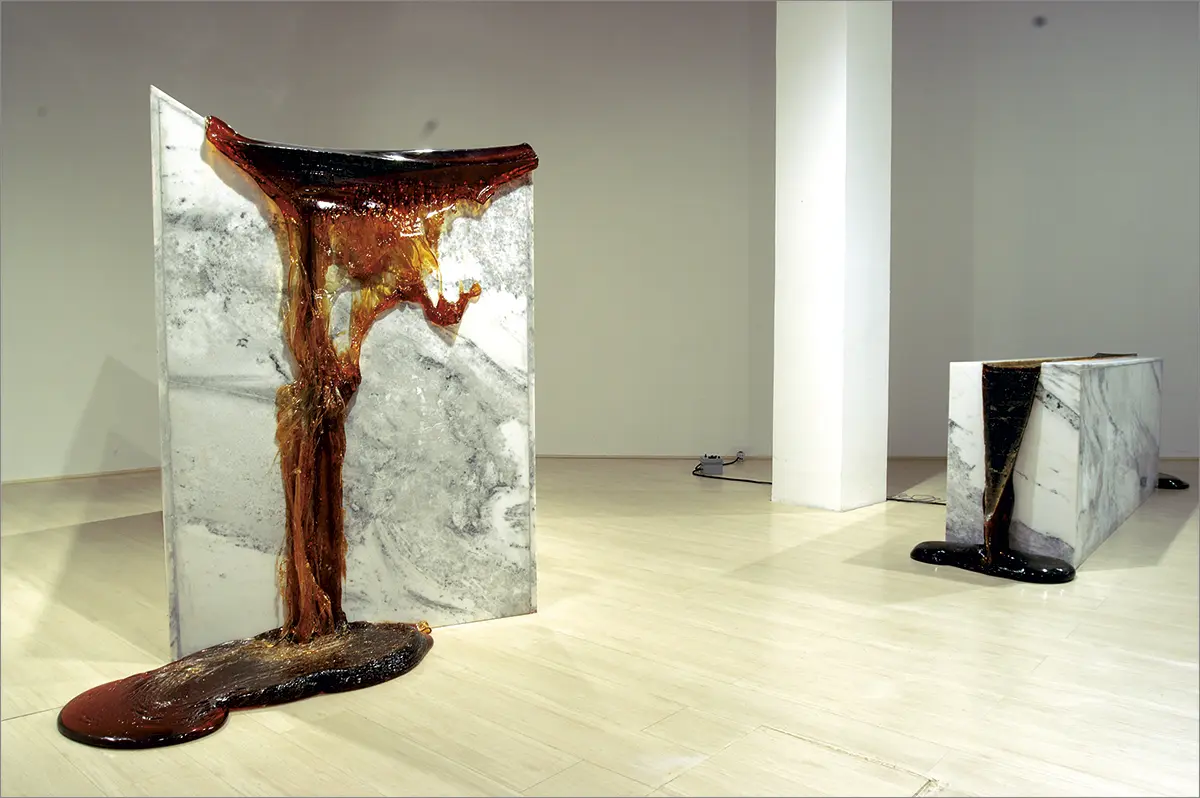
The only group of works not requiring the company of narrative, visual, literary, or musical references was exhibited on the last floor. Choro Negro (Black Weeping) presents tar rocks leaning against white marble volumes. A system of resistances stuffed into the marble pieces slowly moves the solids, creating the impression of melting tar. The marble volumes are rigorously geometric yet asymmetric, so they create tilted surfaces for the tar to drip down and accumulate on the floor. The piece evokes recurring issues in Nuno Ramos’s career; this young artist gained notoriety in the Brazilian art scene as a painter in the celebrated Casa 7 group, in the 1980s. One of the central issues was, undoubtedly, the recurring estrangement through the conjoining of strongly contradictory elements: white marble against dark tar; a cold stone that produces heat; the hardness of one material in counterpoint to the plasticity of another. Above all, it established the symbolic association of marble with tombstones. Again, Death.
Nuno Ramos had already proven to be a restless and entrepreneurial artist, one who ventures into different experiences using new languages —just as he is doing here, for instance with writing and video. The maturity he demonstrates in the intelligent use of the gallery space and, especially, the original and convincing reasoning of his three-dimensional pieces, is yet to be verified in those other expressive media. It has been a long time since he was the artist of those huge matteric assemblages (which lay there, condemned to decomposition) of the late 1980s. His newer work points toward greater containment and control over the final result. In them, he develops an almost obsessive reflection around the transforming effects of time. Effects that are often incontrollable and destructive, but which are also capable of re-articulating the same elements in new directions.
NOTES
1. Ouro Preto, a Brazilian city of great historical importance, located in the state of Minas Gerais.
2. See note 3.
3. “Dawn in the hill, such beauty, nobody cries, there is no sadness, nobody feels bitterness.”
4. It refers to the hull of a boat.
VALERIA PICCOL