With a group of twelve small- and medium-format canvases and thirty-three drawings by Roberto Matta, the Malingue Gallery (which organized excellent presentations of Yves Tanguy and Max Ernst in 2002 and 2003) continues its work promoting emblematic figures of Surrealism. This show hoped to contribute to a better awareness of Matta’s work in France and limited its scope to the period of intense creativity in the Chilean artist’s career when he lived primarily in the United States. The show was more cultural rather than commercial—only a portion of the works were for sale—and highlighted private lenders, a large number of whom were from North America.
Rigorously conceived by the French art merchant, among the most prestigious in Paris, the fine-grained and tight selection of works (1936-1944) accounted for those years of transformation and affirmation during which Matta assumed his mature surrealist moorings and made his entrance into the world of painting. These works confirmed, as if such confirmation were needed, the intimate energy of a complex and significant interplay of lines, strata, and blotches, and reversed the artist’s relationship with the world. The coziness of the locale (three medium-size halls) allowed viewers to appreciate, in a small space and with limited time, without a true chronology but through a trajectory dominated by affinities between the works, the elaboration of a structured plastic and iconographic language, with emphasis on the relationship between André Breton and Matta, and the place the latter occupied at the center of the Surrealist movement.
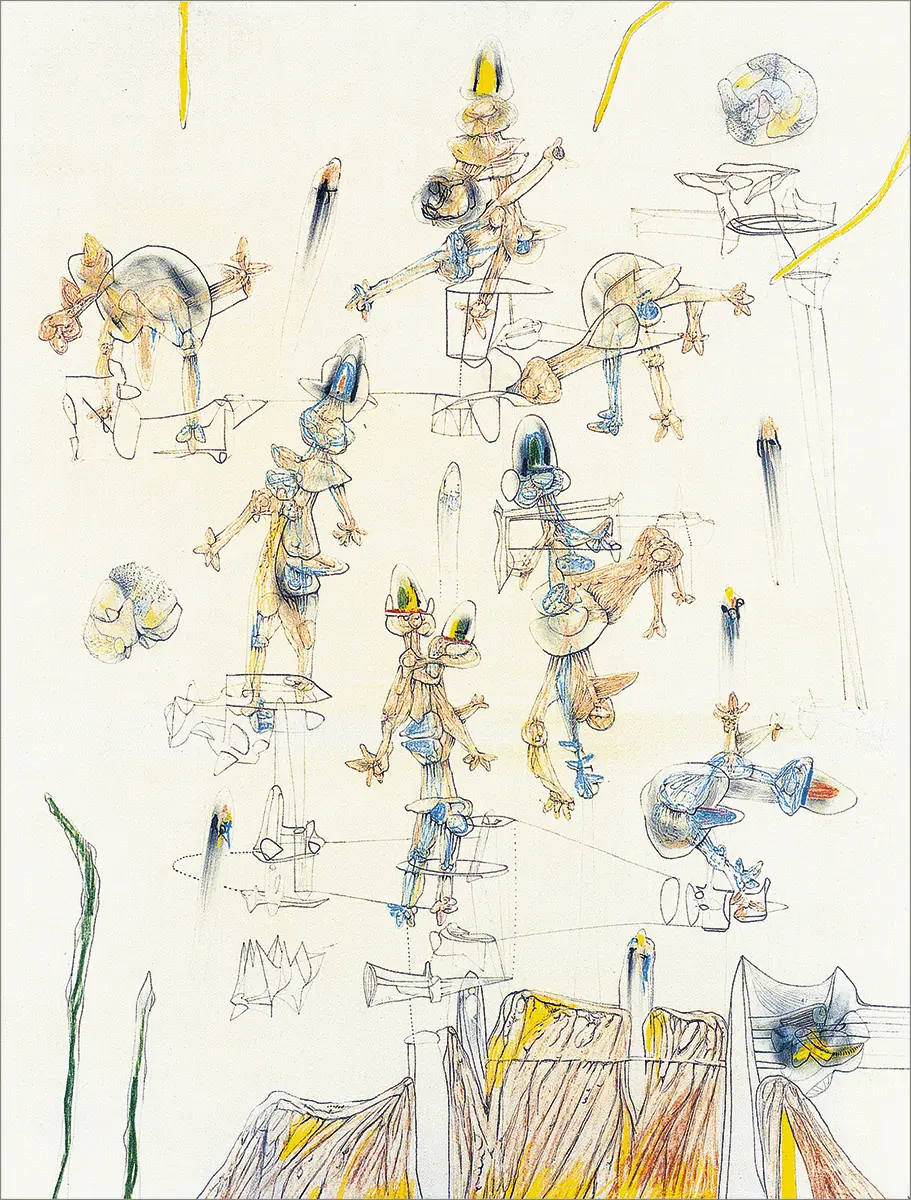
By way of introduction to the spirit of a time when the best painters and writers established a dialogue and blended the images of one with the texts of another—Latin American artists such as Wifredo Lam, Matta, Rufino Tamayo, and Alberto Gironella, to name but a few, were at the vortex of this privileged relationship—the show’s organizers gathered together in the first gallery several works by Breton that were illustrated by Matta. These works, among which were found The Surrealist Manifesto (Le Sagittaire editions, 1949, black and white illustrations) and Arcane 17 (original Brentano’s edition, New York, 1944, illustrations in color) attested to the intense and fruitful collaboration established between the painter and the writer that was fueled by Breton’s interest in Latin American art, and corroborated by his selection of artists such as Lam, Tamayo, Frida Kahlo, or Agustín Cárdenas, alongside Matta, for his anthology of surrealist painting (1928-1965). This initial exhibition space also included twenty-three works dated between 1936 and 1942 (a 1935 collage, the earliest Morfologías psicológicas, and several drawings that introduced Matta as an architect). In two of the 1940 drawings, The Horbites of Patricia (colored pencil and lead on paper, 65 x 50 cm) and Tira cómica (ink, lead, and colored pencil on paper, 42.5 x 53.4 cm), the gestural character of the tracings is already established with freedom we encounter again in The Displaced Continent (1944, oil on canvas, 72.5cm x 92 cm), which introduced Matta’s spatial explosion and organized dispersion in a perennial, cosmogonic kind of movement. In the remaining canvases of the Morfologías psicológicas series, painted between 1938 and 1939, the construction is structured while the fiber and texture of the drawn shape disappear, diluted in a transparent, undulant, eruptive color; the artist rejoices in his foray into painting the explosive spaces that foreshadow his future sojourn in Mexico.
The next gallery exhibited fifteen works (drawings and oils on canvas), and it was dominated by three large canvases, El diario de un seductor (1942, 126 x 96 cm); Prince of blood, Tragiptyc (1943, triptych: 76 x 184.1 cm); and Teoría del árbol, created in Taxco (1941, 74.6 x 94.9 cm). They reveal the impact of volcanic and subterranean Mexico on the unmooring of Matta’s pictorial space. If Teoría del árbol is still related to the eruptions of his Mitologías, the reduction of form and palette attest to a different explosion, a new catharsis. Diario de un seductor presents a cut filigree where the famous glass plates that divide space begin to appear. This is a space where blotches of color surrounded by a whitish opacity float, a kind of unstable and evanescent nebula. Prince of blood, Tragiptypc announces the era of large paintings, his cosmogonic universe electrified by a permanent revolution. The six magnificent drawings dated 1938 (colored and lead pencil) that are displayed around these three paintings let forth that organic element so appreciated by Matta—where the form is only suggested by the rubbing of pencil-stained fingers on paper—alongside forms that evoke the chaos of nature (boulders, caverns, stalactites, totems, rocks, etc.) next to the stars and other images that were to become recurring icons of Matta’s mental and pictorial universe.
The third gallery held thirteen works. These oils on canvas surrounded by relatively figurative drawings confirmed the relevance of the curator’s twofold intention: on the one hand, to invite us to capture the emergence of a unique iconographic and pictorial language in order to understand a key moment in an artistic trajectory; on the other hand, the museography decision to highlight the complicity that exists between the works and their shared or intertwined discourses. Two large oil-on-canvas pieces confront each other, Tallo verde, las posesiones (1943, 110.3 x 141.2 cm) and the emblematic El esclavo de la luz (1943, 195.5 x 251.5 cm), and establish a dialogue with two medium-format works, La pantalla (1941, 55.1 x 65.3 cm) and Locus Solus (75 x 94.5 cm), another occasional piece created in Taxco in 1941. In these two last canvases, whose luminous golden-yellow hue is balanced with gray and black areas, a constant liquid or aerial movement was installed. A magnificent contrast between stasis and movement stands out in La pantalla, a rarely seen small canvas from a private collection. The drawings surrounding these major works, such as Los suicidados (1943, colored pencil and lead on paper, 25 x 42.5 cm) underscore the symptomatic emergence of the figure, which was never fully lost and now returns to populate Matta’s anxieties and certainties alike. Several drawings from 1942 and 1943 (in the same vein as the former) attest to the Chilean artist’s permanent interest in humanity.
The purposefully reductive character of this exhibition (both in terms of time and space) allows it to display with even greater clarity the almost nuclear energy that flows through Matta’s paintings and drawings. This confirms our feelings about the nostalgia for meaning, a time when painting intended to deliver an experience, to evoke the certainties and the doubts of the imaginary and the real, to sketch the sins of existence, or to invent a visible or invisible knowledge; it was a time when there existed complete empathy between the creator and his work, and painting was inscribed outside the dominant discourse of fashion. Matta’s pictorial generosity invites us to conclude—with hope and in his own words—that “the question is not to be or not to be. The question is to be born from something and at the same time to give birth to something. It is not creating. It is procreating, engendering.”
CHRISTINE FRÉROT