His first individual show, held at A Gentil Carioca (the gallery opened about a year ago in downtown Rio de Janeiro, devoted to emerging production and managed by artists Ernesto Neto, Laura Lima, and Márcio Botner,) became a true challenge: to bring this investigation into the most conventional architectural space. Water, in its matteric, morphic, or symbolic aspects, is the show’s triggering and unifying element, recurring in every work. And when it relates directly to the architecture of the space, as in the case of Nuvem Transparente —Transparent Cloud (all works are from 2004,) Thiago seems to count more freely on the viewer’s comprehension, thus giving his own imaginary greater freedom, doing away with more traditional principles of representation, which are present in his paintings, watercolors, and photographs. The sculpture is executed through rectangular plastic planes that are filled with water, suspended, and installed in a skylight inside the gallery. With such natural light, it is possible to appreciate the alteration of intensities and drawings created by the sun and by the real clouds, up there in the sky.
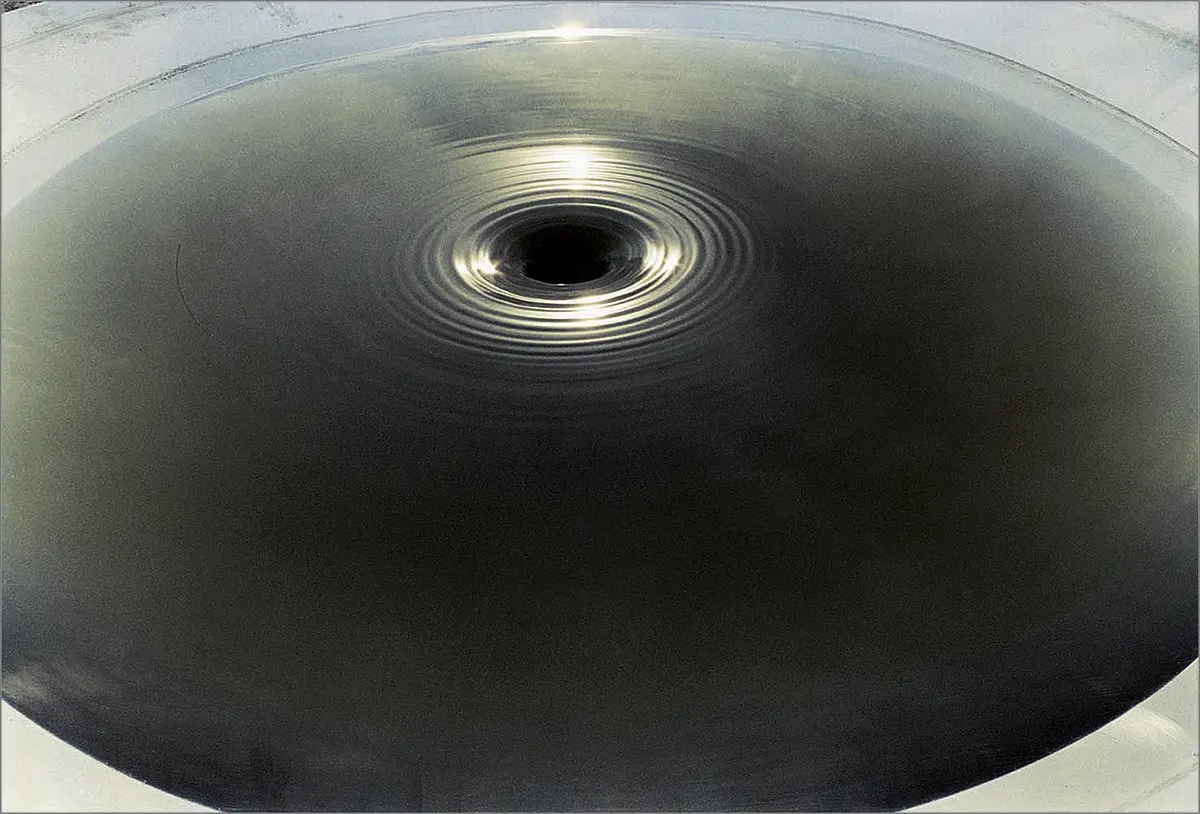
Interestingly, perhaps this is the strongest work in the show, thanks to its reference to the interplay of a progressive scale with successive stops in the sculpture itself, in the gallery, in the sky over the city, and finally in the universe itself. This is not the usual tendency to seek a “new physical perception” of the gallery space in order to let light filter through but to connect a piece of this space to a more comprehensive context, which is a simple and discrete (as well as symbolic and allusive) way invades the white cube through the sculpture. This kind of operation had already been deployed in Fonte (2003) a site-specific piece created for his show at the Pampulha Museum of Art: a kind of fountain inverted into a reflective concave arch, installed en plein air, which takes water from a neighboring lagoon and creates a circular movement in its interior only to return it to its point of origin. This sculpture not only evokes the life cycle, but it also welcomes, reflects, filters, repeats, and amplifies nature in the invention of art.
Fonte reappears in the current show in photographs of the same title showing the sculpture in Pampulha. Leaving aside the image’s plastic qualities, it is above all a documentary record of the sculptoric potential of water in the work and not of a photographic incursion on the action itself. The other photograph in this show, Chuva Fósil, is able to bring the viewer to a more subtle point of observation. It represents a rock in Rio de Janeiro, a small hillside, punished by the action of time, of rain, of nature. The tracings seen on the rock, painting amplified in the field of nature and captured by the artist’s eye, come to us interrupted by the act of photographing it, but it will continue through the centuries.
Belonging to a different series of works, rains appear in order to create atmospheric, vertiginous paintings: a triptych in which we are submerged in an environment charged with pictorial realism, where every drop of painted matter (ink) is equal to a drop of the same represented matter (rain) —the result is more abstract and process-oriented than naturalistic. Just as in the act of perception, there is a conflict between what exists and what is perceived. Unity appears as a pictorial attribute in the triptych (celebrating s tribute to romantic painters, especially William Turner): Sublimaçao, Condensaçao e Precipitaçao. A tempest over the seas: the action of gravity, which gives form in painting to nature’s water; the rock painted by the movements of water and time. The natural space is framed inside artistic thought. Formal debates occur between sculpture, painting, and photography. The interplay of nature and art began a long time ago. Thiago installs new ways of thinking about it.
RODRIGO MOURA