
Muniz famously extends this aesthetic by first making his “original” object referenced to something else—such as a famous painting—and made out of something else—such as sugar or syrup—that also references something else—such as sugar cane workers—before he makes his “original” photograph. Got all that? Such an objectified sense of subjectivity allows adults to play conceptual games while remaining engaged creators. This intersection is where Muniz lives and thrives.
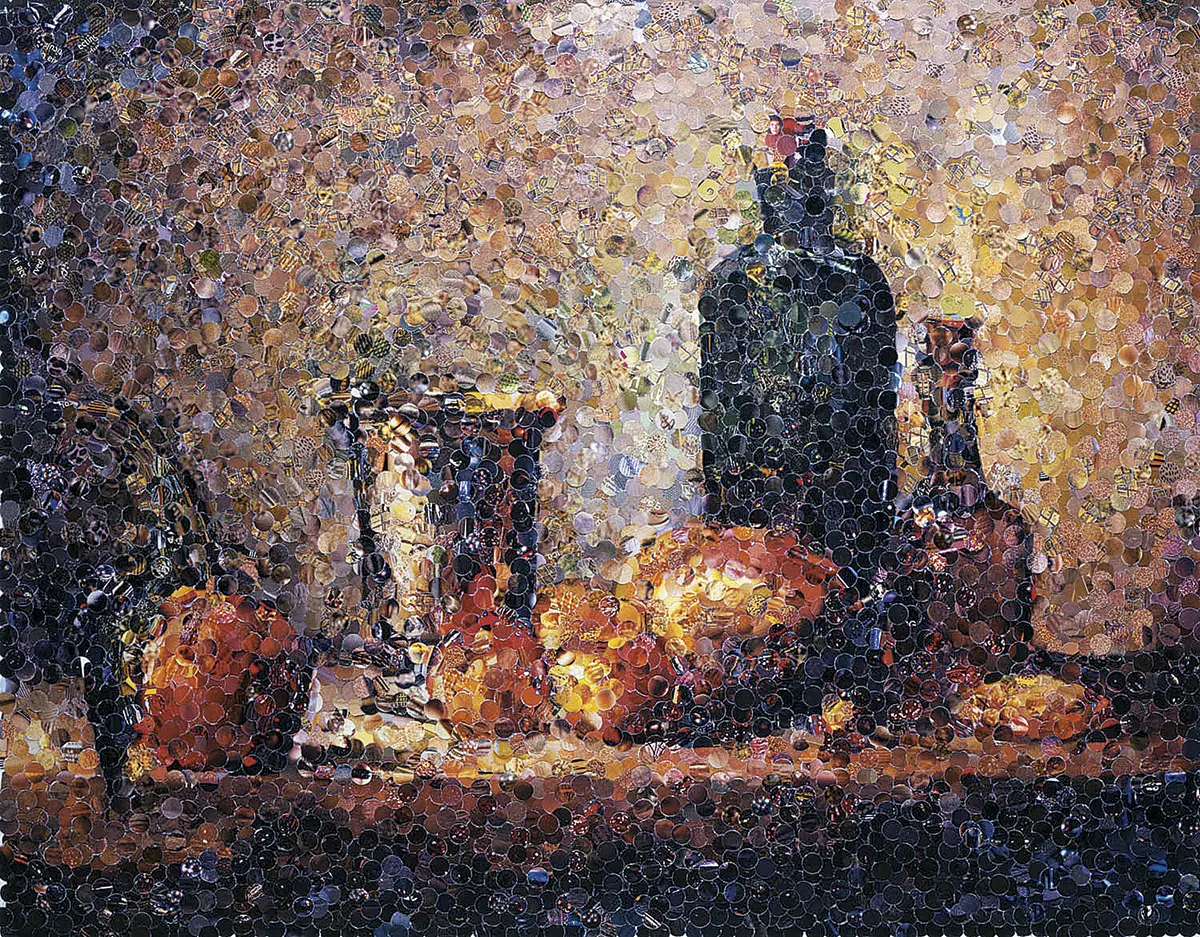
The original sources for the seven large-scale chromogenic prints at the Brent Sikkema Gallery are appropriations from famous painters. In this case, the “original” artists are known for their careful study of objects rendered into some kind of equivalency through the art of the still-life: Cézanne, Chardin, Morandi, Fantin Latour, Gauguin, and Sanches Cotan. But Muniz first recreated their still-life paintings from small, circular bits of colored paper taken from magazines using a paper punch. Since he prefers to work in series in order to explore a pre-established theme, the self-conscious title of the series is Pictures of Magazines. Please note he did not title it pictures from magazines. That is too clear and indexical.
One of Muniz’s favorite strategies, taken from the Conceptualists of the 1960s and 1970s, is a purposeful play between concept and thing that undermines the clarity of categorical separations. Now, you ask how is it a picture of, rather than a picture from a magazine? We’re not entirely certain, and the incomplete or non-answer keeps the question in conceptual play, that is, self-conscious.
The result is seven brightly colored creations that are not simply recreations, and that is the rub. Usually Muniz shocks or mystifies the viewer with his choice of materials—sugar, syrup, lint, thread—chosen partly for their aesthetic properties and partly for shock value, but also in large part for a dose of humor. The materials are also chosen because the medium has some strategic and critical relation to the concepts of formal problems that concern Muniz, or a social relation to the subject matter, or he wants to emphasize the fictional quality of images. Such multiple reasoning applies here.
The eternal aspect of his first source, the famous art, is now known and experienced through the ephemeral nature of magazine newsprint. But this does not make his work ephemeral because it is also returned to art status through the enduring record of a photograph—itself a medium that not too long ago was not considered art—and by its re-contextualization in an art gallery. Muniz also thickly layers levels of play between the bits of text found in the pieces of magazine, and through the illusionistic use of the flat paper to recreate painterly issues such as surface texture. Such homage to Jasper Johns is the perfect backward spiral of conceptual play Muniz so loves. But there is also a crack in the mirror.
Conceptual play needs to have a distance to work; it’s an intellectual way to comment and, to some extent, control. Here, the visual play is too strong, the brightly colored works too seductive and independent of both the original painting and the sense of separation that photography usually provides. The paper images establish themselves as separate works and this weakens them as an index to concepts. What you remember after you walk away are the brightly colored objects. But I don’t think my claim would disappoint Muniz, for several reasons.
First, Muniz trusts the effects of memory, having used it for years to distill what is essential. Second, that he has created something that is neither fish nor fowl, but remains an original creation is part of his long-standing goal to cross categories. Third, Muniz’s acceptance of the equality between materials is reasserted by the impression that fine art can be produced by bits of magazines. Fourth, that some dimensions of his conceptual aesthetic be undone through the juiciness of the visual object/creation supports his long-standing commitment to the experiential “truth” (his word!) of art. Finally, it points us to what many have chosen to ignore but what Muniz has claimed for years: he is a traditional and even romantic artist concerned with creation and recreation, aesthetics, and materialism.
Is this the end of the Muniz we have known? Not likely. But there is a change, and it is bigger than the work of one artist. The postmodernist strategies of self-conscious distance used since 1980 are wearing a bit too thin for the times. They do not play out as well because the nature of reality changes. Stay tuned!
RICHARD LESLIE