
Near the Kunstakademie in Düsseldorf, where a group of German neo-expressionists from the 1980s like Jörg Immendorf, Markus Lüpertz, Ohlen, and AR Penck teach, the K20 K21 Museum is presenting Germany’s second comprehensive show of works by William Kentridge (Johannesburg, 1955). It is not just by coincidence that this exhibition, which comes from the Castello di Rivoli, Museo d’Arte Contemporanea in Turin, has included the Nordrhein-Westfalen region as an important stop in its itinerary. Beyond the possible formal reference in his work to the expressionism of the historical avant-garde, last fall Kentridge received the prestigious international Goslarer Kaiserring award. With invitations to the two most recent Documentas in Kassel (1997 and 2002), Kentridge has secured his position as one of South Africa’s internationally recognized artists.
More recent works were included in this show, Kentridge’s second large-scale European foray (the first one was at the Palais des Beaux-Arts in Brussels in 1998). Curated by Carolyn Christov-Bakargiev, one of the most recognized experts in Kentridge’s work, the show also offers a substantial selection of the artist’s work in film. Films are among this South African artist’s most important oeuvre. In fact, the show’s spatial design was based on the films. The halls of the K20 were divided and designed for the loop projection of six films, among them two of Kentridge’s most recent productions: Fragments for Georges Méliès (2003), and Tide Table (2003). In another room, the public had a chance to see a selection of six animated shorts, among them the very significant Johannesburg, the 2nd Greatest City after Paris (1989). Toward the center of the six rooms was the Archive Room, which showed the preparatory sketches, drawings, and prints from the 1970s to 2003, as well as bronze sculptures. Rather than attempting to be a retrospective, the show also included works by artists who are essential for an understanding of several aspects of Kentridge’s work. The publication of a catalog with essays by the curator and by Jane Taylor, a Kentridge collaborator; commentary by the artist on his own films; and a comprehensive chronology make this show an obligatory point of reference for understanding his recent work.
Known for animated films based on charcoal and pastel drawings that are continually altered through the process of adding or erasing images, Kentridge has created a unique, immediately identifiable body of work that is entirely based on the combination of film, drama, and drawing. The result has been an exploration of drawing as a process in time and space; a kind of drawing that develops in multiple superimpositions on the surface of the white paper, thus creating a true palimpsest of images. This resource of “Stone Age filmmaking,” so named by the artist due to its primitive technical procedure, derives from an initial need to produce film without the expensive infrastructure of an animation studio. Kentridge began to shoot various drawings developed on the same piece of paper; in other words, he used the same support for each movement, erasing or adding to the previous one, unlike the usual animation process of one drawing for each movement. The result was images that fused into one another, like the bodies that become landscapes in his animation Felix in Exile (1995), or the gestures and movements recorded as the sequence of a shadow in space that is characteristic of all his films. At the same time, the cut-up figures and black silhouettes of processions against white paper backgrounds or printed pages from books—which are a part of his visual world—come from Kentridge’s long experience in the theater and in pantomime with Johannesburg’s Handspring Puppet Company.
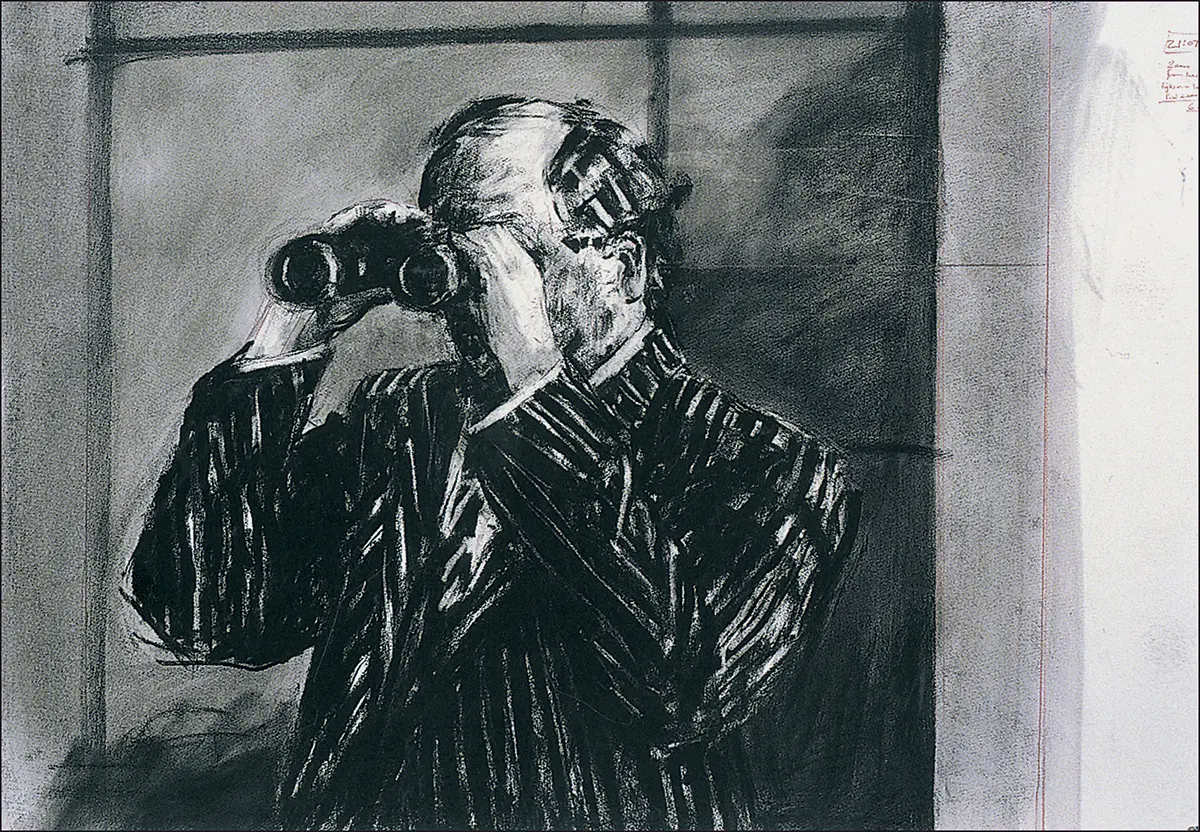
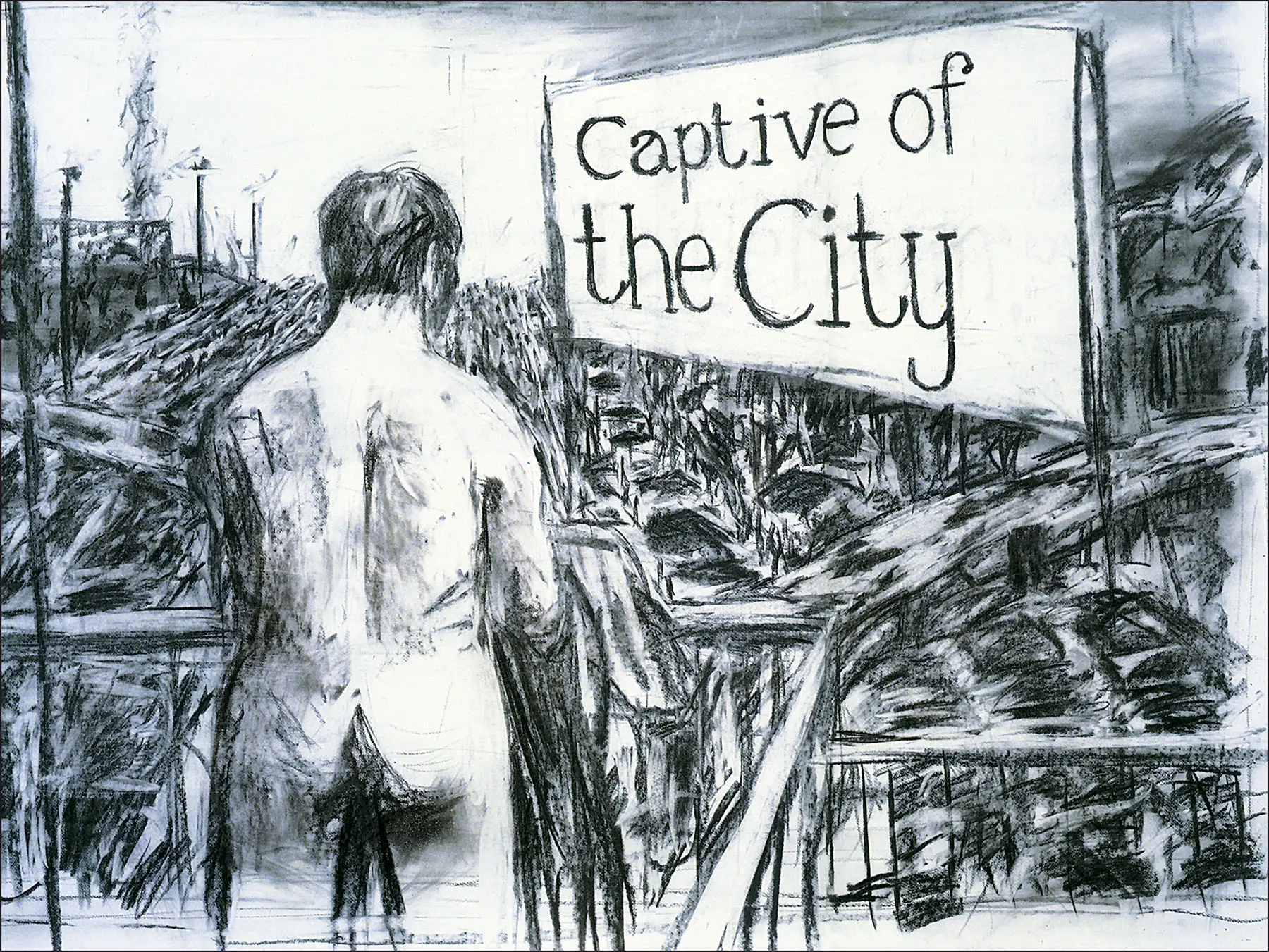
In general, Kentridge’s film narrative has centered on the psychological complexities of the individual and on an inward-directed gaze, having as its stage the complex socio-political reality of apartheid South Africa and its transition to democracy. From the earliest film in the series, Drawings for Projection (1989), Kentridge has used two characters or stereotypes: wealthy industrialist Soho Eckstein, and the artist’s alter ego, Felix Teitelbaum. With them, Kentridge has created true sagas, individual narratives that are immersed in the history of late-twentieth-century Johannesburg. On the one hand, Eckstein symbolizes the white elite that created a modern city of skyscrapers, the transformer of a suburban landscape ravaged by mining and other forms of “progress” that destroyed a certain Romantic vision of the colonial landscape. He always appears in a formal pinstriped suit, sitting in his office, immersed in a world of numbers, typewriters, telephones, alarm bells, and memos. On the other hand, the artist Felix, in love with Eckstein’s wife and almost always seen from behind and naked, offers a world of absurd objects, daydreams, and music that contrasts with the rationality of numbers-oriented, neocolonial capitalist mentalities.
The characters of Felix and Soho give Kentridge’s narrative a more personal view of South African history where politics, present in nearly all his films, permeates the everyday drama of individual life. The search for an identity and a place in the context of post-apartheid society is fulfilled in this process. Blacks are not represented or individualized; in that sense, Kentridge is not a hypocrite. Like critique, identification happens from within a privileged social class. A guilty conscience that partakes of the social situation of apartheid and its aftermath is subtly present in his later films, as in the WW I scenes linked to the white presence in South Africa in Zeno Writing (2002), or the transformation of a melancholic Soho in Tide Table (2003).
At first, Soho was a stereotype of the voracious and cruel capitalist, bringing to mind the drawings of German artists Otto Dix and Max Beckmann. In Johannesburg, 2nd Greatest City after Paris (1989), the film in which both characters made their first appearance, Soho is drawn grotesquely, and hurriedly. Additions and erasures are evident; Kentridge’s draftsmanship is fast and nervous, and he doesn’t try to hide the “mess,” so to speak, of backgrounds worked one on top of the other. Soho’s empire is built on the anonymous mass of workers in his mine. He buys part of the city, seen in profile against his menacing shadow; he eats and throws food at the workers with aggressive gestures. Felix is drawn with greater care, and his relationship with the city is more romantic; it appears with large loudspeakers and harmonious sonorities. His presence and his furtive visits to Soho’s wife establish scenes where bodies fuse in the desolate landscape of the suburb and create an intimate history within the same context. In Johannesburg... Kentridge appropriates the narrative mode and tempo of silent film. Words present situations and narrate the story. In this way, individual memory intermixes with collective memory in a subtle game of representation by means of images and words that have as their background the same social context, the perception of which differs according to the character. In individualizing situations, Kentridge offers us a unique vision of transformations within the space of the drawing, which makes formal reference to the memory that sublimates life’s painful events through substitutive images.
During the 1990s, Kentridge developed the characters of Soho and Felix with a less stereotypical psychological profile. The narrative always has as its background the social and political situation of the period in which the film was conceived. The drawing has become more precise of late, and the characters begin to have faces that ultimately resemble one another, and finally Kentridge himself. Blue lines for water and communication cables and red lines for violence or blood traverse the drawings, which formerly had been uniformly black on a white background, or vice versa. In Sobriety, Obesity & Growing Old (1991), Soho, after his wife leaves him and his empire falls, becomes a more introspective person. The topic of abandonment and loneliness is developed against the background of a climate of protest and agitation in South Africa. The collapse of Soho’s private and public worlds is also represented by the explosion of a bomb and the fall of the apartheid system. Introspection and melancholy take over the character that had been his counterpart up to that point: Felix.
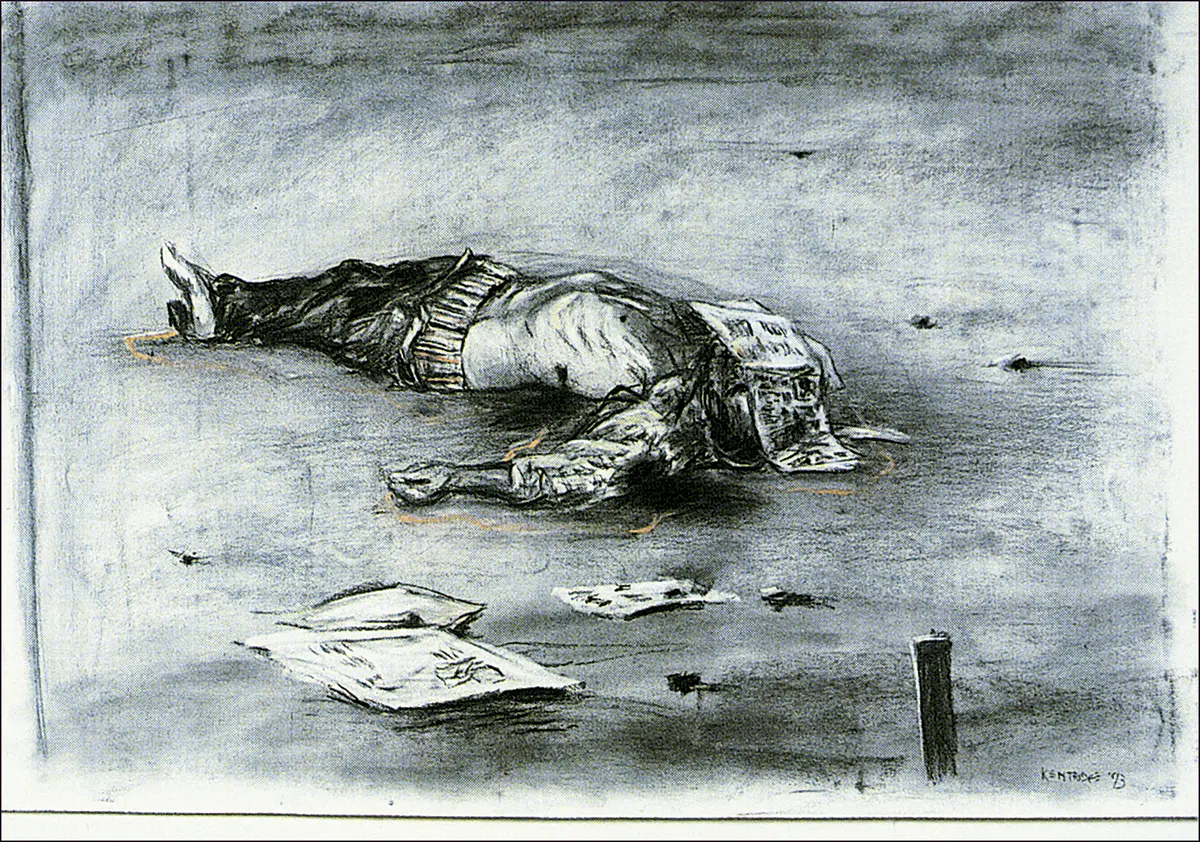
Felix in Exile (1994) is also a work of remembrance. In a locked room covered with paintings from floor to ceiling, Felix examines a suitcase filled with drawings done by a black woman, Nandi, who observes him from a different place through a kaleidoscope. Lines seem to fly off the paper and expose dead bodies, the victims of violence in the desolate landscape of the suburbs. The landscape is also a matter of reflection in Kentridge’s films. The constructed landscape of Johannesburg’s outlying areas has witnessed industrialization, abandoned factories, heavy digging and mining machinery, communication towers, and unfinished roadways that speak of lived history. Machines become bodies in the incisions through which red lines flow, are transformed, and return to the landscape. Bodies are also covered and uncovered by newspapers, a regressive inverse action in the film, a technique Kentridge often used afterward, especially in his tribute to Méliès.
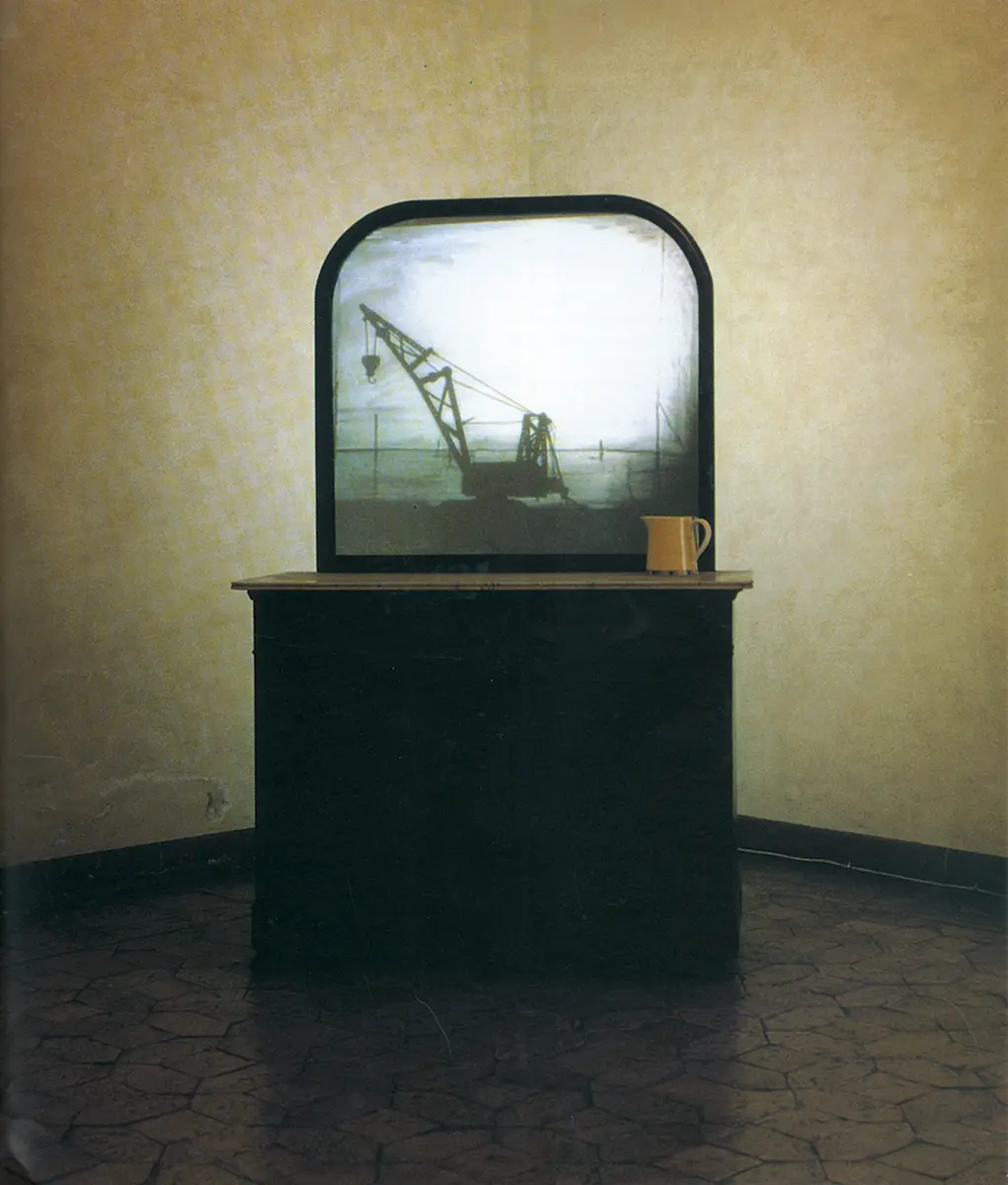
Nostalgia and melancholy pervade the almost dream-like visions of the drawings and silhouettes in Kentridge’s films, especially in Sleeping on Glass (1999). After crossing the gallery where Zeno Writings was being projected, the visitor enters another gallery, occupied only by a chest of drawers and a mirror screen. Sleeping on Glass, with its unconnected images projected on the mirror is a true metaphor of dreaming. Behind the chest of drawers was a painter’s easel supporting the real mirror on which the film was projected, which in turn inverted the image on the commode’s screen. The work combines cut-up silhouettes, animation, and images of a woman in a state of reverie. The film is a synthesis of the elements that have become constant in almost all of Kentridge’s recent films, drawings, and in the later bronzes of the processions. Banal domestic objects such as jars or coffee pots fuse with the devastated landscape of the city’s suburbs. Processions of characters morphed into machines, a tree, and words, and the film’s characters—which to a degree resemble the artist— appear in successive images. Sometimes these sequences remind us of artifacts from the earliest days of cinema, kaleidoscopes, or measuring instruments that tie us in some way to the processes of memory and dream.
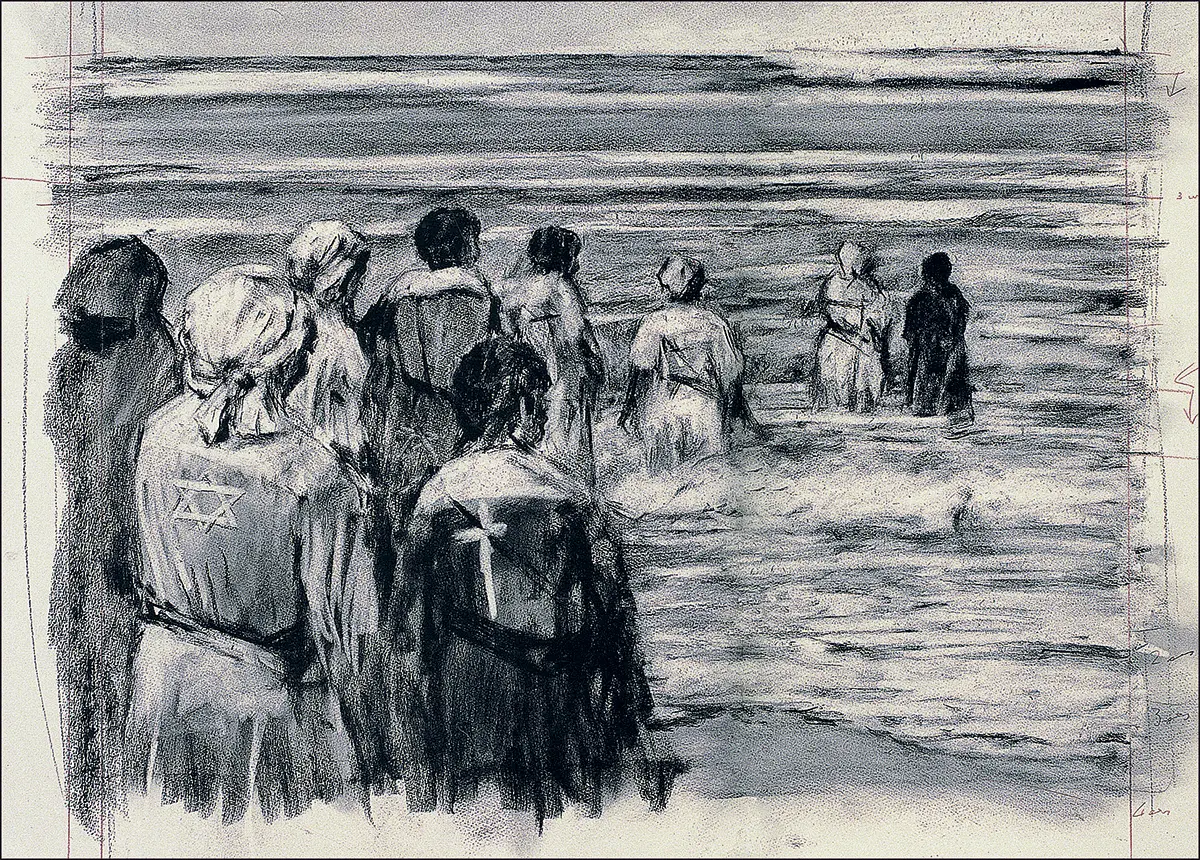
Music is always a fundamental supporting element or commentary on the image. Just as his films are filled with unconnected realities and objects, Kentridge mixes opera and chamber music with very elaborate popular African rhythms and songs. Kentridge’s films are also a symbol of the post-colonial situation in South African culture: a culture of transitions and intermixing, marked by dominant cultural referents. “Blackness,” present not only in music, is seen in the presence of the suffering “other” and as an element of social critique that influences the main story. Blacks have begun to play protagonist roles in Kentridge’s films and appear either individually, like the character of Nandi in Felix in Exile, or in the intimacy of their rituals and suffering, as in Tide Table.
While we can feel the artist’s subtle presence, or at least the projection of his personal worldview, in Medicine Chest (2001), self-portraiture becomes more explicit. Kentridge’s drawings are projected in temporal succession on a medicine cabinet that is attached to the gallery wall and divided into three parts by pieces of glass. The same objects appear in a reiterative way, but here they are linked to a memory of the subject reflected in the mirror—the artist, that is, who approaches it for his morning shave. Birds, jars, pitchers, and again Kentridge’s desolate landscape are presented in a melancholy succession. This is undoubtedly one of Kentridge’s most intimate films, due not only to the size of the projection on the medicine cabinet, but also to the sequence of objects that elicit the memory of something absent, or lost.
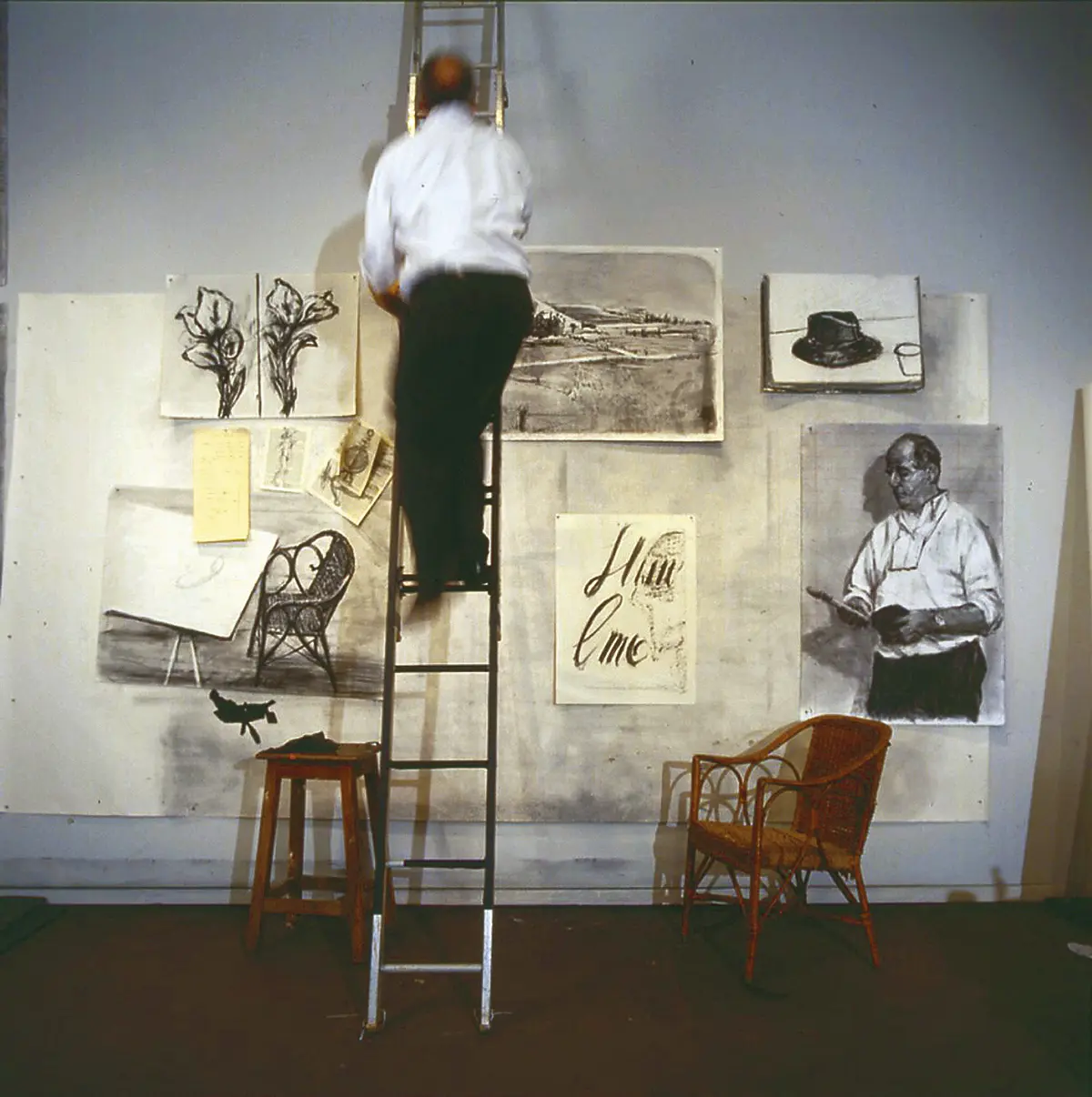
Other recent films are also exhibited, such as Zeno Writings (2002), based on Italo Svevo’s 1923 novel Confessions of Zeno and Tide Table, both of 2002; and Fragments for Georges Méliès (2003), where Kentridge pays tribute to one of cinema’s pioneers. Three projections on a wall play with Kentridge’s own apparition in his studio, and three more present other recurring Kentridge themes. Indeed, the axis that runs through these six projections is the idea of the artist in him/herself as a metaphor for the creative process. On three screens we see the artist’s dance-like movements apart from the camera that has been placed frontally across the paper on the wall: his self-portrait repeatedly rips, constructs, and deconstructs in a process of inversion and backtracking. Imaginings, ghosts, melancholy, the reverse of the image, and the passage of time are presented on two other screens on the wall across the gallery. In yet another projection, the designs created by the comings and goings of ants are turned into moving white lines against a black background through a process of film reversion and complete the narrative. Kentridge is introduced like Méliès in the studio-created world of “magic.” The artist’s espresso coffee maker is Méliès’s moon-bound rocket; the unintentional drawings done by the ants are the sky and the constellations, and Kentridge’s fantasy becomes reality through the process of animation that anchors his intervention in the “real.”
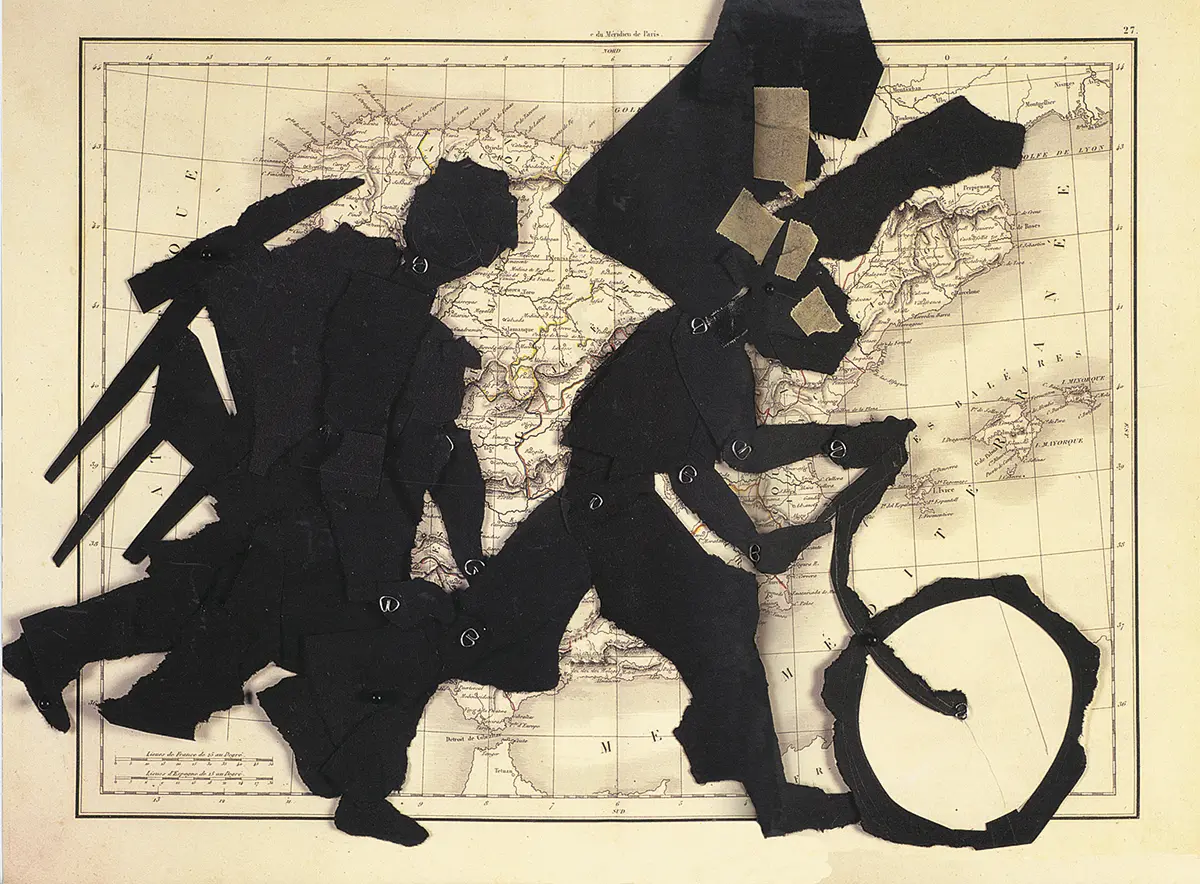
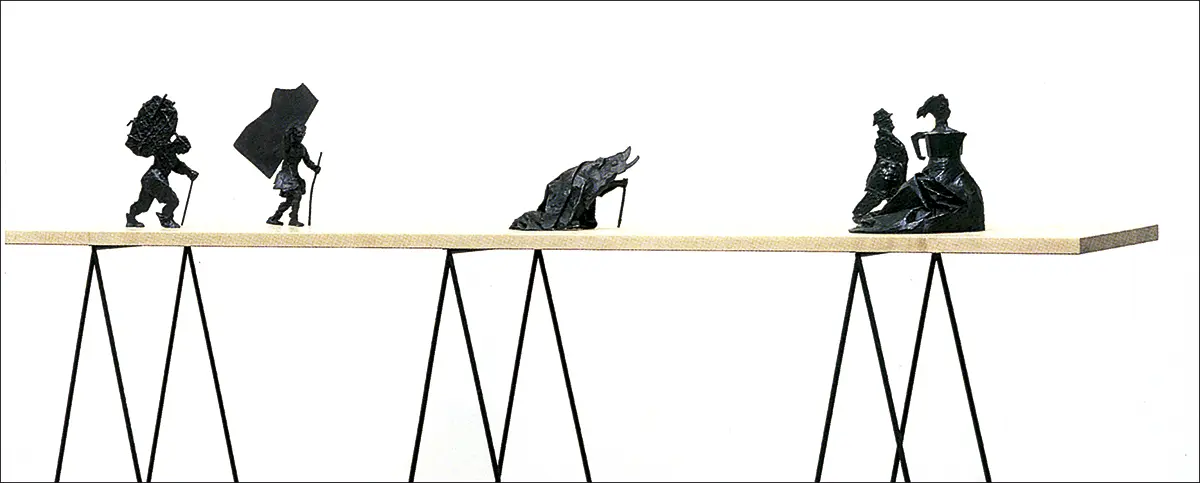
The Archive Room is the only gallery devoted to Kentridge’s drawings, sketches for films, and bronze sculptures. Painted in blue, the gallery intentionally recalls the aesthetic of a history museum, with its display cases and boxes containing historical evidence, but it could also be the artist’s room in Felix in Exile, covered to the roof with paintings after having been flooded with blue waters. In the center of the gallery is a piece of furniture that is part of the installation. Engravings from Francisco de Goya’s series Los Desastres de la Guerra (1810-1820), drawings by South African artist Dumile Feni, and other references are exhibited here alongside Kentridge’s engravings and drawings. In Kentridge’s drawings for the film, we can clearly see his tremendous mastery of line and the traces left by images that he has transformed. In his desire to expand and play with line, to experiment, Kentridge’s versatility has inspired him to mold in metal some of the procession’s figures. Twenty-six bronze figures are presented in the same way the films were displayed on the surface of a long rectangular wooden table, simulating the black, hand-carved silhouettes glued to the pages of a dictionary in Portage (2000).
Kentridge’s experimentation occurs within the boundaries of drawing and animation. He is not an artist of abrupt formal shifts or ruptures with a visual tradition of representation, but a subtle transformer of a personal aesthetic that has become a recognizable style. His debt to the art of the past, to certain humorous, narrative social critiques, and to the mixture of animation techniques, film manipulation, theater, and mime, make Kentridge one of the few contemporary artists capable of integrating different media and cultural traditions. His particular achievement has been the construction of a comprehensive narrative that records and articulates the history of a country in transition through his memorable characters, Soho Eckstein and Felix Teitelbaum.
NOTE
The exhibition will later travel to Sydney, Montreal, and finally, Johannesburg, where Kentridge lives and works.
DERMIS PÉREZ LEÓN
Art critic and independent curator.