Delcy Morelos, born in Córdoba, a conflict-torn region of Colombia, has always been intrigued by human behavior, especially behavior that involves violence and aggression. This has driven her to develop a large-format kind of painting that began as a violent explosion of reds and has evolved into a dense matter, bound at the edges, that alludes to the different colors of skin or the coloration of internal organs through which vital fluids circulate. For Morelos, a reader of the latest scientific theories, the reality is complex, like a weaving that incorporates not only a multitude of elements and components but also a series of human perceptions that create a reality that is ever-changing, in a permanent state of formation and transformation.
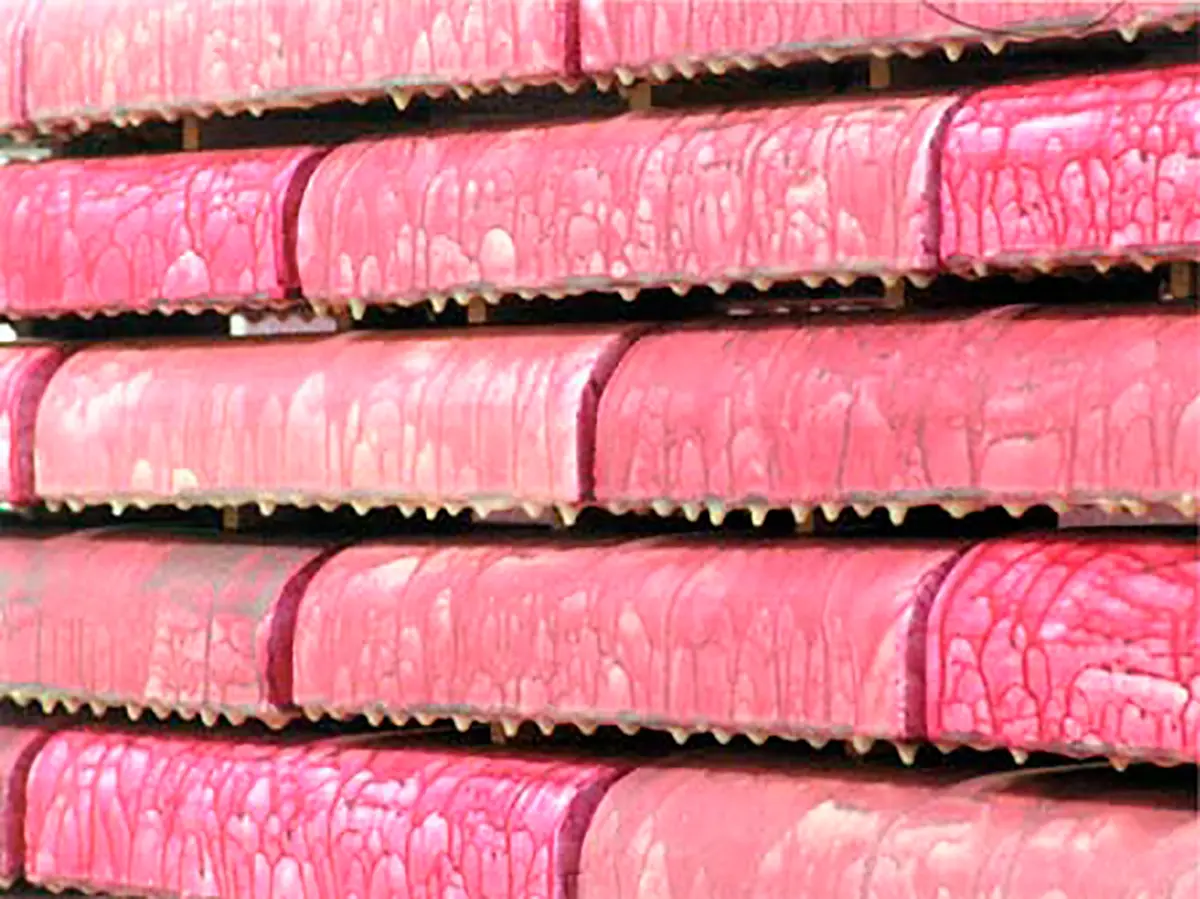
After presenting her installation Color que soy (Museo de Arte de la Universidad Nacional, 2002, and 8th Bogotá Biennial, MAMBO 2002-2003), where she painted a large variety of shades that recreate the various colors of human skin and alluded to cultural connotations, Delcy Morelos showed another installation, En la trama personal, at Alonso Garcés Gallery during May and June. The show comprised a group of twelve large-format paintings on paper, carefully arranged on one of the gallery’s side walls. On this same surface, a plot of vertical and horizontal lines formed a kind of orthogonal grid in a pinkish hue. On the wall across the gallery, along a horizontal line, the artist arranged a series of wooden modules painted in a more intense red than the paintings and covered with a transparent acrylic that gives them opacity. The front wall is left blank so that the successive disposition of the grid and the lateral modules creates a sensation of infinity that multiplies the space.
Studying the paintings carefully, we discover that within the structure, vertical and horizontal lines behave as the support of a weaving; lines that crisscross each other in space generate a low relief, which in turn is carefully worked using color. The raised parts are highlighted in a lighter shade, while the carved parts take on a dark red tone, like that of clotted blood. For Morelos, this color alludes to painful contact, the pressure applied to the body’s internal organs the moment two bodies touch. The interference of two perceptions is created in that instant; a kind of hematoma appears in that “personal plot,” and a new reality begins. These encounters, repeated continually through the gallery, provoke strong visual sensations that take over the general perception of space.
Upon entering the gallery, the viewer is struck by a strange association generated between the precise orthogonal distribution of the structure supporting the plot and the ordered arrangement of the modules in opposition to the substance that covers them, a dense, heavy paint in irregular, organic shades of pink, whose texture refers to the interior of the human body and to the coloration and the materiality of bodily fluids. Delcy Morelos defines this relationship as the strange encounter—which she became aware of in her studio while executing this work—between the art of Mondrian and Francis Bacon.
In Bacon, The Logic of Sensation, Deleuze alludes to the diagram, a term Bacon used to designate the moment prior to the creation of a painting, and establishes a connection between these two very different artists, joined through the practice of painting. The diagram is not exactly a sketch; it is the preparatory work in which the canvas is filled with random stains and marks that obey the order of sensations as they relate to data in the painter’s mind. This diagram at once implies catastrophe, chaos, and the beginnings of an order. “With the diagram,” Deleuze points out, “the preparatory work ends, and the act of painting begins.” In the case of Mondrian, we jump from chaos to a spiritual order; where horizontal and vertical lines meet in perfect equilibrium the chaotic diagram is replaced by a “spiritual visual code” that is perceived optically with clarity. “Bacon,” says Deleuze, “will not cease to insist on the absolute need to stop the diagram from proliferating, the need to keep it confined to certain regions of the painting and to certain moments in the act of painting... Saving the contour: there is nothing more important for Bacon.”
Delcy Morelos’s recent work evinces these two ways of understanding painting. Her diagram begins with an accumulation of layers of transparent, watered-down acrylic painting, superimposed with brushes on paper; when one layer is absorbed by the support and dries completely, another one is added. Through a slow process, the painter achieves the desired matter, tone, and texture. On the other hand, the outlines are geometrically and minutely defined, and they contain a vital, watery fluid. By installing her painting in the entire gallery space, Morelos impacts the viewer beyond the visual; the painting surrounds and envelopes the viewer’s body with that very personal plotting where Mondrian’s spiritual purity, an ideal order for the world, coexists with the palpitating flesh (the catastrophe) that inhabits Bacon’s work.
MARTA RODRÍGUEZ