
Philadelphians had a hint of the kind of work Neto does if they took a trip to the Carnegie International at the Carnegie Museum of Art in 2000 at the other end of the state in Pittsburgh. Neto is well known to European audiences but less so to denizens in the United States. The Fabric Workshop has been the harbinger of contemporary Latino art in their July 2002 installation, Jardín de Frutos Prohibidos/ZONA FRANCA (The Garden of the Forbidden Fruit/DutyFree) by the Puerto Rican artist Charles Juhasz-Alvarado. Though Philadelphia is close to New York, the Fabric Workshop provides a welcome service of keeping a close watch on representatives to the Bienal de São Paulo, one of the marketplaces of creative thinking in the visual arts located in São Paulo, Brazil. Avoiding the pitfalls of seeing Latin American art as prototypically about military juntas, lush and rare indigenous tropical plants, and/or spin-offs of French-inspired surrealism of the last generation, artists who have participated in the São Paulo Bienal are fully conversant in the need to express relationships.
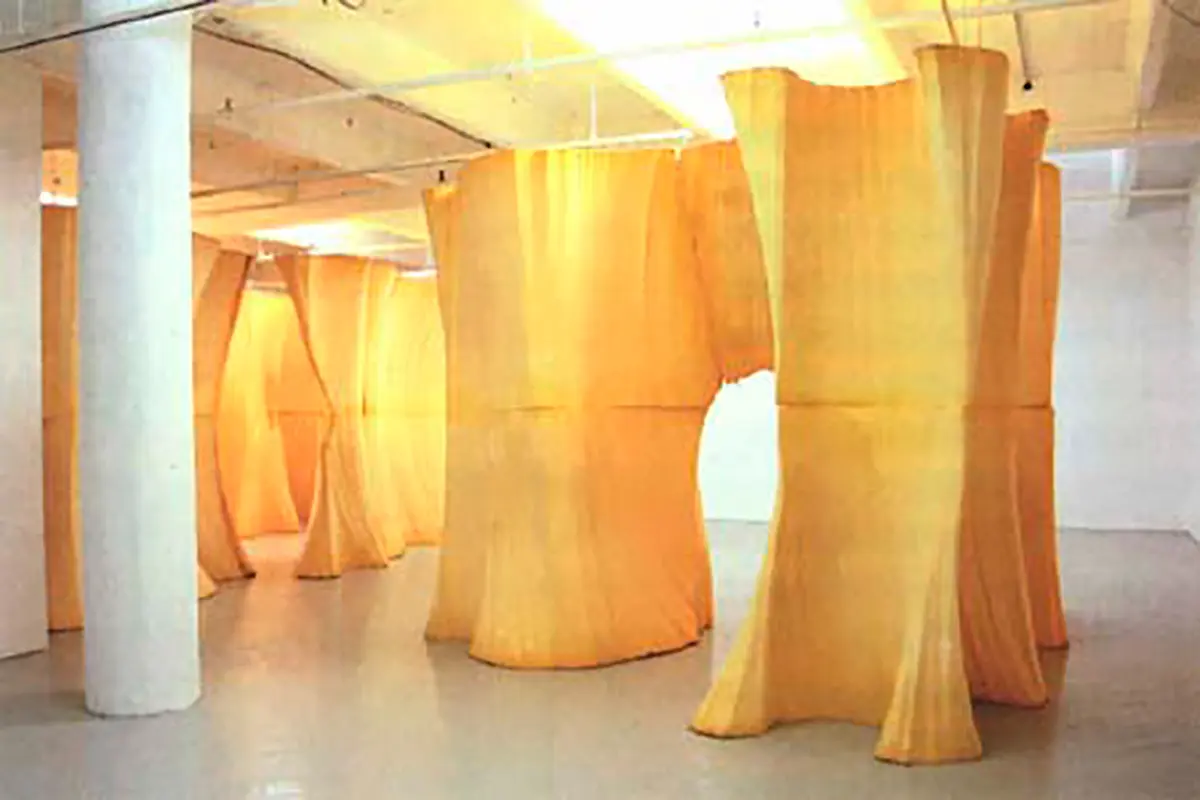
As in the Fabric Workshop piece, one needs to participate in Neto’s sculptures by moving through the undulating sawed walls. Neto’s pieces involve an interrupted contemplation. A bit like the artist himself, the work is nurtured by spontaneous creative wanderings. Neto has described his earlier pieces of stretched stocking jersey fabric as the ‘anatomy of his body.’ On the sixth floor of the Fabric Workshop in the large gallery adjacent to The Garden and The Gate, is the hour-long video of Neto’s talk given to the public on March 5, 2004. The artist is gregarious, and charming in his enthusiasm for his work and the excitement of discovery. He relishes learning from the smells and colors of a spice shop, of the falling and folding of tube-like balloons, and the technical problems of securing the thin gauze-like material of his sculptures to historic walls. He speaks to the baseness of his lead weights to hold down but purposefully pull, at times, latticed fabric so that a sexual/biological association permeates through the large installation. Light, a necessary ingredient for plant growth, illuminates and shadows his sculptures aiding their animated appearance.
Ernesto Neto is adventurous but both panics and wallows in the uncertainty of the creative process. He first saw the possibilities of fabric in twirled and elongated rope, in an elastic jersey, in the sensual orifices of splattered collapsed stockings, in the effect of gravity on the lead balls that weigh down his signature stocking room-sized forms all referencing colonies of terrestrial growth and astronomical expansion. The density of the multiple forms in some of his installations causes a vacillating state of tension and relaxation. Ernesto Neto’s work is both about novelty and being recognizable, yet there is an understanding that he never stands still. He uses various translucent fabrics but also opaque blocks of solid polyurethane foam in indoor and outdoor installations.
The process video in the Fabric Workshop front gallery shows cranes lifting the huge foam squares through the outside window of the Workshop. It shows Neto and five other men working a double-handled saw cutting through the thick foam to create the rippled surface of the walls. Wearing hats during a cold February, Neto and the studio assistants tugged, separated, carried, and refit the foam walls into several two-tiered pieces. The relationship of the scale of the gallery walls to the foam walls, the foam walls to each other, the foam walls to the void of the entrance to The Garden and to The Gate, and the foam walls to the active participant walking through the space is the essence of the piece in the gallery. The suggestion of primordial beginnings in the works of mid-20th century Chilean painter, Matta, is revisited by Neto with synthetic fabric now a global resource, as a reference to change through time.
LAURA FELLEMAN FATTAL