Entering this modest retrospective of the Icelandic painter Erró at the Grey Art Gallery in New York, one has an initial impression of chaos. This first-ever major exhibition of Erró in the United States has a little Lichtenstein here, a little Rosenquist there, a smattering of images from comic strips, some Japanese erotic woodcuts, and a dose of Socialist Realism.1 On closer inspection, it's possible to see a certain continuity of methodology. In an early series of collages in the Surrealist mode Erró appropriates and mixes together familiar Surrealist imagery using free association of ideas. A similar, more politically guided method is apparent in his later work in Pop aesthetics, where he blatantly appropriates and mixes imagery familiar to the Pop tradition. One could say that Erró appropriated Pop Art aesthetics the way Pop Art appropriated North American consumer aesthetics.
Erró became fascinated by Pop Art during a visit to New York in 1963 when it was the reigning aesthetic in the galleries. The fact that he came to it with a surrealist sensibility gave him sufficient distance to avoid derivativeness. Unlike mainstream Pop Art, Erró’s acts of appropriation were used for political critique. Pop Art was a visual discourse that took capitalist vernacular imagery and transformed it into high art through the application of formal devices. If any critique was implied, it was no more than the slightest touch of tongue against the cheek. No substantial political stand was reflected in the Pop Artwork regardless of the (mostly progressive) beliefs of its practitioners. In Pop Art, the abstract-expressionist tradition of political people doing apolitical art was continued. But this was an American twist on a project that had originated in England with different sensibilities.
When Pop art started in England with the show This is Tomorrow in 1956, it was generated by the artists’ critical distance from social events and carried with it an ironic posture towards consumerism in the industrial nations. Richard Hamilton’s emblematic collage Just what is it that makes today’s homes so different, so appealing?, which was specially made for that exhibition, was linked to an earlier development initiated by John Heartfield and Gustav Klutsis in 1919 with their political photomontages. When the British art critic Lawrence Alloway subsequently created and imported the term “Pop Art” into the United States, this notable critical distance did not travel with it, or at least if it crossed the Atlantic, it failed to take root on the shores of North American ideology. Two artists provided an exception to this rule. The first was Andy Warhol, who infected critical distance with cynicism, thereby managing its erasure for his own benefit. The second was Oyvind Fahlstrom (a friend of Erró since 1960), who created imagery that was politically informed, which seems to explain why he was never fully integrated into the North American Pop Art movement.
In U.S. Pop Art, a critical distance appeared around 1965, when [Elaine] Sturtevant (she doesn’t use her first name) created combination furniture with fragments that seemed to have been painted by the Pop masters but were fakes made by her. This started what later became known as Appropriationism. That same year Erró started his “Pope Art” series and appropriated Picasso in Magritte-like fashion in his diptych Papa Picasso, transposing parts of a portrait of the Pope into a Picasso painting and vice-versa.
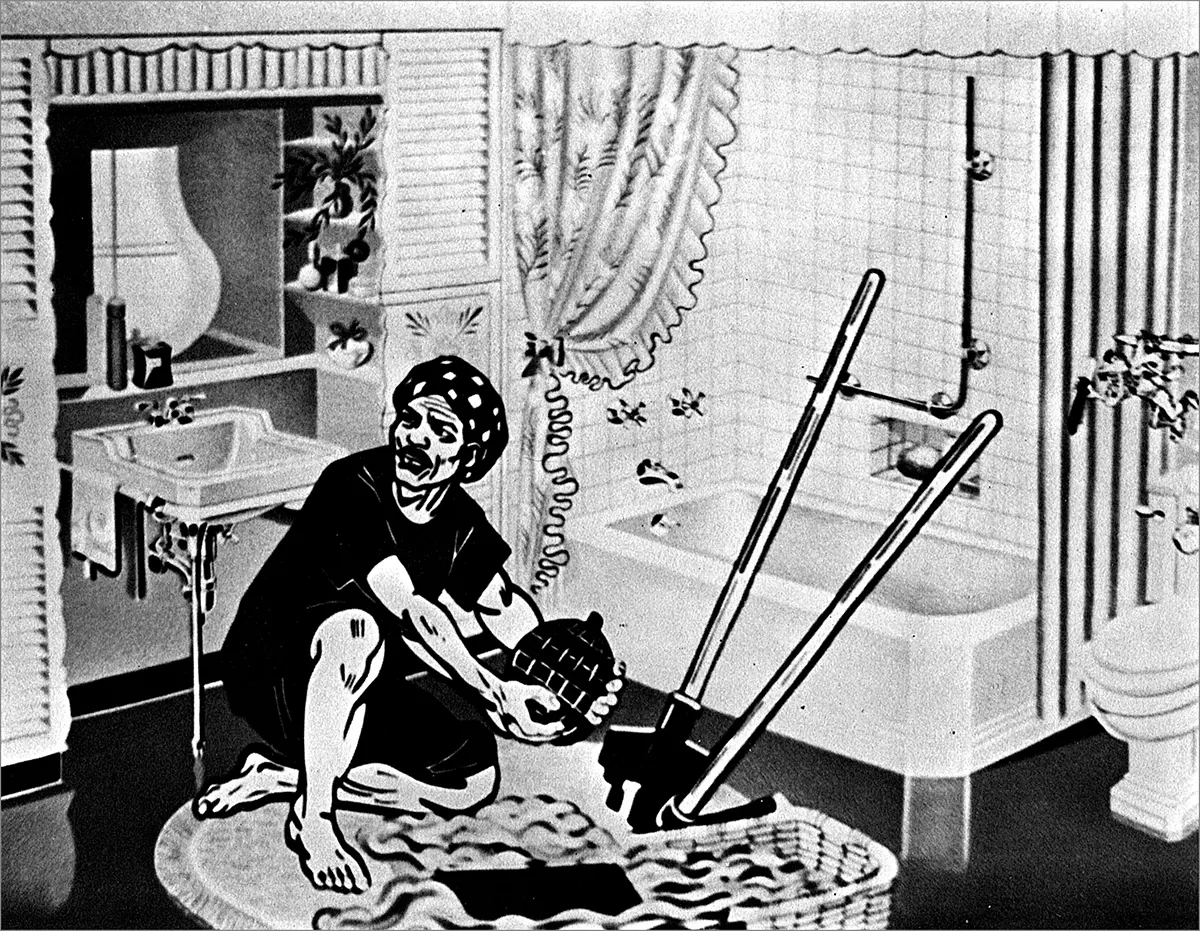
Erró began to move freely between styles to make his points, mostly politically acerbic points, as he carried appropriation to an extreme and jettisoned all formalist scruples. However, a direct visual link was established with the Heartfield/Hamilton tradition in Erro’s 1967-1968 American Interiors series, works that surprisingly and unforgivably are absent from this exhibition. These paintings, with scenes of Viet Cong soldiers invading American middle-class kitchens, were based on old house paint catalogs that had illustrations of painted interiors. Erró found them in Cuba in 1967, during his sojourn there to participate in the international mural that Wifredo Lam sponsored to honor the Cuban Revolution. At the time, the American Interiors series was one of the few achievements that escaped the confines of art and invaded the political consciousness of the observer. Today this series still stands as a unique example of art’s potential to challenge passivity and complacency. What the exhibition in the Grey Art Gallery, unfortunately, documents is that American Interiors was a peak performance that Erró has not since been able to match.
Erro’s subsequent work, however, is not dismissible. Formally, he continues with his connections to the Pop artists, particularly Lichtenstein and Rosenquist. However, if he had to be classed with other artists, they would be Fahlstrom and Peter Saul. Although Erró’s relation with Fahlstrom’s work is ideological, it also has a formal dimension, in that, like Fahlstrom, Erró makes much use of the language of comic strips. There is a conceptualist bent to the production of Fahlstrom, however, which is altogether lacking in Erró’s work. While Fahlstrom’s most important works were installations, Erró has been adamant in his emphasis on painting. (He’s made some excursions into film, happenings, and sculpture, but the weight of his production has been in painting). In terms of visceral emotional sensibility, Erró may be closer to Peter Saul, whose work takes an expressionist approach to cartoon language. But he is less subversive than Saul in that his use of visual media is more respectful of painting as a medium. One could say that Erró is an expressionist of the intellect.
Much of Walt Disney’s world has been pastel-colored, reserving cuddly curves to signify goodness and angular shapes to communicate evil. Saul takes benign cartoon characters and makes them threatening by the simple device of removing them from their safe place—a geometric universe of circles and ellipses—and distorting them into biomorphic, oozing, liquefied organs in aggressively acid colors. Saul’s technique is to seamlessly stretch characters into a repulsive shape. Erró goes about his work in a much more intellectual fashion than Saul. His anger and critique, though equally boundless, are channeled by a strategy that enables him to maintain his painterly cool, so that while Saul is obvious (and masterful) in his language, Erró is more obvious in his content.
Erró’s painterly language is a carefully assembled potpourri of styles. The narrative context and the combination of images and styles in collage form often give the result a sledgehammer quality. Erró does not internalize styles; he administers them as a collage artist lays out the paper clippings before gluing them down. In the end, there is an odd dissonance in his paintings. His indignation, sometimes carried to sophomoric heights, is expressed in images that are deliberate and coolly rendered.
If there were a cosmology into which one could fit Erró, it would be that of pastiche. It is this feature that probably justifies and makes important the fact that Erró focuses on painting. By confining himself to a relatively disciplined medium and controlling the images, he creates space for analysis without becoming a part of the discourse. Erró acts like a dispassionate but opinionated observer—an anthropologist—who ultimately wants to change the situation he is observing. I find something fascinating, though difficult to explain about his work. Perhaps it’s that he stands for a perspective from the periphery that is more clearly articulated in him in some fashion than in other artists.
Erró once denied his use of ideology: “Painting consists in overcoming silence and shock. Like an observer without religion, without ideology, a passer-by, a tourist."2 This is somewhat disingenuous, for Erró goes well beyond tourism. His observations about usage, custom, and belief are often incisive, and while he may be somewhat schematic in his perception of issues, one respects the anger and resistance driving the work. But whereas his American Interiors were clear and effective, the work exhibited here is not consistently so. It is advertisement painting, occasionally making a good point, but also frequently trivial.
Erró was born in Iceland in 1932 and raised on a farm. He was twenty when he left Iceland for the first time, going to Oslo and then to Spain a year later, after which he changed his name from Gundmundur Gundmundsson to Ferro, and then subsequently, in 1967, to Erró. In 1954 he studied at the Academy of Florence and started building friendships with European artists such as Jean-Jacques Lebel and Dieter Roth. Though neither was from a peripheral culture, both shared with Erró a distrust of the mainstream and a desire to disarticulate it.3
It was not until he achieved adulthood that Erró got to see the originals of the works he had studied in art history. Mainstream art is mainly seen on the periphery in the form of reproductions that inevitably give a distorted view. There are stories, for example, about the disappointment felt by Latin American constructivist artists in discovering the imperfections in the original paintings of Mondrian. Erró’s first experience of Surrealism was of “reproduced Surrealism,” with little knowledge or understanding of the context in which the mainstream art was produced. These aspects of cultural distance produce what might be called a “peripheral vision” affecting art made outside the mainstream. On the periphery, what is often understood as a view of the mainstream is really more of a view from the periphery.
Peripheral vision operates in two ways, one when art is imported, and the other when the artist is exported. When art is imported, it is how these achievements are re-used and adapted to indigenous socio-economic and cultural conditions that make them local, useful, important, and independent. The same peripheral expressions that are dismissed as “derivative” by guardians of the art centers, when seen from the periphery may represent a functional appropriation and transformation, blended and syncretized with local creations. Shapes may be adopted but put into a different context with different meanings. These expressions can be seen as examples of recycling, not very different from what happens with imported machinery on the periphery. Parts of “foreign machinery” are used and reused for specific local purposes, sometimes with the help of wire and masking tape.
When the artist is exported, as in Erró’s case, the encounter with the mainstream is a mediated one. To the immigrant artist, mainstream production is not seen as a differentiated “own,” but rather as a generalized “other.” It is a particularly problematic vision, but for that reason is also often fruitful. On the one hand, perceiving an undifferentiated “otherness” can lead to excessive simplification in interpretations of the other. On the other hand, it also allows for the perception of patterns not easily seen from within. This is what might explain the difference between Saul and Erró. Saul is trapped inside mainstream production and tries desperately to ram his way out, using anger as his fuel. Erró, who is not embedded, can preserve his cool, translating information into manageable fragments, and thereby making the discourse more accessible.
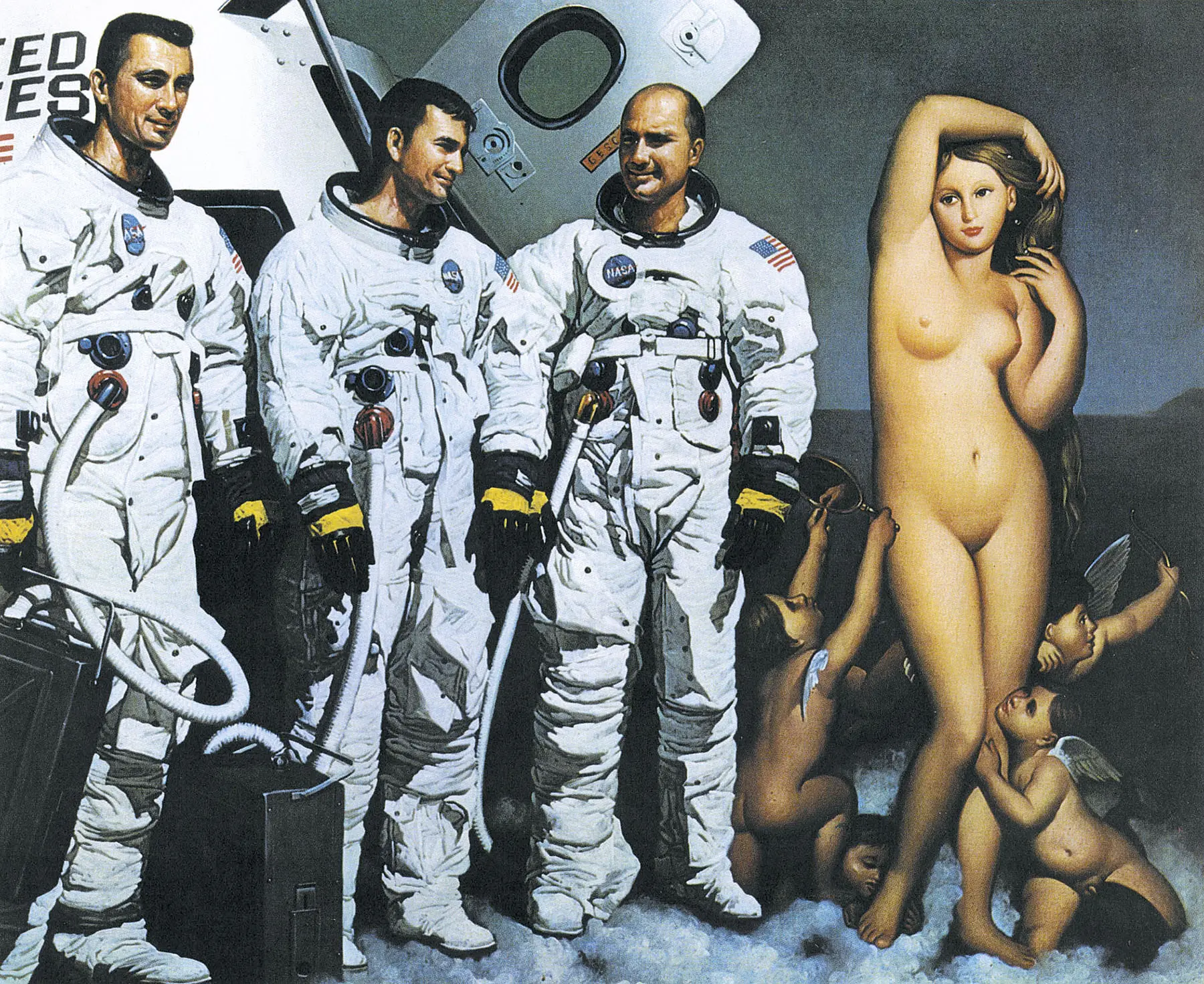
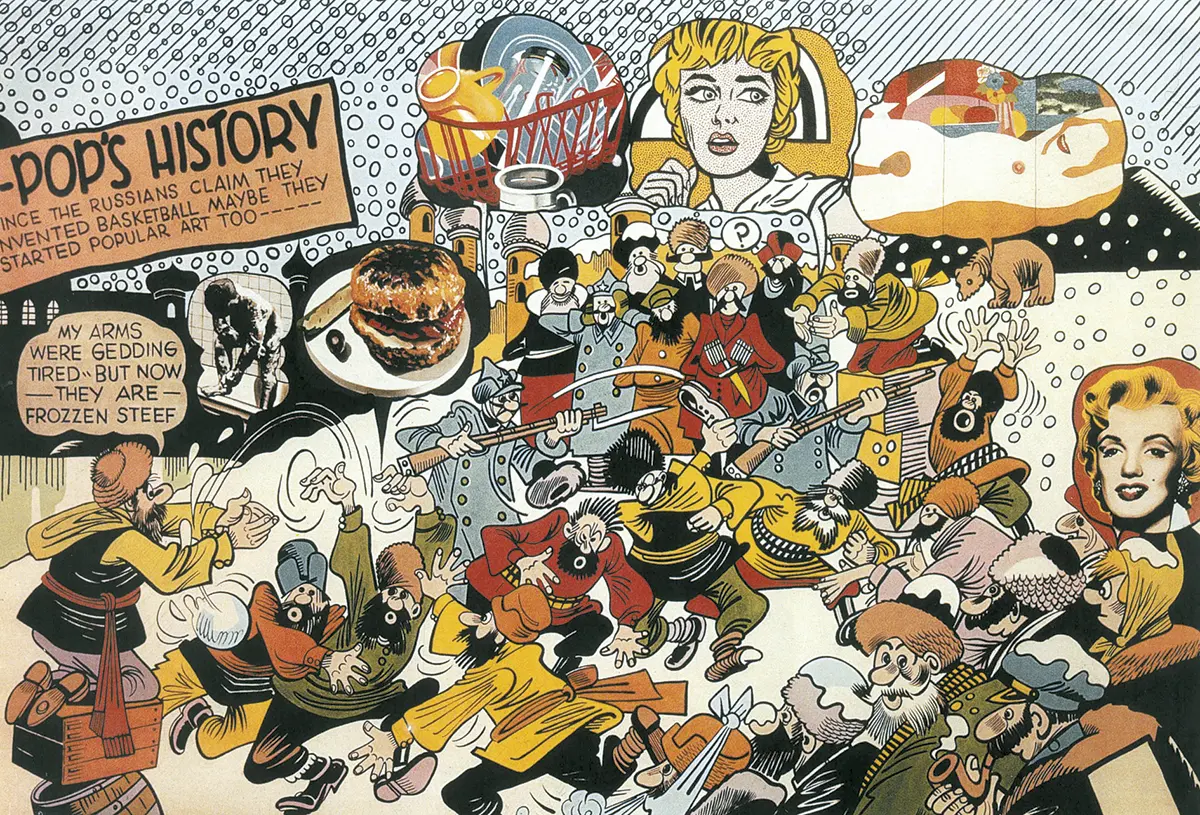
This critical distance in Erró sometimes results in work that is uninspired, as when he combines a Venus by Ingres with an illustrative painting by Robert McCall about the U.S. astronauts on the surface of the moon (On Venus, 1975). But it can also result in pieces that are sharp and funny, as in Pop’s History, 1967, in which he depicts freezing Soviet villagers dancing and quarreling while they imagine images from Warhol, Rosenquist, and Lichtenstein.
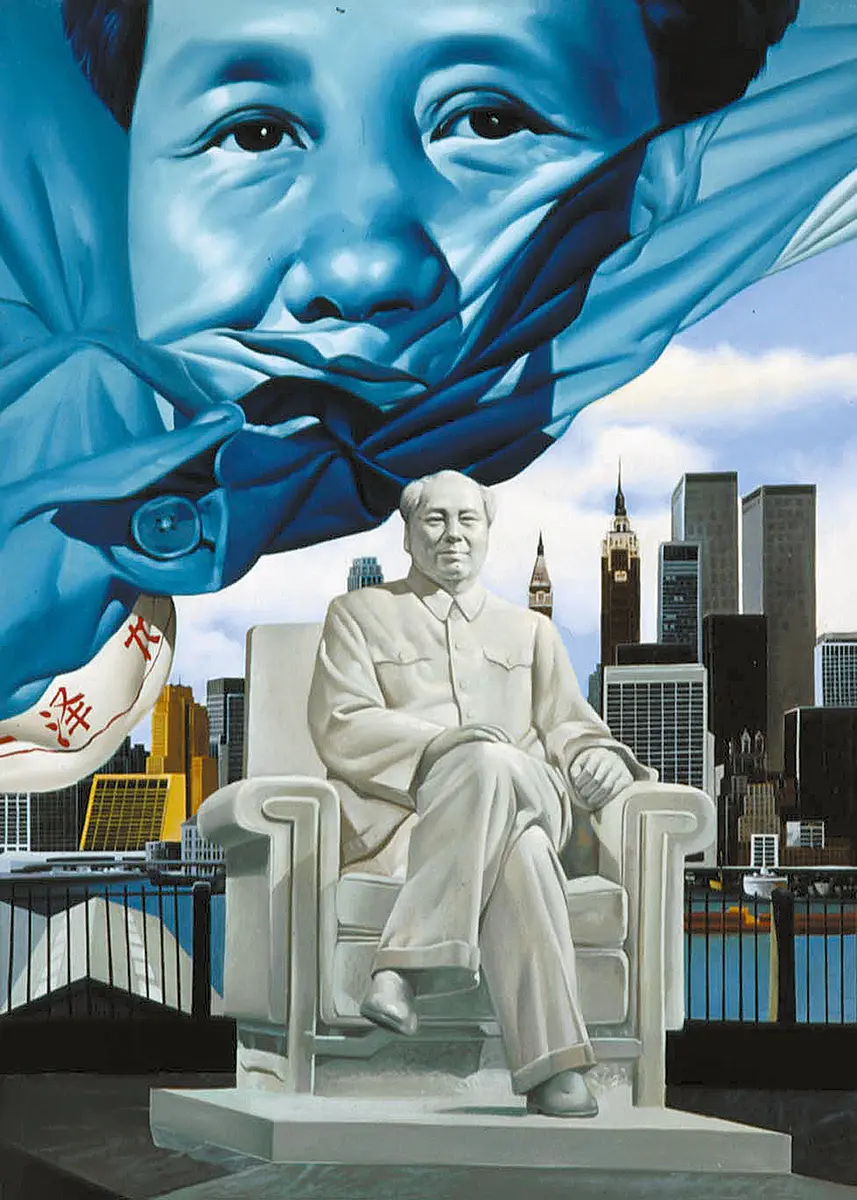
At its best, Erró’s cultural distance allows for the discovery of similitude in styles normally seen as distinct and separate. Leger’s imagery survives and integrates well with comics and Picasso; Socialist Realist painting seems alarmingly consistent with much of Pop Art's renditions. In New York City, 1979-1980, and in Chicago, 1974, he comments on displacement by integrating incongruous images of Chinese school children and a Chinese worker. In Breeze, 1979-1980, oddly one of the more beautiful paintings in the show, Chairman Mao appears sculpted in the style of the Lincoln monument, sitting in Brooklyn with his back to the Manhattan skyline, with a flag of his face folding over in the wind. Here the aesthetic is not one of transposition, but of coherence; the Mao sculpture could be in that setting as well as anywhere else.
Most of the formal congruence of Erró’s work is created within the cartoon world, a recourse that is formally easy, and over great quantities of work becomes tiresome. Sometimes coherence is generated by the narrative overlap, where the formal incongruence adds to the meaning. Either way, his work is not exactly subtle and his lack of subtlety seems to be his general and proudly held trademark. Yet, what makes Erró’s work remarkable is that it somehow manages to remind the viewer that the mainstream eye is not the proper tool with which to approach his work. There is no delectation, no formalist innovation, and no major narrative insight to speak of. Instead, it would seem that he is playing with a zoom lens, experimenting with distance and focus much more than with the visual subject matter that is presented. It is a political experimentation, not a technological one, a departure in art that would seem worthy of more attention.
Edited by Selby Hickey.
NOTES
1. “Worldscapes: The Art of Erró,” Grey Art Gallery, New York University, New York, April 13-July 17, 2004.
2. The artist, from Discontinuous Narration, quoted in http://www.gkm.se/erro/
3. Coincidentally, at this time Erró also befriended Fernando Botero, whose studio in Florence he inherited.
LUIS CAMNITZER
Emeritus professor at the SUNY College, Old Westbury.