Franco Aceves Humana articulates a critical commentary on the state of contemporary art and the work of artistic institutions. With this, he would seem to carry on a tradition that dates back to the nineteenth century, and that maintains artistic activity as a privileged site for a polemic about art. In fact, although the artist’s method coincides with the irreverence and the eclecticism of the postmoderns, the fundamental values of his work derive from a modernist sensibility, in which the concept of painting as an autonomous object (but also as the privileged site of representation) continues to be fundamental.
An excellent draftsman, Aceves Humana exploits the possibilities of the pictorial plane to their maximum potential. He takes advantage of both graphic and figurative elements, along with matteric ones. He plays with different textures and pigments, gives different qualities to his surfaces, and achieves a balance between the aesthetic value of the painting in itself and the whole discourse that complements it.
Nevertheless, these paintings continually refer to nonpictorial manifestations of contemporary art, in most cases, referring to projects, actions, or three-dimensional works attributed to the various characters invented by Franco, and finely delineated by Flavio González in the catalog.
The artist also incorporates texts in his paintings, as descriptive and narrative elements or as informational labels simulating museographic resources. The relationship between texts and paintings turns each one of the latter into a kind of document, a second-hand image, apparently devoid of artistic pretensions. Aceves’s paintings are both pictorial and textual, representational and documentary, and evince an expressive and conceptual desire. This is an intelligent body of work, not only for what it says and the ways in which it says it but also because of the way in which instinct seems always under control with that kind of self-repression that sometimes indicates the level of rationality and awareness in a given artist’s work.
Given the negative implications it assumes, Franco Aceves Humana articulates a self-subverting discourse with subtlety and irony. The political irreverence and incorrectness in his work have a double effect: they are at once a self-critique and a critique of contemporary art’s excess of discursiveness. Indeed, the whole work is directed, through exaggeration, towards a critique of excess, thus establishing the caricatured nature of the representation.
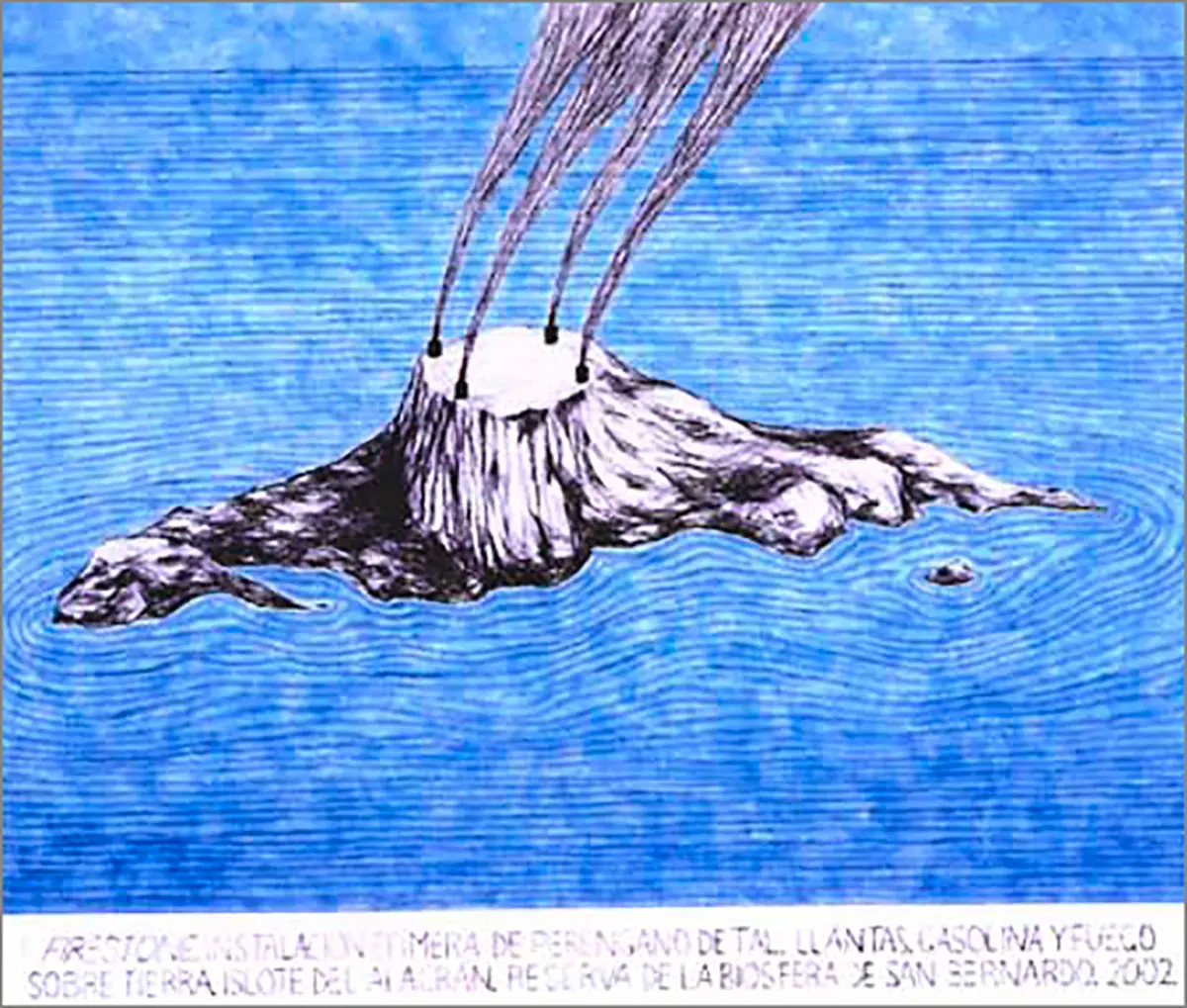
We find here a range of allusions, from ecology to our relationship with cultural heritage, from the excess of dramatics to insensitivity or cruelty, from an excess of content to ideological vacuity. It is within that range that a supposed “intervention” on a Pompeii fresco is situated (Fresco, 2003,) as is the representation of tires burning in an ecological preserve (Islote, 2003.) A painstakingly produced painting shows (proposes?) the transformation of an archeological zone into a parking lot (Estacionamiento, 2003). In another painting, we see a bucket of oil dumped on a sea lion (Foca, 2003). The text that accompanies the image, a kind of technical file for it, summarizes the absurdity and the cruelty of what is being represented: “¿Qué estamos haciendo? Acción del artista plástico Mengano. Reserva de la Biosfera del Vizcaíno, BCS. Febrero de 2003. León marino californiano irritado, petróleo y chapopote” (What are we doing? An action by artist Mengano. Vizcaíno Biosphere Preserve, BCS. February 2003. Annoyed California Sea Lion, oil, and surf).
Por una nariz is a show that tests the authority of the curator (in truth, the show’s full title would be: Por una nariz. Curated by Nelson Jairo de la Mora. Contemporary Art from Tizapán) while at the same time unflinchingly confronting the language of critique. Anything that could be said of a contemporary work of art is already stated in Aceves’ pieces and in Flavio González’s texts. Among the booby traps that rig this show is the appropriation of the critic’s language and the anticipation of the critic’s discursive act, canceling a priori (or perhaps reabsorbing in advance) the entire rhetorical and ideological structure of the critical exercise.
JUAN ANTONIO MOLINA