
On April 8, the Design District’s Chelsea Gallery opened the show A Small Retrospective with works by Cuban photographer Rogelio López Marín (1953), known as Gory. Gory’s work in photography since the 1980s situates him among the most important Cuban artists of his generation. This period of great intensity in Cuban visual arts has been dubbed by critics as the “Cuban Renaissance,” being a kind of flowering of art after a somber decade. Gory was a member of the celebrated group Volumen I, which marked a new period in the country’s visual arts. From that moment on, artists whose works defined an era formed different groups. It was an art of rebellion, of protests, and of confrontations that were not always passive. Gory’s work belongs to the first generation of artists who blazed that path.
Gory’s academic training began with studies in painting at the Escuela Nacional de Arte. Later he studied photography and graphic design under Raúl Martínez, and finally art history at Havana University. His most important work, however, has been in photography. The present exhibition comprises twenty-nine pieces: twenty-five photographs and four paintings. Let’s remember that in the initial years of his career, painting was Gory’s main creative medium. The well-known anecdote of the unfinished piece for a Volumen I show, in lieu of which he sent a photograph, in a way marks Gory’s transition to more active work in photography.
As its title indicates, this is a small retrospective of his work in recent years, a mixture of pieces from those that have been known since 1980 to his most recent photographs, dated the current year.
Es sólo agua en la lágrima de un extraño (1986) is, undoubtedly, a classic of Gory’s oeuvre, and it defines his work during that period along with the triptych, 1836/1987, 1936/1987, and 1984/1987. Although Gory’s work as a whole possesses a poetic quality, it is in those two pieces that quality overflows its boundaries and rises to the fore, becoming as important as the image itself. These are multi-part works where a philosophically inclined narrative seems implicit at first glance, while after more detailed study a multitude of images resulting from those actually “portrayed” are revealed. Undoubtedly, anthology works.
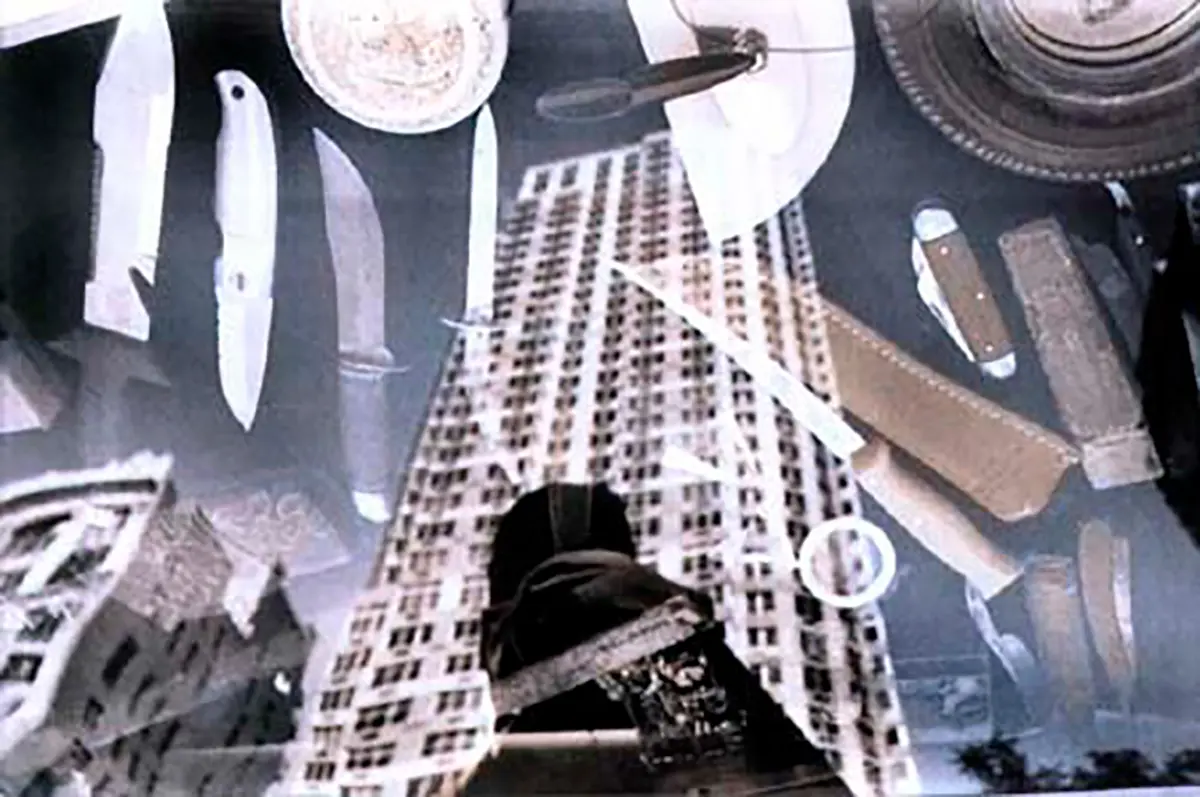
Gory’s most recent photographs were shot in New York, and they are a kind of tour of that city, maximizing each seemingly everyday element (in fact, they may just be everyday stuff for the city’s denizens). Each photograph’s title gives an idea of the observation. Gory lends his “outsider” eye as a witness to the fact that even the world’s most cosmopolitan city has its routine, along with the charm of its uniqueness. There are two images in which Gory uses the reflection on shop windows and their ulterior image. One of them is titled Los cuchillos de la ciudad, and its double image results from the juxtaposition of a knife shop and the reflection of a nearby window on its window. The second piece is Los vestidos de la ciudad; it works on the same constructive basis, superimposing two images from a window’s reflection. This image creates a kind of allusion to the past, the volume of cloth in the dresses and their cut contrast with the modern character of the buildings.
Gory chooses sections of New York that allude to the place without being the city’s oft-depicted identifiers. A classic example of this approach is Las puertas de la ciudad (2002). New York is famous for the amount of taxi cabs that cruise its streets; the “yellow cab” is an inescapable element of the city. Instead of a conventional shot of one of these cabs, Gory chooses the image of hundreds of taxi cab doors, with their logos, piling up in an empty lot, ready to be junked.
Gory handles his compositions from an almost surrealistic perspective, whether thanks to the superimpositions he achieves or thanks to the situation being portrayed, which are closer to an absurd rather than to a “logical” reality. This is why he chooses places like New York, where everything is possible, from finding a Picasso in a parking lot (La pintura de la ciudad, 2001) to find a horse in the middle of the street (El caballo de la ciudad, 2002). This is not new in Gory’s work; it is rather an almost ubiquitous component, in terms of the juxtapositions in his compositions or the willful selection of situations that are not realistic. Previous pieces such as Mi dulce Señor (1980) and one from his series Ausencias (4), appeal to the religious element in our culture, presenting, in situations like the one described before, details of everyday life seen with fresh eyes, eyes that dissect and fragment this reality into a kaleidoscopic effect.
Unquestionably, Gory is one of the most creative Latin American photographers working today, whose work has set the bar for others. This retrospective covers his work of the last twenty years in a condensed way, very likely due to the space available. Carefully selected and presented, this retrospective was more oriented towards Gory’s recent works, which show a significant shift while still within the artist’s recognizable style. A project to keep in mind is a more complete retrospective of his work accompanied by an exhaustive and detailed publication. Twenty years is a long time, especially for so productive an artist as Gory, whose work has reached a level of maturity that entirely justifies the recognition.
IRINA LEYVA